Kingly Dancers At Work

Alonzo King Lines Ballet
Yerba Buena Center for the Arts
November 6, 2021
San Francisco, CA
It is rare to get a standing ovation half-way through an evening’s program. But the Alonzo King Lines Ballet dancers had it more than had earned with outstanding performances of excerpts of four King choreographies, the oldest going back to 2007. The company had been on the road and, after two performances only, was about to take off again for a tour of Europe. The audience acknowledged Lines’ artistry with a rousing “welcome back.” King had lovingly entitled the selections Four Heart Testaments. The audience acknowledged Lines’ artistry with a rousing “welcome back.”
King has always been assiduously careful not to establish a hierarchically structured company. He recognizes every one of his dancers as highly trained with an exceptional ability to dig into him or herself to unearth individual truths. Today, if there are something like Lines star performers they would have to be Adji Cissoko and Michael Montgomery. There was hardly a piece on this program with Montgomery not in it, often in singular parts. As for Cissoko the tensile strength of those silken limbs are as likely to look chopped as the branches from a tree. She turns like a tornado and winds her torso assertively around others not their own.
Four Hearts opened with Shuab Elhassan, Cissoko, Ilaria Guerra--another of King’s tall women--and Montgomery in ‘Pié Jesu’. It’s an excerpt from “Grace,” developed and recently premiered during a King residency at San Francisco’s Grace Cathedral. That aria is the most popular of Fauré’s “Requiem”. Despite having been sentimentalized too many times, it proved no problem for the dancers’ rigorous but gentle exploration of a mysterious space and each other’s connectivity. With Cissoko as a kind of leading spirit, they gave great dignity what could have been maudlin spirituality.
In ‘Over My Head’, an excerpt from “Writing Ground,” Madeline DeVries, took her cue from Kathleen Battles shifting moods of soaring and being weighted down. DeVries’ talent is a quiet one, so seeing her responding so fluidly to Kathleen Brattle’s take on ‘Over My Head’’s exaltation, sadness and hope was a special treat.
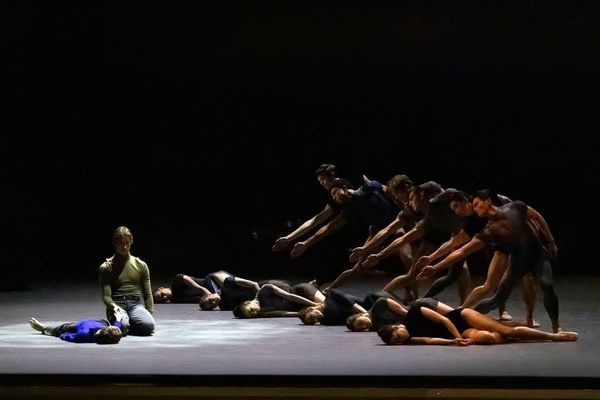
It was the men’s turn in the excerpt from “The Radius of Convergence” (music by Edgar Myer Pharaoh Sanders). Five Dancers, astoundingly different even in size, showing their individuality until four them coalesced into a quasi-mechanical unison to give Montgomery an almost safe landing.
The excerpt of “Rasa” showcased individuality Babatunji’s whiplash fierceness, Ilaria Guerra’s elegant grandeur and Montgomery space-devouring leaps. The performance looked very much at ease, allowing the dancers to play with Zakir Hussein and Kala Ramnath’s intricate beats.
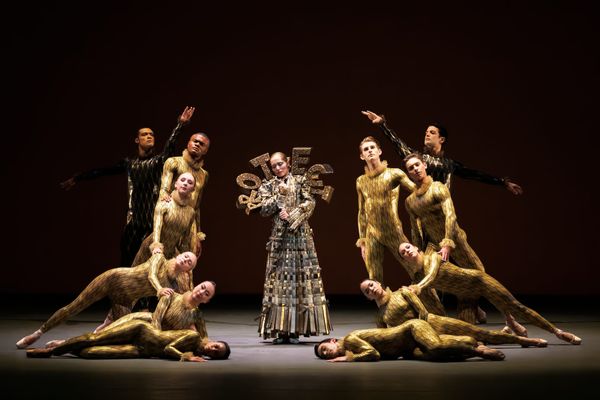
For the second half “Azoth”, King explains in a program note, is the element that contains all others, and is used in alchemy to effect transformation. What originally is chaos, eventually gets transformed into perfection. Robert Rosenwasser’s ever-different costumes certainly did suggest an ongoing change, maybe of an evolutionary nature.
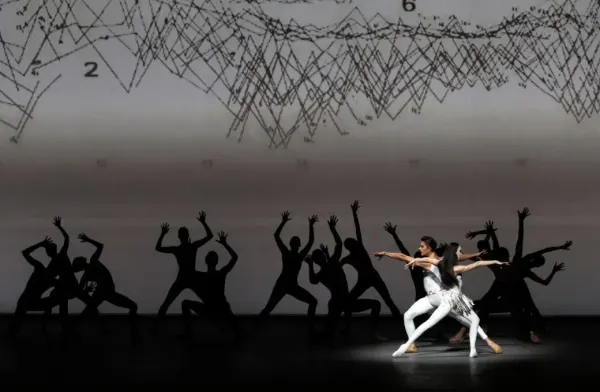
Jim Campbell’s suspended squares of lighting panels descended and rose upon the dancers as if sent by, perhaps by a spaceship. But to keep “Azoth” from becoming too serious, dancers at one point held squares of light with tiny stick figure dancers inside. A gentle joke?
As choreography, “Azoth”, however, remains problematic. A colleague suggested that the Charles Lloyd and Jason Moran saxophone/piano jazz score may have proved to be more involved than originally planned. I would have gladly listed to it on its own. But it was difficult to find a trajectory as various soloists took center space and flowed backed into the ensemble.
Shuaib Elhassan stormed into a diagonal that was shaped by strongly articulate legs with arms that almost shot beyond their sockets. Sometimes his dancing thrives on internal pulses; here he seemed carried as if by surprise. Perhaps, the most intriguing solo came from James Gowan. This was almost a character study with furious strides and thrashing against what held him back. He seemed the outsider trying to find a place for himself. Finally four hand-holding dancers encircled him, whether to cage or welcome him could not tell.
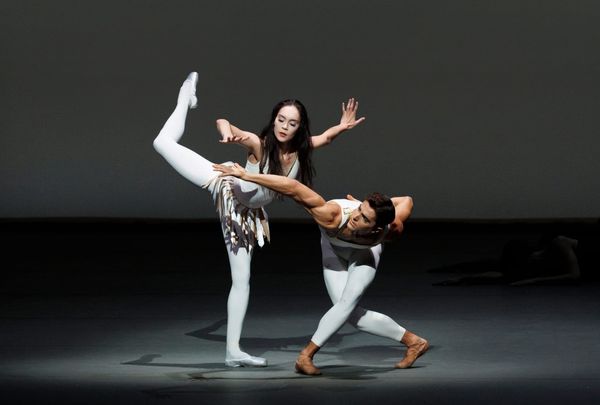
Azoth’s finale came as a wondrous surprise. Maybe there is something to alchemy, transforming base material into something pure and precious. King created an exquisite Pas de Deux--the apex of classical European dance--for Montgomery and Cissoko. Exploring space together and individually, the tension between them emphasized their equality. Whatever separated and distinguished them also balanced them as a unit. Isn’t this what Classicism means?
copyright 2021 © by Rita Felciano