Just Desserts
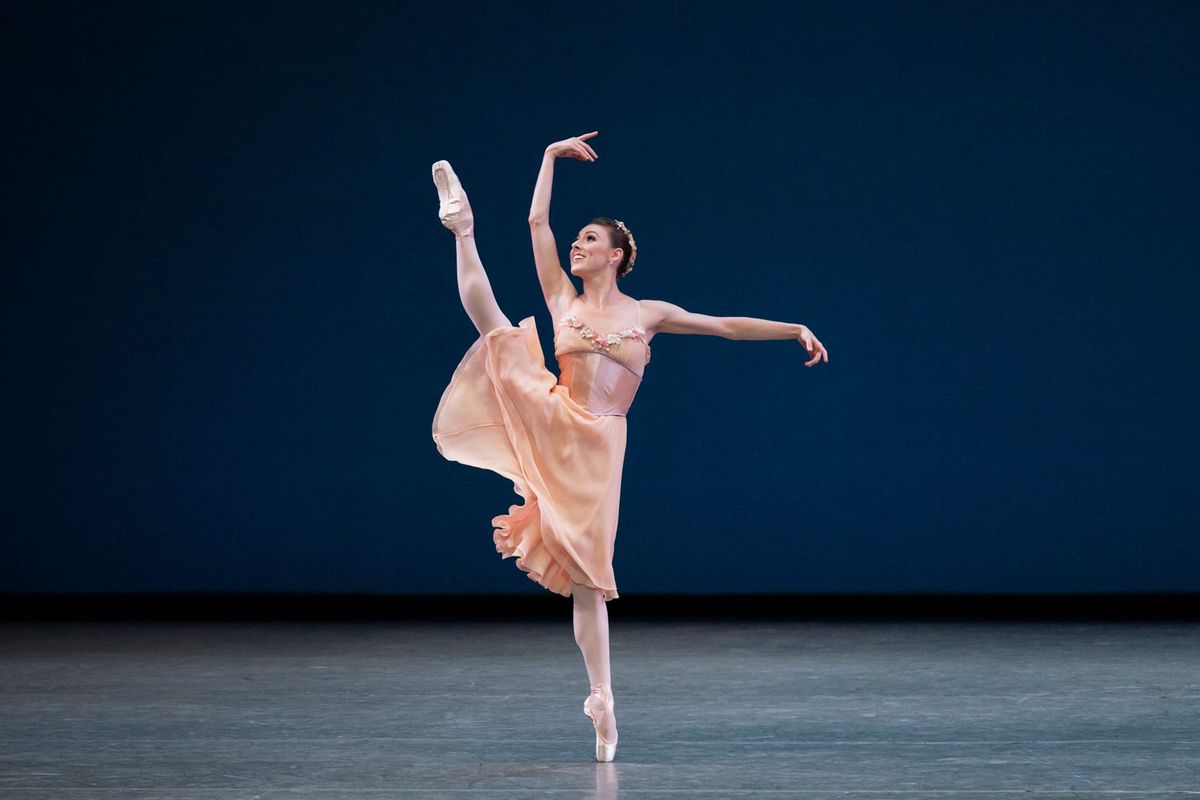
"Raymonda Variations", "Tschaikovsky Pas de Deux", "Piano Pieces"
New York City Ballet
David H. Koch Theater
Lincoln Center
New York, New York
September 24, 2022, matinee
Though all the music on this program was Russian, the atmosphere was certainly not gloomy; the ballets cheerful collections of beautiful dancing without a tear in sight, set to enticing music by Glazunov and Tchaikovsky. Glazunov's full length "Raymonda" has some of the most limpid melodies and lush orchestrations in the ballet world and Balanchine, who set a complete version based on Petipa's choreography for the Ballet Russe de Monte Carlo in 1946, mined the score for several ballets, completely avoiding the somewhat baffling story to luxuriate in the gloriously danceable music.
The heart of his 1961 "Raymonda Variations" is the set of classical solos (nine in all) for the six women and one man, with a frothy pink-tutted corps prancing through some elegant and exacting geometry at the beginning and the end. Unlike most classical works, the pas de deux (danced by Isabella LaFreniere and Chun Was Chan in their debuts), is the appetizer, not the climax, and it comes before all the solos. After this first introduction there is little connection between the couple, other than the finale, when the ballerina runs from backstage to dive headfirst into her partner's arms. The ballet is pure dance, a celebration of beauty for its own sake (and to some extent a celebration of Petipa, since Balanchine used the old master's outlines for many of the variations, adding his own accents).
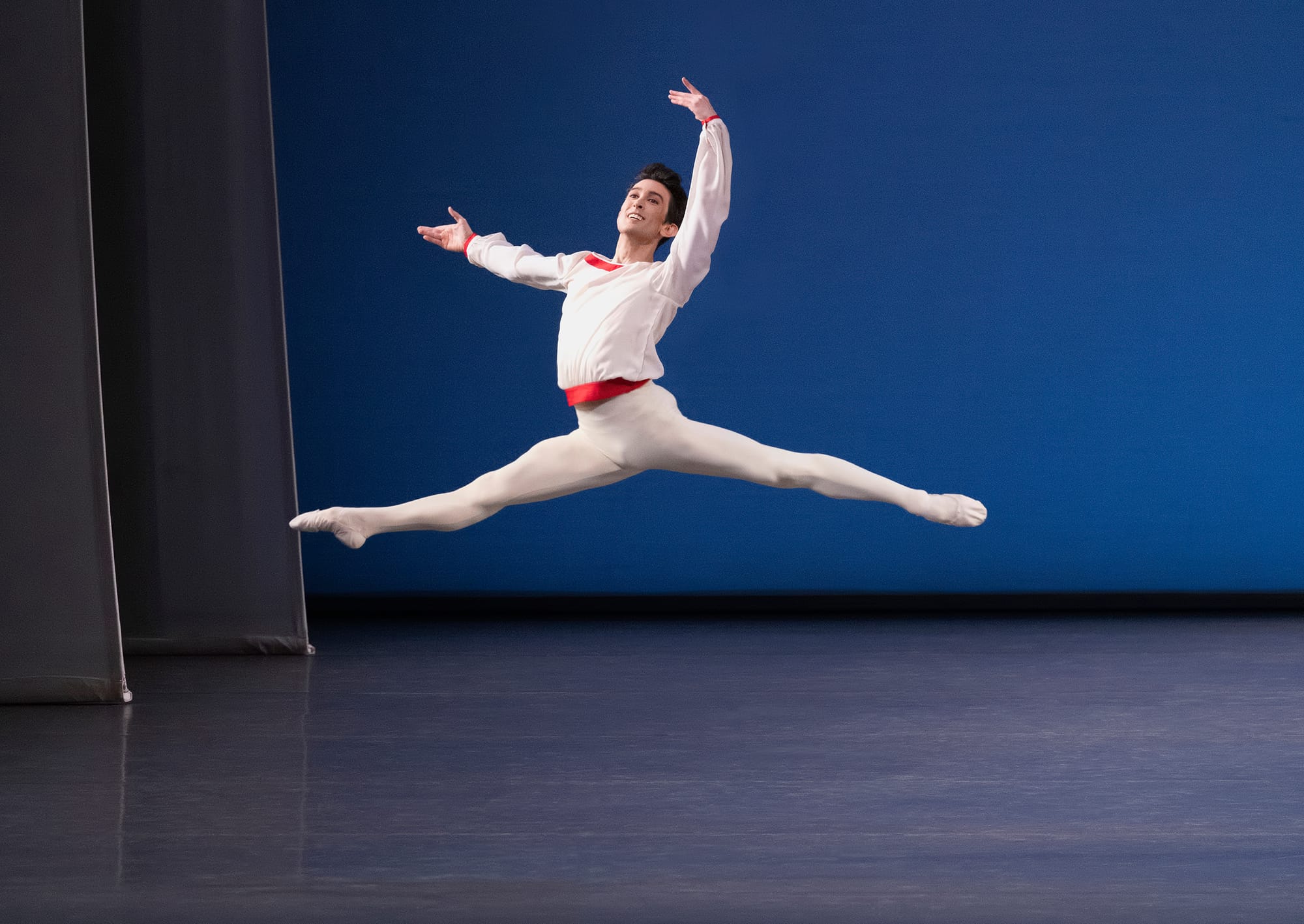
Chan was a late substitute for the taller Peter Walker, and on pointe LaFreniere is about a head taller than he which gave the pas de deux an air of a friendly conversation rather than a love story. The man spends a lot of time admiring the ballerina from the far side of the stag, rushing in now and then to catch her in mid turn, and the partnering went smoothly if a bit carefully. Chan, recently imported from the Houston Ballet and even more recently promoted to principal, is a generous partner with a soft, elegant upper body, a rich, juicy plié, and joyous beats--after his first solo he really should have been crowned Mr. Bluebird.
LaFreniere used her stately form and long, elegant legs well; her fearless penché arabesques in the pas de deux were magnificent. She showed off her legs again in her first solo with her explosive pas de chats, and used her upper body in some delicate Hungarian arm movements, an echo of the original story.
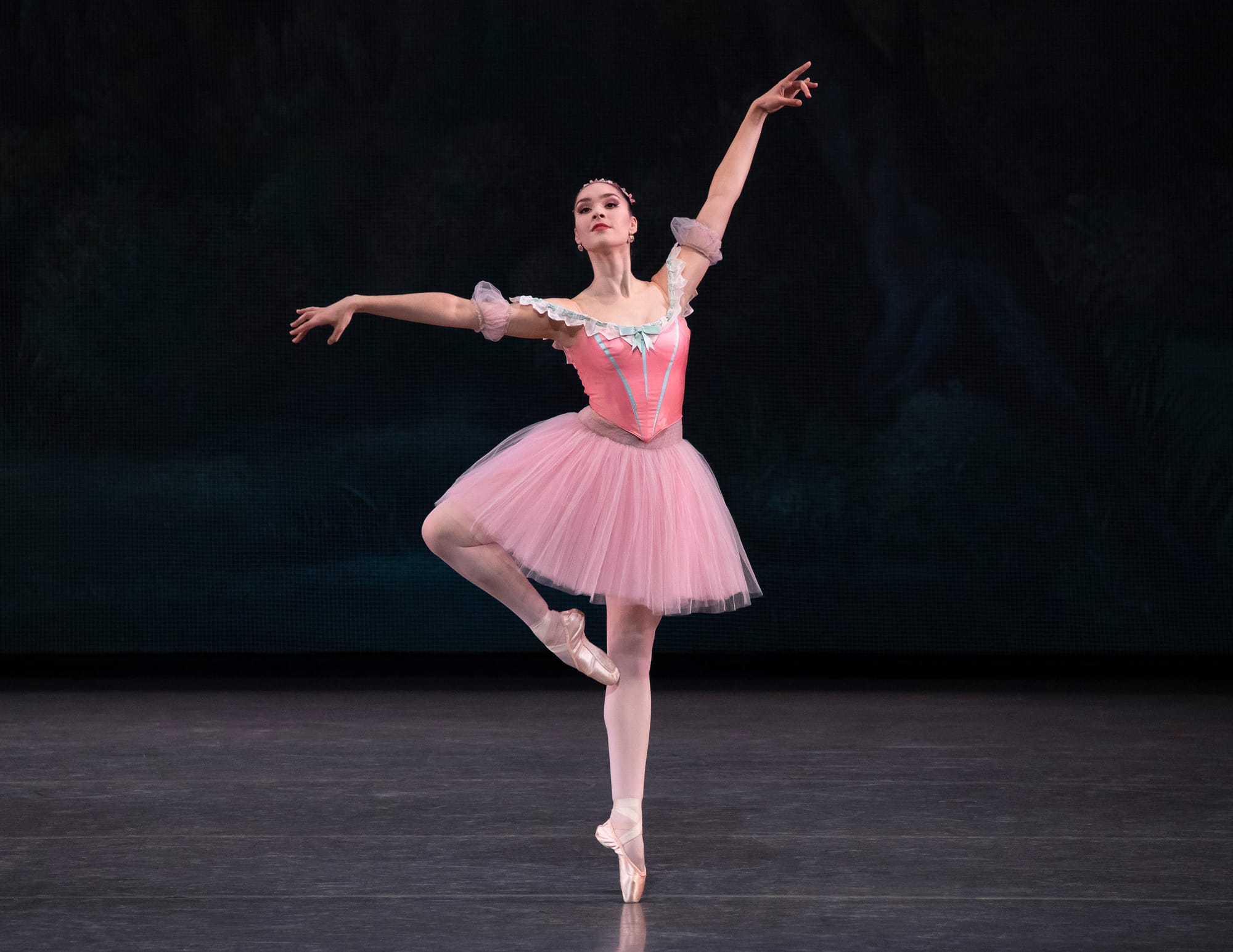
There were three debuts among the soloists, Mimi Staker in variation II, Meaghan Dutton-O'Hara in Variation V, and India Bradley in Variation VI. Staker danced with a great deal of aplomb, with elegant jumps and secure turns. Dutton-O'Hara and Bradley looked a bit uneasy and their dancing had a staccato quality that didn't match the flowing music. It may have been nerves but Bradley's hands were stiff and flat. There was no stiffness in Mira Nadon's luminous variation VII, with her precise, playful dancing and delicate arms highlighting her elegant little head movements.
There was plenty of elegance too in Balanchine's "Tschaikovsky Pas de Deux", that joyful bon bon. It is a model of a classical pas de deux, building so carefully to its explosive climax. Tiler Peck and Joseph Gordon were the lucky couple. Gordon's phrasing in his opening solo was exemplary, calibrating the sideways jumps so that they grew in excitement rather than just going for broke each time. He gave the coda a classical sheen without any inventive additions. His turns a la second were solid, fast, and grounded, showing that the extra, often unmusical hops, while exciting, are not necessary.
There was of course nothing unmusical about Peck's dancing and there was nothing coy or exaggerated about her musicality. Her speed and clarity were physical phenomena but her sense of joy, the feeling she gave that there was nowhere she would rather be than dancing those steps to that audience at that time was her greatest gift.
Jerome Robbins' 1981 "Piano Pieces", set to selections of Tchaikovsky's piano music, does not always feel like it really wanted to be there, it felt like it really wanted to be dancing to Chopin. It does have a number of roles for the company's exploding talent even occasionay lit seems that Robbins skimmed the froth off the surface of "Dances at a Gathering". Though it lacks the earlier ballet's depth with "Dances'" sense of community and powerful memory, "Piano Pieces" does have plenty of folksy moves (Russian with an occasional polka) and women in pastel chiffon wafting around. Anthony Huxley as Le Petit Cavalier was bracingly crisp in his two solos and lighthearted in the overly cute Polka de Salon (lots of arm pumping and jogging) with the enthusiastic help of Jacqueline Bologna and Baily Jones.
The three chiffon couples (Emilie Gerrity in lilac with Jovani Furlan, Indiana Woodward in turquoise with Sebastian Villarini-Velez, and
Unity Phelan in green with Alex Knight) danced their pas de deux and solos with a radiant conviction though the choreography did become a bit monotone. Gerrity and Furlan did stand out for the youthful urgency of their dancing and Phelan's willowy, languorous solo, dancing with an invisible partner was haunting. But after the earlier ballets, the misty sweetness did leave me hungry for something more substantial than another dessert sweet though it was.
copyright © 2022 by Mary Cargill



