Julliard Premieres
New Dances: Edition 2012
"Stages", "In Pursuit of Falling", "Visions and Miracles", Footholds"
The Julliard School
Peter Jay Sharp Theater
Lincoln Center
New York, NY
December 12, 2012
Four Julliard classes of dance students performed four new works as part of the now annual "New Dances" program. The choreographers, Camille A. Brown, Emergy LeCrone, Susan Shields, and Jarek Cemerek, worked for several months with their assigned classes, and the dancing showed it. The dancers were uniformly precise, energized, and beautifully rehearsed. The dances, though, were more varied, from the disappointing (LeCrone) to the radiant (Shields).
The evening opened with Camille A. Brown's "Stages", and obliquely titled work set to recorded percussive techno-music by Jonathan Melville Pratt. The dancers, dressed in grey showed off their exuberant physicality in a smokey backdrop, crouching, bending, twisting, and generally treating their spines like corkscrews. Brown showed a confident use of space, and the crowds emerging and disappearing in the dark smoke created striking pictures, but the incessant energy had little variety and the dancers little emotion. It was like watching a high-class aerobics class.
LeCrone's "In Pursuit of Falling", to several composers, including Beethoven played over a breathy garbled conversation, could have used some aerobics, as it was a bit static. She also costumed her dancers in grey, with a light background illuminated by bright pylons. The large cast spent much time lined up along the sides, watching various dancers go through mechanical movements, interspersed with moments when the women, hoisted on benches, fell down into the waiting crowd. It was opaque, probably deliberately so, and the dancers, who, when given a chance to move, looked wonderful, had uniformly glum expressions.
Shield's "Visions and Miracles", to infectious music by Christopher Theofanidis, was a welcome tonic. The dancers' one-piece short unitard, green on the bottom and shiny white on the top, gave them a bright, slightly edgy look, and the sprightly little jumps and group dances made them look like a set of modern nymphs and satyrs, cavorting in an urban park. The central sextet was was a flowing set of patterns, as the patterns merged with a gentle but slightly wistful playfulness.
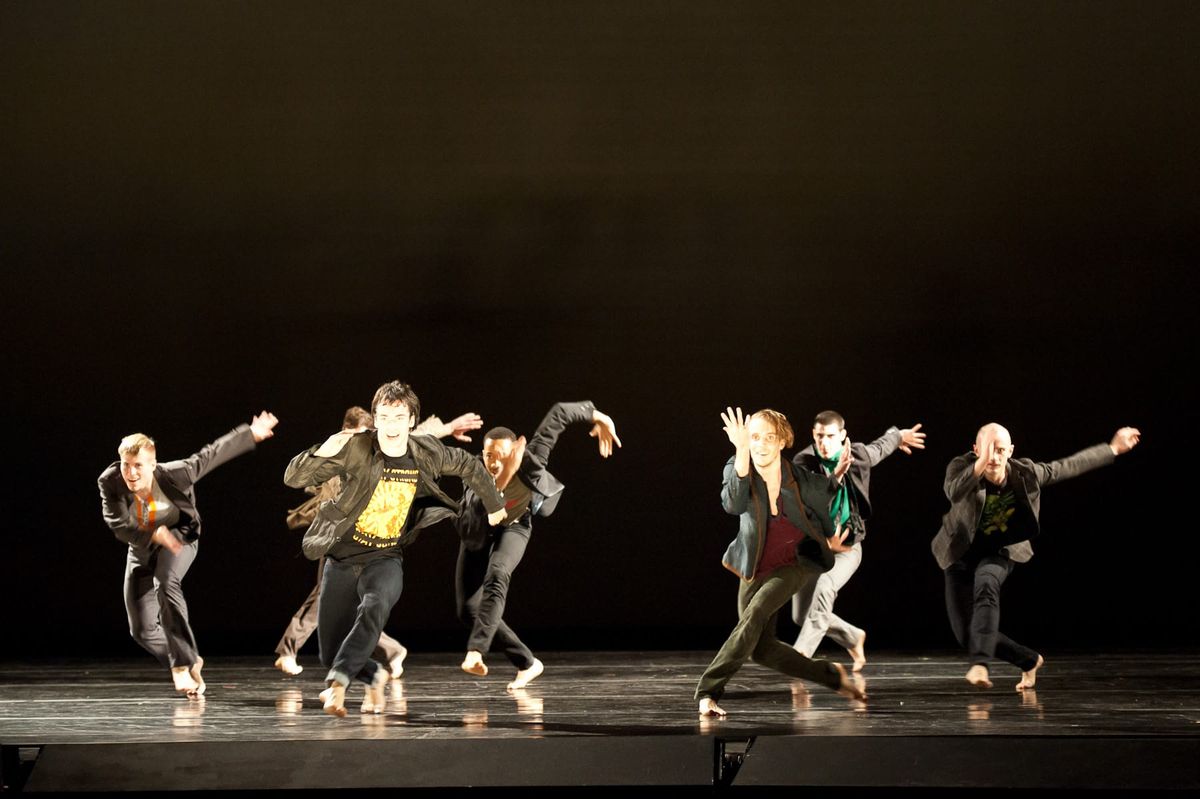
There was nothing wistful about Cemerek's "Footholds", as he, according to the notes, was inspired by the anonymous feelings New York can generate. Most of the music, again recorded techno-beat, was a bit off-putting (again, that was probably intentional), as the dancers, dressed in multi-colored jeans and t-shirts, moved somewhat aimlessly with the familiar corkscrew bodies, avoiding contact. The Balkan funk section with its pulsating rhythms, for a group of men, was a welcome relief, and the dancers seemed to riff on folk dances, breaking out of the circle for various flamboyant displays. It was pure adrenaline, and the dancers, one and all, were thrilling.
Copyright 2012 by Mary Cargill