It's Only a Paper Moon
"A Streetcar Named Desire"
The National Ballet of Canada
Four Seasons Centre for the Performing Arts
Toronto, Canada
March 2, 2022
The National Ballet of Canada is back with full capacity performances at last. The pandemic delayed many retirements and planned farewell performances for dancers around the world. Thankfully, principal dancer Sonia Rodriguez was able to hold out and close a remarkable 32 years in the company with a run as Blanche DuBois in "A Streetcar Named Desire." It is the kind of meaty dramatic role that highlights a mature dancer's range. John Neumeier's production is a flawed one, but Rodriguez and the large supporting cast gave a committed and emotional performance.
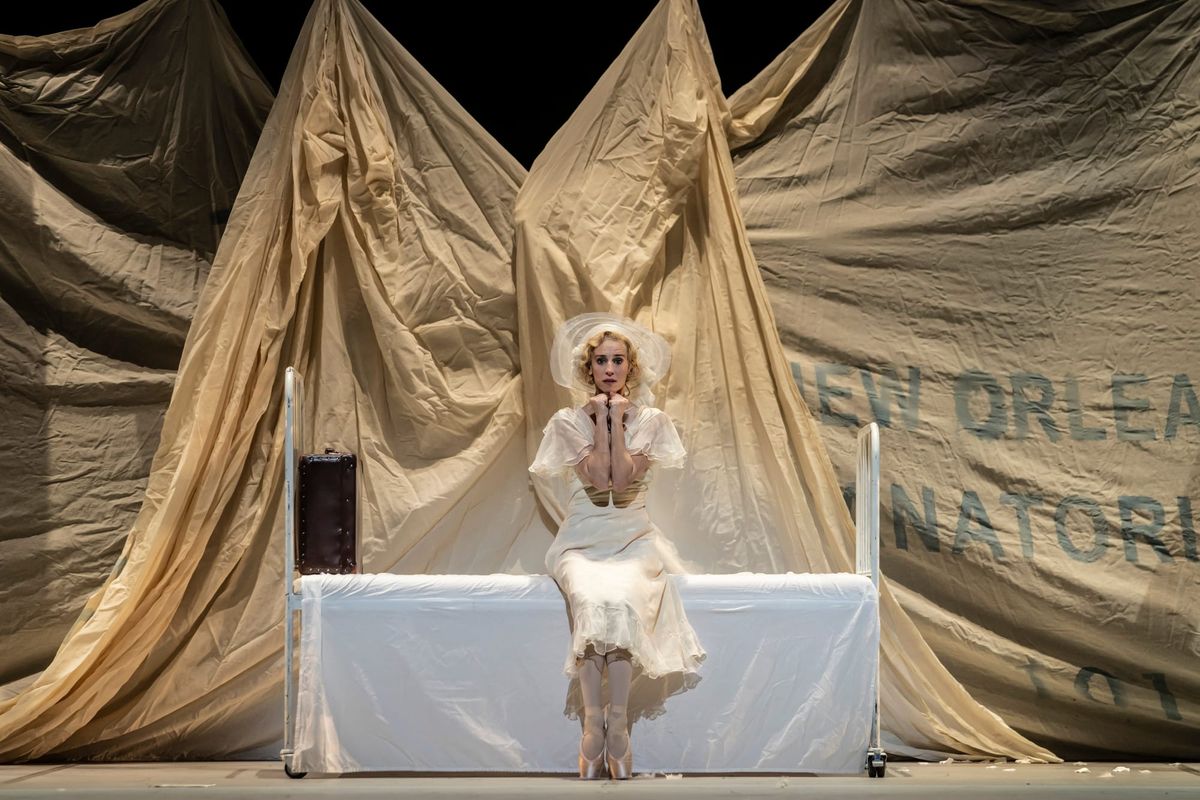
Tennessee Williams' complex play is difficult to convey in a medium without words. The ballet relies on program notes and the popularity of the play and film, as major developments in the plot are expressed in broad strokes. Familiarity with the story helps a lot and certain subplots and details are omitted. The first act opens in Blanche's asylum room, where she has flashbacks of her life in Belle Reve, the DuBois family estate in Mississippi. It gives the audience the context to understand the events of the second act, which picks up where the play begins. In her hospital bed, Rodriguez desperately clings to her suitcase which holds a flimsy, tattered veil – the sole remnant of her previous life of comfort and identity as a Southern belle. It takes her back to memories of her wedding day. Wedding guests arrive dressed to the nines and there is a celebratory mood, yet upstage, people dressed in black sit motionless - a foreboding presence. Neumeier is able to express so much in one tableau. It is a commentary on the decay of the old South and at the same time shows the beginning of Blanche's life being upended. From there, Blanche is thrown into a series of traumatic events – her husband's suicide, the collapse of Belle Reve, and crude sexual advances from men at the seedy Flamingo Hotel. Although the ballet leaves out the fact that she has lost her teaching job due to sexual misconduct with a minor, it is evident that she is disgraced and there is no turning back to her previous life.
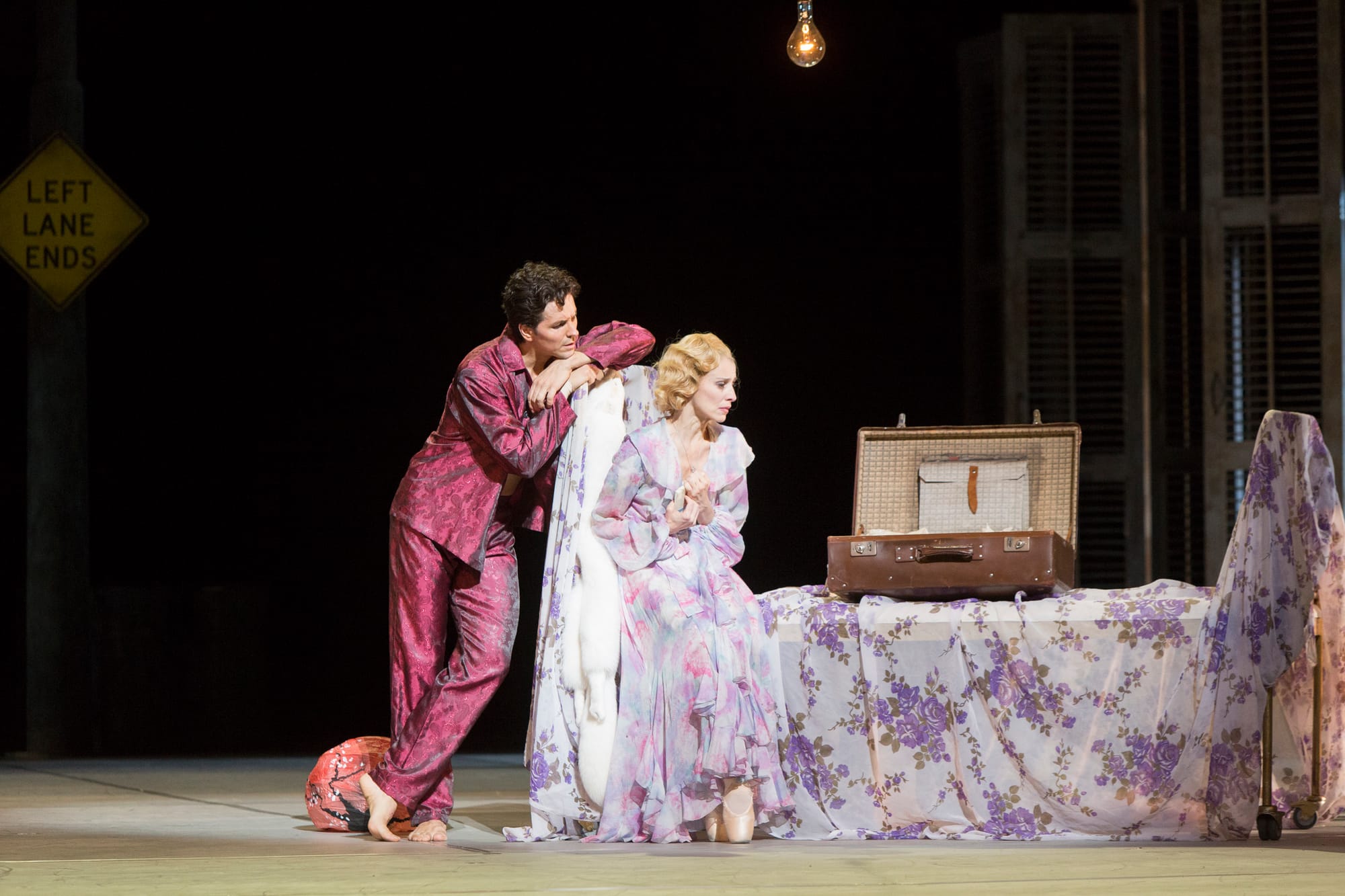
The second act show Blanche arriving in New Orleans on the ballet's namesake streetcar. Alone and broke, she is literally and figuratively at the end of the line. She has to swallow her pride as she shows up on her sister Stella's (Jillian Vanstone) doorstep and comes into direct friction with Stella's brutish husband, Stanley (Guillaume Côté). Stanley sees through Blanche's pretense and discovers her dark past, using this knowledge to thwart her hopes of a new romantic relationship with his friend, Mitch (Brendan Saye). Stanley is toxic masculinity personified. Mitch is his foil, mild-mannered and quiet. Blanche is already in a fragile state when Mitch rejects her after finding out about her past. She retreats towards an inner world of delusion, pathetically flirting with a young newspaper boy. The trauma of being sexually assaulted by her brother-in-law completes the unraveling of her fantasy, as she is carried off to the asylum.
There is a lot to appreciate in this production that tackles a classic American play with theatricity and style (in addition to the choreography, Neumeier designed the striking sets, costumes and lighting). So where does this ballet fall short? It relies on many tired tropes in a heavy-handed way. As with Neumeier's "Nijinsky", depicting mental illness in dance is a delicate matter. Some of the movements and gestures are over the top. The use of disjointed segments of Alfred Schnittke's chaotic first symphony to mark Blanche's unquiet mind feels predictable. The choreography is often not musical; the dancers move through but not with the music. Neumeier's fascination with sports as a way to depict a specific type of masculinity also gets old very quickly. Instead of playing poker together as in the play, here Stanley and Mitch let off steam with boxing. Watching ballet dancers shuffle around the stage throwing jabs does not need to go on for more than a few bars of music. The boxing choreography is reminiscent of the overdone lacrosse sequences in Neumeier's "Anna Karenina".
Then there is the painful-to-watch extended rape sequence (calling it a pas de deux feels wrong). The ballet was created in 1983 and this scene did not age well. To be fair, there is a "content warning" on the program and website, as the scene is quite graphic. It makes the gang rape of the wench in Act I of James Kudelka's "Swan Lake" look tame. Yes, the act is a critique of male domination and abuse of power. But it still seems unnecessary for it to go on for so long. It is neither choreographically interesting nor dramatically impactful. At one point, Rodriguez is on her back, legs in a wide straddle while Côté humps one leg and then proceeds to hump the other. When it is finally over, he thumps his chest in victory. Some restraint in the choreography here would have gone a long way.
All this being said, the performance belonged to Rodriguez who has embraced so many challenging roles in her time with the NBoC. At 49, she is the company's longest serving dancer and has been a principal dancer since 2000. She fully threw herself into the role of Blanche, imbuing the flawed heroine's story with great pathos. Her longevity is truly impressive as she still moves with such facility and ease. Her technique is assured and solid as ever. Her portrayal of Blanche is truly a marriage of physicality and dramatic presence, each informing and enhancing the other. She made a not particularly likeable character worthy of our sympathies. As Stanley, Côté is totally cast against type. When the NBoC first performed this ballet in 2017, he appeared somewhat stiff in the role, sometimes overacting. This time, however, his performance was darker and more believable. Vanstone, who is also retiring this season, similarly added depth to her Stella as a woman who was aware of her husband's aggressive tendencies yet chose to overlook them.
Rodriguez will surely be missed; her legacy at the NBoC is massive and enduring. She is a complete artist who can elevate almost any ballet in which she appears.
copyright © 2022 by Denise Sum



