It’s a Wrap
“Solo Echo,” “Concerto Grosso,” “Twelve of ‘em,” “Matria Etnocentra,”
Fall for Dance Program 5
Joyce Theater
New York, NY
June 21, 201
by Martha Sherman
copyright © 2017 by Martha Sherman
After a rich lineup for the 2017 Fall for Dance season, the fifth and final program was a fine coda, with a mix of top choreography, excellent regional companies, a New York star, and an international troupe that wrapped up the program and this FFD season with a rousing, rhythmic finale. A program deep in balletic virtuosity, this evening wanted for some intellectual challenge, but it was fulfilling to sink into the seats and be sated with beautifully executed dance.
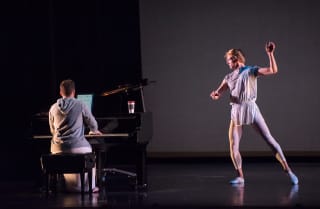
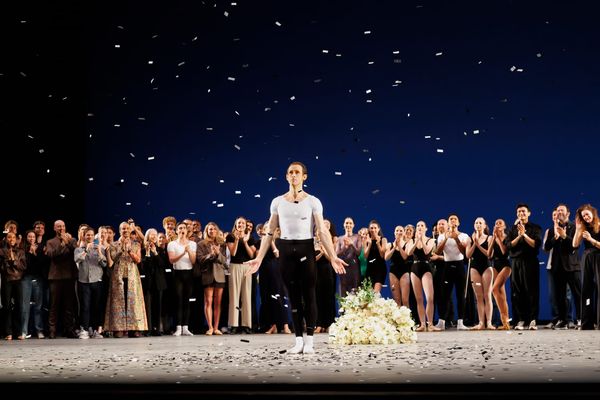
The star turn in the program’s center, David Hallberg’s world premiere solo “Twelve of ‘em,” was a Fall for Dance commission choreographed by Mark Morris to Benjamin Britten’s Twelve Variations for Piano. It was played live onstage by Colin Fowler, who was also Hallberg’s foil. Hallberg, the model of a danseur noble, stood still through the short first variation, offering only his posture and bearing until the very last note, when his graceful arms deigned (noblesse oblige) to sharply move out in a curved pose, tickling the audience into a burst of laughter – a proper opening for the self-referential humor that Morris strewed throughout the work.
The musical movements were of mixed lengths and tempos, offering shifts that allowed Hallberg to mix it up – his bravura balances, leaps, and turns, woven with casual collapses or twirling fingers that looked like rain moving in reverse. In one variation, his body shuddered like a small earthquake, in the next, his arms and legs splayed like the Leonardo figure of a man – and like the Greek god he conjured. Hallberg’s relationship with Fowler offered the dyadic moments, in shared sly smiles and eye contact. Morris likes to play with movement, and Hallberg offered an ideal mix of dance skill and disposition.
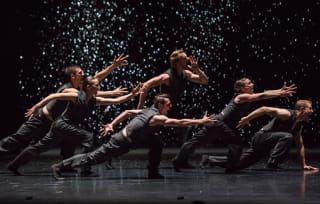
Hallberg followed the two American troupes who had pride of first and second place in the program for good reason. Hubbard Street Dance has come fully into its own as a premiere American dance company, and the troupe opened the evening’s program with “Solo Echo” a haunting, gorgeously danced piece, choreographed by Crystal Pite. As snow fell behind the dancers, they moved from solos and duets to mixed combinations of sweeps and scoops, vessels for the snow, sharp and crisp as they gobbled the stage in large swathes of movement.
The Hubbard dancers are universally powerful (the bare-armed costumes they wore made their defined muscles an intimate part of the show,) and in the pairings any dancer lifted or led another, no gender roles, just lone power meeting lone power. One lift started with just a hand pulling another hand – the power of the pull was so strong that the second dancer folded over the body of the first as if summoned by a force of nature. In the cool, harsh light, the dancers’ solitude was evident; when they touched or lifted, it was not with tenderness.
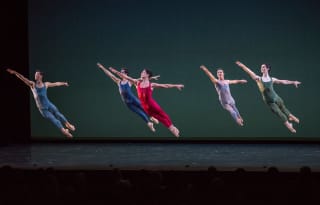
In the second half of “Solo Echo,” the dancers became a human chain, the arms of one dancer linked around the waist of the next, pulling one of their fellows from the floor to their arms and over their heads. When they broke to dash across the stage in horizontal slashes, it looked like an invasion. They re-formed into a moving sculpture of seven, heads, arms, and legs of a few caught and supported, before they oozed out to catch others. Molded together in the last body sculpture, their mouths opened in a shared silent scream. They slipped from each other’s arms, disappearing from view, until the last body collapsed in the snow.
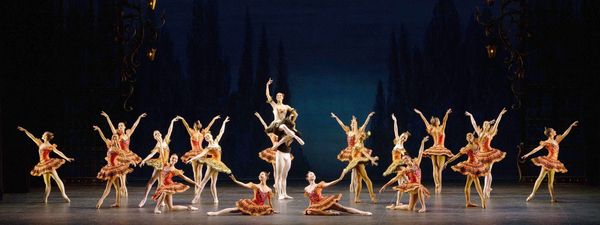
Following Hubbard’s haunting piece, the San Francisco Ballet offered the most classical dance of the evening, Helgi Tomasson’s “Concerto Grosso,” an elegant male quintet that highlighted both the individual talents of the dancers, and their artful collaboration. In simple patterns – a “W” of the five, or a circle – the men’s parallel leaps, turns, and port de bras were spot on, their bodies melding into engines of balletic skill. Each had solo turns, with close readings of the music – stuttering leaps to the quick violin line, and slow deliberate balances as the music shifted to adagio. Wei Wang was especially notable for the control of his movement, and the classical proportion that he brought to each combination. It was a dense and satisfying piece, with the relentless rhythms matching the dancers’ focus.
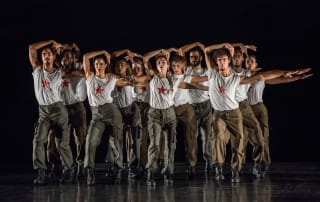
The final work of the evening was Danza Contemporanea de Cuba’s “Matria Etnocentra,” a bellicose work suggesting Cuban military discipline and rhythm, the music and movements rang with force and specificity. The power was in the whole, a throbbing mass of pounding feet and slicing arms, and the individual – a lone man who was periodically abandoned in the center of the stage – found it hard to maintain his individuality. The dancers, in muscle shirts with a large military star in the center, were synchronized in dense lines for much of the work – arms up or thrust forward, deep squats and shifting balances or turns.
In the long opening section, everything was linear and angled, but after a series of bravura solos, the group returned in dresses and guayabana shirts to slide in and out of their lines, circling and undulating. Although the troupe broke ranks to move outside of their perfect parallels, the dance suggested that even when at leisure, this is a culture that revels in the collective. In an odd cross-cultural suggestion, some of the movement was reminiscent of Riverdance, especially in the communal rhythmic pounding. And although this was a work about the power of the whole community, the final image – as the troupe dashed offstage – was of that lone dancer, whether abandoned or by choice, alone at the center of the stage.
copyright © 2017 by Martha Sherman