Is There "Almost" in Art?
Damian Woetzel's DEMO: Now
Terrace Theater
The John F. Kennedy Center for the Performing Arts
Washington, DC
March 7, 2018
The focus of Damian Woetzel's latest talent show was dance. All but a couple of numbers featured dancers. Six of the works had originally been commis- sioned by Colorado’s outdoors Vail Dance Festival and one was a premiere sponsored by the Kennedy Center. Even so, this program didn’t add up to being a triumph for choreography. Too much of the movement in several pieces seemed almost cutesy – although there’s no such thing as "nearly" in the arts. If a work is almost wonderful or almost awful, it is the unqualified ultimate that lodges in the audience's perception. What saved this bill were some of the performers, especially the singular and well known Lil Buck (gym shoe artist Charles Riley) but also newcomers Jason Collins and Victor Lozano. The latter two joined Miami City ballerina emerita Patricia Delgado in the evening’s premiere piece, ”Blueprint” by Pam Tanowitz. Another ballerina, New York City’s Sara Mearns, showed herself in a taxing solo by Alexei Ratmansky. As usual, there was a finale, partly improvised, involving all the dancers and musicians.
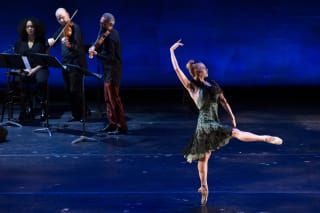
The piece that came closest to being cutesy was a clownish duet, "Desire Liar" by Rashun Mitchell and Silas Reiner. The two men, modern dancers, looked as if they were trying to parody the mechanical motions of the once popular Alwin Nikolai. Actually, Mitchell and Reiner used to perform not for Nikolai but for Merce Cunningham and John Cage, yet their dance showed little concern for the significance of space, coincidence or anatomic articulation. More substantial was Alexei Ratmanky's "Fandango" solo for Sara Mearns, although it wasn't entirely free of "almost" attributes. It looked like a modernization of ballerina solos circa 1900 that show off stitchy pointe work, daring stretch and balance, stellar speed and stamina. In between display sequences were casual moments in which Mearns wandered among the accompanying musicians. The imposingly built Mearns wasn't in her marvelously mellow form on this occasion, but threw herself at Ratmansky's technical challenges with determination.
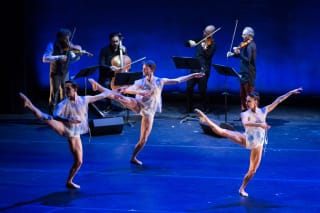
"Solo for Patricia" Delgado and "Blueprint", both choreographed by Tanowitz, showed the former Miamian as a mature beauty responding sensually to music. Delgado shuttles between two violinists in the solo. In ”Blueprint", her relationship to the pair of younger male dancers suggests possibilities but is left undefined. This trio is very leggy with elaborate costuming covering the dancers’ upper bodies whereas their lower limbs are left undressed and busily engaged in varied steps. Collins and Lozano delivered the Tanowitz leg work cleanly and with a winning freshness as Delgado imbued it with wise assurance.
Lil Buck's pneumatic footwork strikes me as phenomenal, no matter how often I see it. On this occasion he was sometimes accompanied by Ron “Prime Tyme” Myles, whose caution and careful stepping (also in gym shoes) made the pliancy of Lil Buck’s dancing all the more apparent.
Much of the music for the program was played by the Brooklyn Rider band (Johnny Grandelsman, Colin Jacobsen, Nicholas Cords, Michael Nicolas). Savannah Harris, a percussionist, and Caroline Adelaide Shaw - a vocalist, instrumentalist and composer - were also featured as performers. Compositions included a Boccherini quintet with guitarist Scott Borg (for the Ratmansky / Mearns dance), some Glen Kotche sound (for the Mitchell and Reiner duo), a Bela Bartok for Delgado’s solo dance and Caroline Shaw’s (for the premiere), a score based on Persian traditions (for one of the Lil Buck / Prime Tyme duos) plus another Caroline Shaw original.
Damian Woetzel, as expected, was the affable emcee. His entire DEMO series almost seems an American version of the televised New Year’s Day concerts from Vienna.
copyright © 2018 by George Jackson



