Is Paris to Blame?
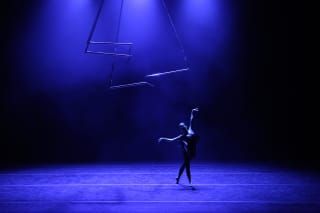
"Work"
Kim Yong-geo Dance Theater from Korea
Terrace Theater
The John F. Kennedy Center for the Performing Arts
Washington, DC
November 9, 2017
"Work" could use a sense of play, of gracious relaxation, of elegance. This hour plus display, choreographed by Yong-geol Kim, is crammed full with different dance numbers and has, sometimes, a military air – especially when its corps de ballet struts onto the stage in marching file. For the opening, though, there were no bodies, no dancers visible but only ballet barres. Four such objects filled much of the floor space. With a copper sheen and a deco shape, these classroom tools looked like art works. From the wings, dancers appeared, gravitated to the barres and began to do limbering routines – exercises that, indeed, are work. The bending, stretching, rotating and whipping motions performed while holding on to a barre were individual, until an up-tight figure slowly walked on and clapped his or her hands to impose uniformity on the dancers' training actions. Dim lighting, not just for the opening but for much of the display, made it difficult to tell females from males or recognize individuals when they re-appeared. A bit of strobe lighting and vapors that clouded the light beams also did not help visibility. Perhaps that's why the dancers' names were not in the printed program. Anonymity reigns at this worksite.
When the warm-up class was over, all the human bodies disappeared into the wings and the ballet barres rose into the air, clanging together, and then remained hanging high over the stage like a piece of mobile sculpture: artsy, but not particularly effective. Distinct numbers, or acts, followed. First, the teacher (likely a male) did Ausdruckstanz, a grotesque expressionist solo containing a few ballet steps and stances. Another solo was for a ballerina in the guise of a bird –- likely not a swan, nor a firebird but per chance a bonghwang? Some duets were for definitely male pairs, but in one for a mixed gender couple it was about dominance with first the man winning and then the woman. A trio that in the West might have been intended for the three Graces had each of the women wearing sunglasses. Often the thematic of these divertissements seemed neither original nor evocative but trite. There were also group numbers. Much of Kim’s choreography is fidgety. He uses a variety of music but seems to prefer compositions with repetitively tedious rhythms. His use of the dancers stresses flexibility, especially that of the women. Yet the movement has too little follow through and phrases tend to end as exclamations, which gives the action a stiff cast despite the pliant buildups.
Coordination for the group numbers, while not quite that of the Rockettes, is considerable. Kim does not assign the women pointe work and seldom even a high demi-pointe, but uses their feet as if they were pads, which contradicts balletic line. That part of this choreographer’s career was spent at the Paris Opera can’t be the reason for his preferences in matters of taste and technique. Could it be that Kim moonlighted at some of the French capital’s nightclubs and tourist bars?
copyright © 2017 by George Jackson



