Indian Love Song
"La Bayadère"
American Ballet Theatre
Metropolitan Opera House
New York, New York
May 23, 2014
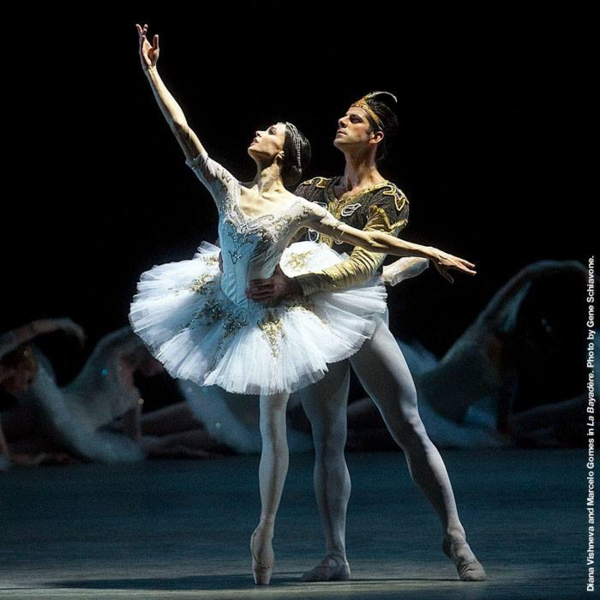
The Makarova-Petipa eternal triangle got a glorious sendoff with its opening night cast, including Diana Vishneva as Nikiya, Marcelo Gomes as Solor and Gillian Murphy, in her first appearance this season, as Gamzatti. Vishneva is a beautiful woman with an expressive face, and her Nikiya was no shrinking violet. She was both shocked and angry at the High Brahmin's untoward advances (Victor Barbee at his hulking, menacing best), rejecting them fearlessly. She was not coy about her love for Solor, throwing herself in his arms with complete confidence. For me, her dancing, though beautiful, was at times almost too filigreed, with tendril arms and exaggerated back-bends; her mime often looked polished beyond coherence, and seemed studied rather than spontaneous. The fight with Gamzatti, however, was riveting, as she reacted to Murphy's dominating presence. She really did seem ready to stab her rival.
Gomes' Solor was well worth fighting for. The role is a perfect fit for Gomes, showing off his many strengths. He is blessed with a handsome face and noble proportions, is a gracious and generous partner, and has the sympathetic imagination to make Solor a flawed but sympathetic hero with a weak will and a strong heart. And he is no slouch in the technical department; his jumps may have been higher in years past but his control is phenomenal.
He was proud and confident in his entrance, knowing that he alone could kill a tiger with one blow, but was still tempted by the magnificence of the Radjah's palace. The chess scene was a mini-play, as Gamzatti moved the pieces with arrogant confidence while Solor picked them up almost apologetically, his hands barely lifted above the chess board as if he were afraid of committing some social error, either by playing too badly or too well. The final act, as he stood in the middle of the candlelit circle, crushed with grief and dazed with the memory of Nikiya, raising his hands to pray and bringing them down as Minkus' lilting melody descends takes the old-fashioned story from melodrama to tragedy.
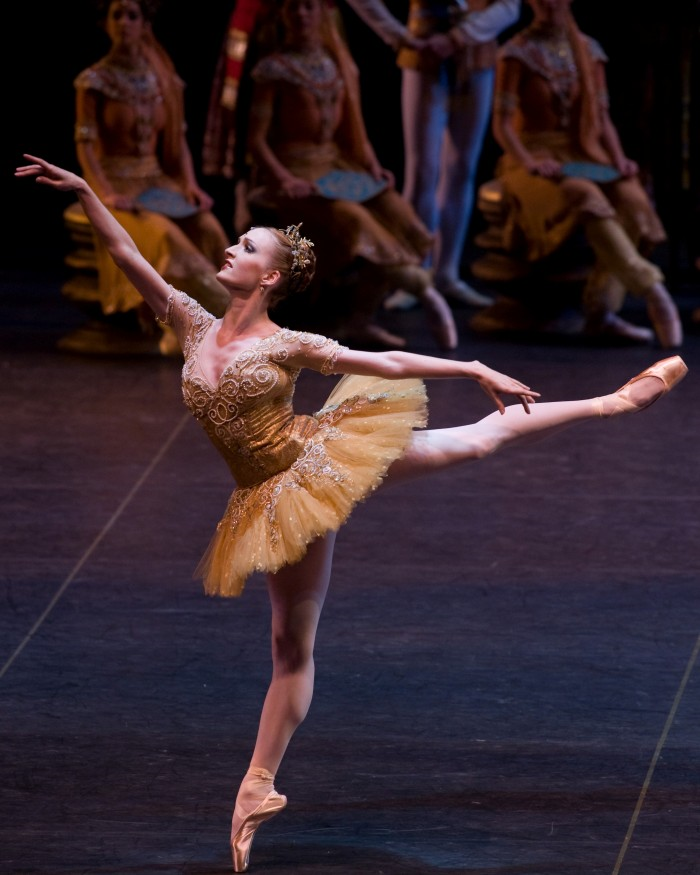
Murphy showed no signs of her recent injury, as she charged through her turns in the betrothal scene with a blazing confidence; the audience welcomed her back with cheers. She is a greedy, hard-edged Gamzatti, a much more exciting version than the softer Gamzattis we sometimes see, who just really, really love Solor and can't help it if snakes crawl into flowers. She almost cried tears of rage as she danced with her wedding veil; her pride rather than her heart was wounded. Few dancers have made the contemptuous gesture so cutting, as she forces Nikiya to look around the magnificent surroundings and then sneeringly points at her, "you insignificant little temple dancer". Murphy makes even this hissy-fit complex, as she despised Nikiya but was also ashamed at her own helplessness. The glare she gave the loyal Aya when Nikiya shoved her to the floor would have sent anyone scrambling for poison.
The Radjah, Alexandre Hammoudi, was elegant, but not as menacing as some earlier ones, and he didn't make the slow walk to the back of the stage as poor Nikiya danced her heart out seem like a death sentence.
The corps in the magical minimalism of the shades scene was, with a few minor exceptions, steady and fluid, not exaggerating the arabesques to the point of strain. The shades, Sarah Lane, Devon Teuscher, and Misty Copeland, were not completely matched stylistically, though Lane used her fluid upper body and strong feet beautifully. Teuscher, in the difficult second variation, concentrated on control rather than flow, and Copeland had some trouble staying on point in the third. But these were minor hitches in a rich and moving performance.
copyright © 2014 by Mary Cargill



