In A Galaxy Far, Far Away
“Tesseract”
Charles Atlas, Rashaun Mitchell, Silas Riener
BAM Harvey Theater
Brooklyn, NY
December 13, 2017
It opened with a starry sky, viewed through 3-D glasses. In their mixed media dance and film extravaganza, dancer/choreographers Rashaun Mitchell and Silas Riener partnered with videographer/director Charles Atlas for a two-act performance, the first half: a rollicking 3-D dance video, the second half: a live dance performance with simultaneous video shadowing. Not surprisingly, the dancers – some schooled, as Mitchell and Riener were, under the tutelage of Merce Cunningham – were superb, and each step, leap, turn, and gesture was crisp and forceful. The glitzy, fantastical premise, though, ended up being more silly than splendid, and never overcame its reliance on science fiction imagery or movement repetitiveness.
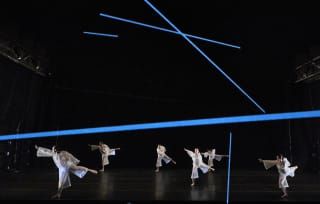
A tesseract is a cube seen in four-dimensions; imagine what happens to a square to make it a cube; that’s what happens to a cube to make it a tesseract. After the eight-sided geometric figure floated in the film’s opening dark starry sky, several tall thin lines rotated then thickened, and eventually emblazoned the 3-D word “Tesseract” on the screen; it was hard not to envision the title screen for “Star Wars,” an apt touchstone for the entire show.
The visual effects that Atlas applied in the Act I video ranged from geometric split screens and kaleidoscopic mirrors, to a scene shown upside down, defying gravity. In addition to the choreography, Mitchell and Riener provided wild, over-the-top costumes and make-up. In the opening dance sequence, six performers had black boxes of make-up around each eye, and their costumes were dotted with scattered black squares on white. The film reveled in gender-blending; the costumes and makeup in each scene were uni-sex, and in a stereotype challenge, Riener, whose thick hair falls almost to his waist, was balanced by shaven-headed female dancer Cori Kresge. All were dance creatures of a non-gender-specific species.
The black and white clad performers bounded around and behind large columns of black and white designed panels in a dizzying visual effect, with the 3-D glasses deepening the impact of the movement. This troupe of dancers was made for geometry -- perfect straight legs, balances, turns, shifting and collapsing into endless distinct shapes, (in a later scene, their own shapes melded around actual geometric props of three-dimensional cones, cubes, triangles.) The movement was often more mechanical than fluid, sometimes even purposely robotic; and the patterns stopped holding much interest, especially when competing with the dramatic scene changes in Atlas’s peripatetic world.
From the black and white opening, the scene shifted to the upside-down world, where all the dancers wore lime green wigs, and the floor rotated as they writhed, reptilian-like, on the ceiling-turned-floor. Soon, all were transported to a desert planet (perhaps Tatooine?) – all orange sand and hot light, with a weird communication tower looming on the film’s horizon. And so the scenes proceeded – each completely disconnected from the one before, each demanding our 3-D attention, as the dancers became second fiddles to their settings. Some of the scenes were pleasantly playful, reveling in strength and disciplined specificity. In a scene that the camera manipulation made increasingly kaleidoscopic, the way the dancers’ mirrored limbs intersected across the sharp lines of the kaleidoscope were beautifully artful, but, finally, just another visual trick.
Mitchell and Riener were soloists in several scenes, and performed a duet in a set that dripped with enormous twisted plastic ropes hanging, like a multi-colored day-glo jungle, from the ceiling. These two riveting dancers used most of the scene in unsubtle sexual imagery, oozing along the floor, weaving in and out of each other’s legs, tender and deliberate at first, then twitching, jerking, bobbing and flopping through the plastic ropes. It was a visual frenzy, as the camera shifted, too, freezing frames and manipulating pace.
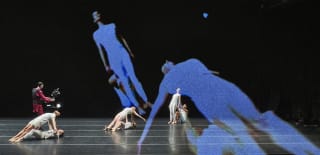
Act II was the live act, although much of it was performed behind a stage-sized transparent scrim. The act opened, though, not with a dancer, but with the camera operator, Ryan Thomas Jennings, standing in a small pool of bright spotlight. (In a head-scratching score choice, his scene was set to Roberta Flack’s “The First Time Ever I Saw Your Face,” a brief disorienting shift from the background electronic score by Fennesz that underlined the rest of the work.) Jennings wore a fuschia robe and diamond-sided shoes and donned a scary-looking machine – the camera – that hooked into a metal body vest. The live-action video he filmed throughout the act was projected onto the scrim and mediated the audience’s view of the performers through most of the second act. The dancers were costumed in transparent, diaphanous white robes, as if the scrim screen that lightly separated them from the audience had been translated, and their limbs and torsos were also gently shadowed from full view.
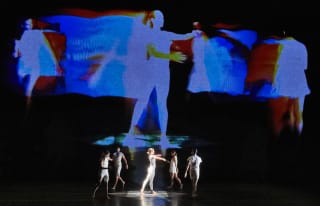
Many, but not all, of the film’s dancers were on the stage. In one cast trade, we lost the estimable Melissa Toogood after the film, but gained the marvelous Eleanor Hullihan. In a simple and satisfying opening scene, the dancers spilled onto the stage, one by one, moving in a sharp square around the edges of the stage. In their white costumes, they became like the floating lines of the film, shifting their bodies into satisfying geometries. In trios, they melded, pulling, pushing and rotating. Riener emerged in large movements, sweeping arms slicing across the stage as four acolytes joined him to parallel and highlight him. The camera zoomed on his face, projecting an enormous image on the screen; the film images loomed, as the bodies shrank behind the screen.
In a beautiful closing scene, Hullihan emerged alone (and unmediated by the scrim,) onto the elliptical apron of the Harvey’s performance space. She looked at the audience and leaned in, twirling and balancing in low elegant motion. She drifted so close to the first row, that after all of the screen separation, now the fourth wall seemed about to break. In the dark, behind Hullihan and the scrim, Mitchell mirrored the rise of her arms and, in his own solo, let loose with his powerful legs popping, his bent knees and squats, precise behind the screen barrier. Jennings returned, having joined the group as a dancer himself, leading a parade of the others, their shaking and twitching exaggerated by the camera. Eventually, the film swirled their rotating bodies until they blurred, the screen darkened, and the twirling masses became again the stars in the opening image of night sky.
Though tremendous dance talent was assembled for this work, the piece was driven by Atlas’s idiosyncratic and extravagant vision, and lost its balance in the urge for spectacle. It was often magnetizing, if not exciting, but it was entertainment, not art, and the dancers didn’t get the better end of this bargain.
copyright © 2017 by Martha Sherman



