In a Community of Artists
“Moss Anthology: Variation #5,” “The Theory of Color,” “You Took a Part of Me,” “Snap Crackle Pop”
“Women/Create” – A Festival of Dance
New York Live Arts
New York, NY
June 11, 2019
Seeing four mature, successful female choreographers take the stage together in a program that celebrates women’s creative pursuits is still a powerful draw. By now, we shouldn’t need this reassurance, and the “Women/Create” festival (their fourth) still misses a broad swathe of the riskier inventions of women choreographers. This year’s line-up offered creations both intriguing and pedestrian, and gave voice to a powerful quartet on the opening night: Jennifer Muller, Karole Armitage, Jacqulyn Buglisi, and Carolyn Dorfman.
In the first half of the opening program, Buglisi’s New York premiere of “Moss Anthology: Variation #5” was paired with Muller’s World premiere of “The Theory of Color.” Each took a universal idea and created visual and dance languages to communicate their enthusiasms; both companies danced beautifully, though – in both cases – the ideas themselves felt more clichéd than illuminated.
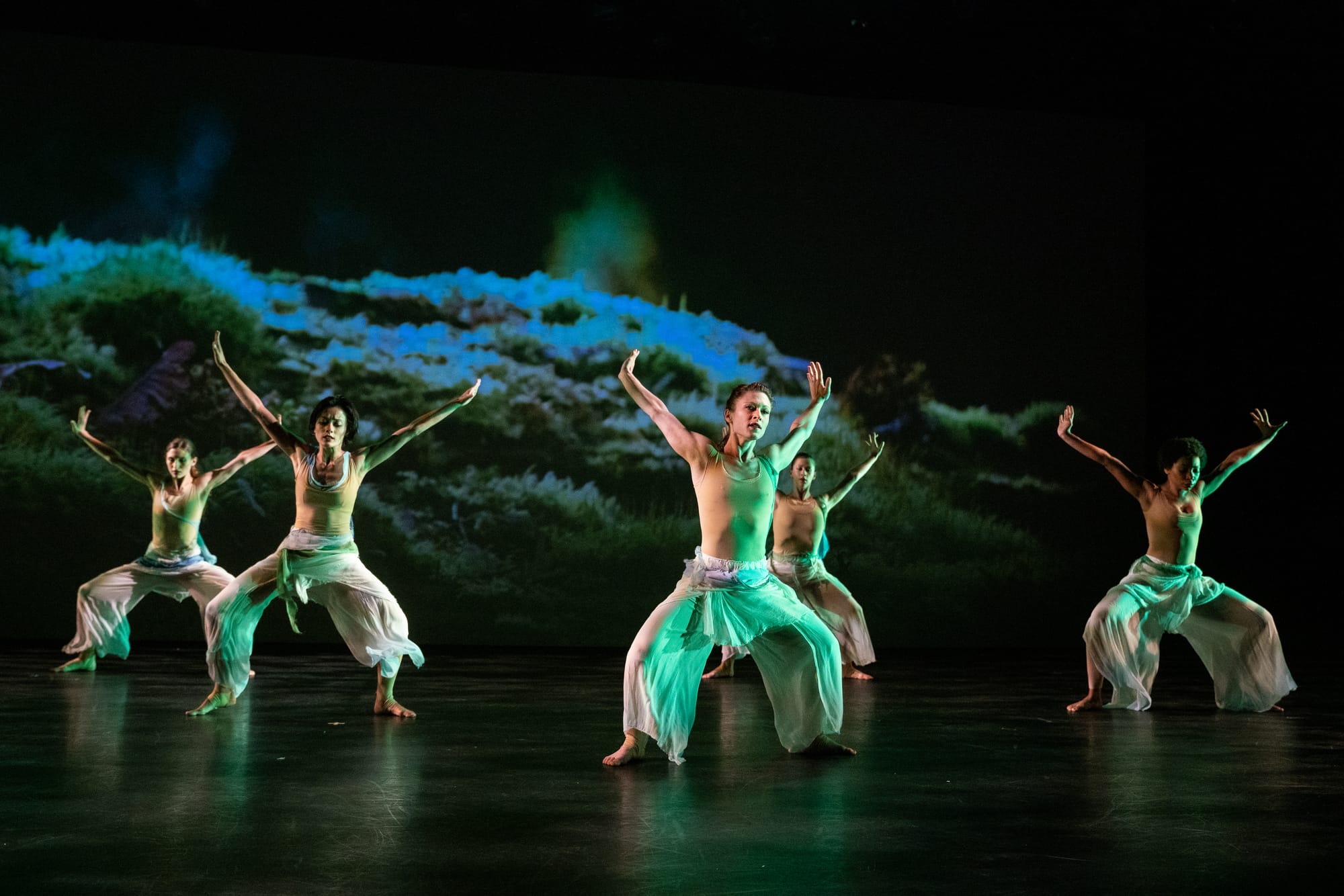
“Moss Anthology,” a continuation of Buglisi’s Moss project, is a paean to the natural world, a plea to protect and preserve the planet. Against large video projections of ancient trees, frothing cascades, twisted root systems, and other natural scenes, a troupe of elegant women moved like goddesses, gazing up and out as their limbs stretched. Their costumes, flowing white and moss green, situated them in forests; often, with their long hair flipped and flowing like continuations of their graceful limbs.
Soloist Stephanie Van Dooren-Eshkenazi sliced through the smooth moves of company with a different energy – crisp, angled, a bright streak of light through the elegant company. As the women split into pairs and trios, in parallel or woven movement patterns, the music, video projection, and dance intertwined in statements that offered physical translations of nature.
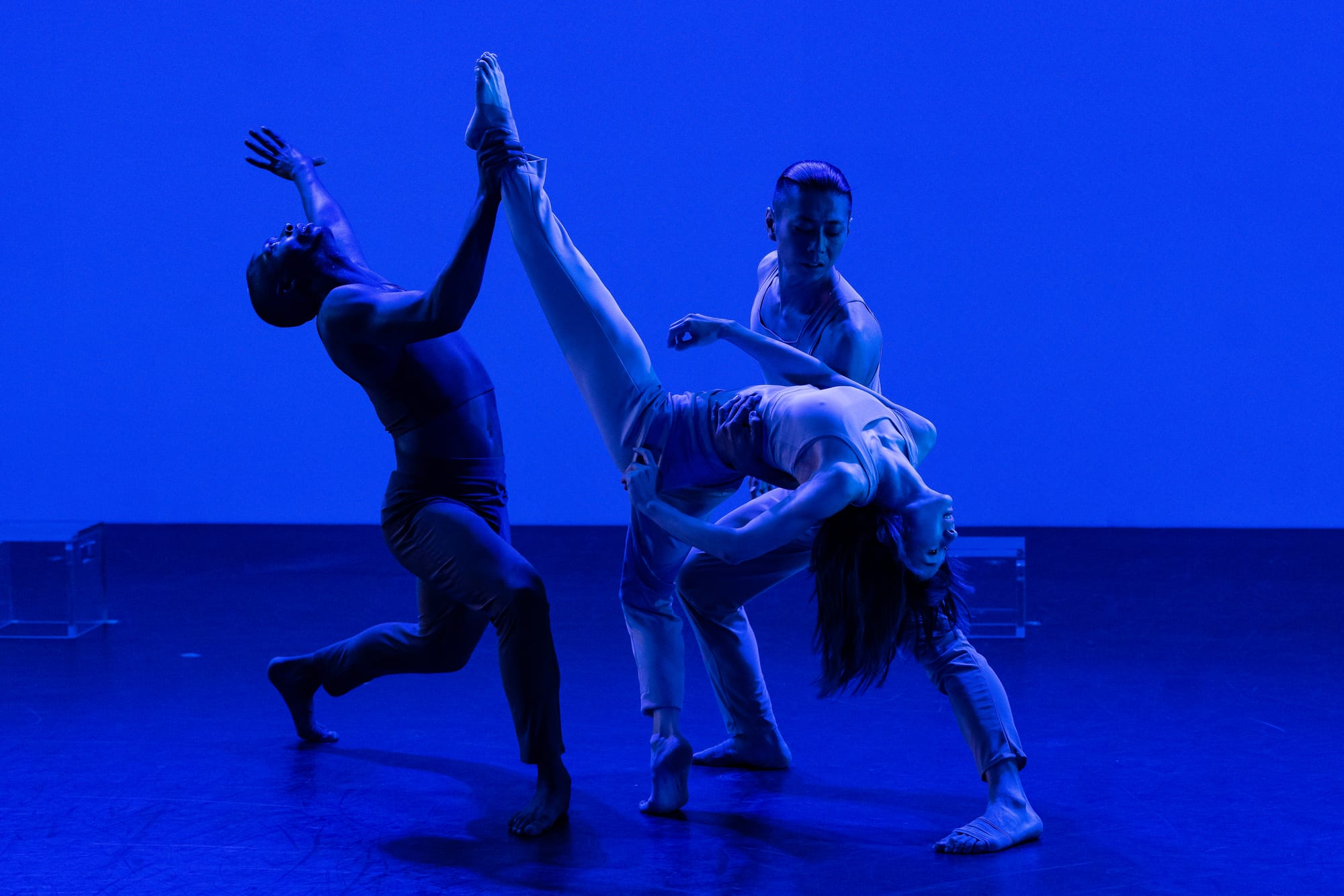
The evening’s second piece, Muller’s “Theory of Color,” was also literal, but added spoken texts, linear and direct translations of her subject. Each scene explored a color, and for each new color a dancer was added, along with a clear lucite box. The red scene was a duet; blue was a trio; purple a quartet. Lighting, by Jeff Croiter, was in deeply saturated lockstep, the color enfolding the stage and the dancers. Because the lucite boxes didn’t block light, their shapes were just shy of invisible, a clever visual trick that allowed the dancers’ movements an added layer of geometry. Between their sinuous moves with each other, they draped over the boxes, or sat splay-legged, like grounded triangles.
Muller’s voice-over texts, read by several (most recognizably, herself) were phrases, poetry, and images, starting with the repeated “Red is for rage; red is for roses.” Though the dancing was masterful, and the choreography took advantage of the opportunities offered by the different number of dancers in each scene, the predictable patterns and clichéd text wore thin.
The second half of the program offered a different pair of works, each offering more subtlety than the first two. The evening’s final work, the New York premiere of Dorfman’s “Snap Crackle Pop,” was choreographed in collaboration with PILOBOLUS’s Jaworski, and offered a refreshing and welcome sense of humor to close the evening. Drawing from the acrobatic and anthropomorphic PILOBOLUS vocabulary, they created complicated human “machines” at the beginning and end. The arms of several dancers became multiple front legs of a slithering construction with several torsos, and legs were balanced over and around other bodies. The vocabulary was both familiar and playful, a clear descendent of the signature movement of Jaworski’s troupe. This piece will be the first to enter PILOBOLUS’s repertory having been made on a different company.
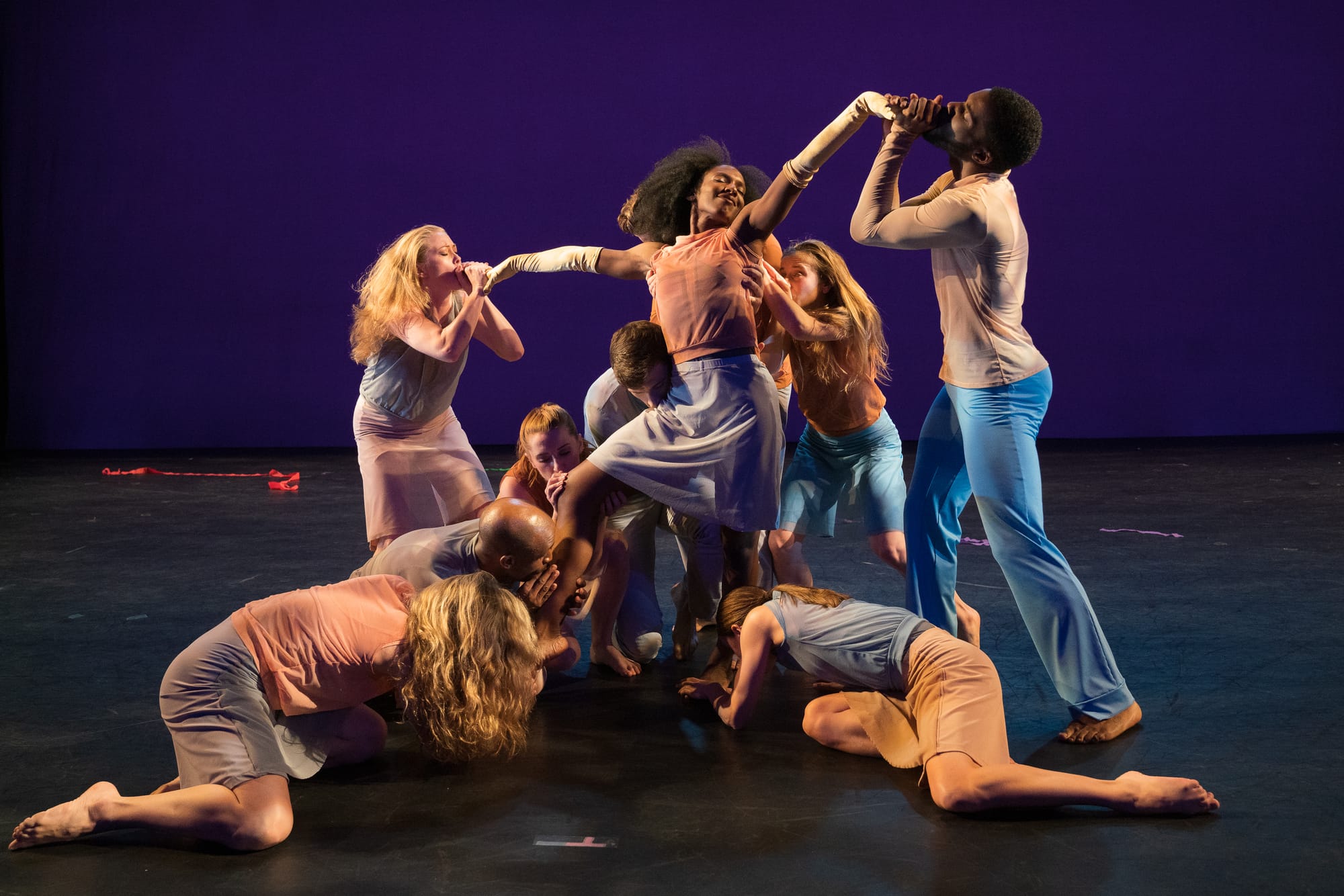
The dance, though, wasn’t defined only by that familiar athleticism and body intersections, but also by storytelling, created here to visualize iconic jingles of the late 20th C. The dancers overcame their “blahs” with the “Plop, plop, fizz, fizz” of Alka-Seltzer’s famous earworm. They hovered with sexual longing over the white-gloved icon of cigarette heyday. Even millennials should get these references. The brisk pace and clever mixes of dance and human sculpture made us laugh, as well as squirm in recognition.
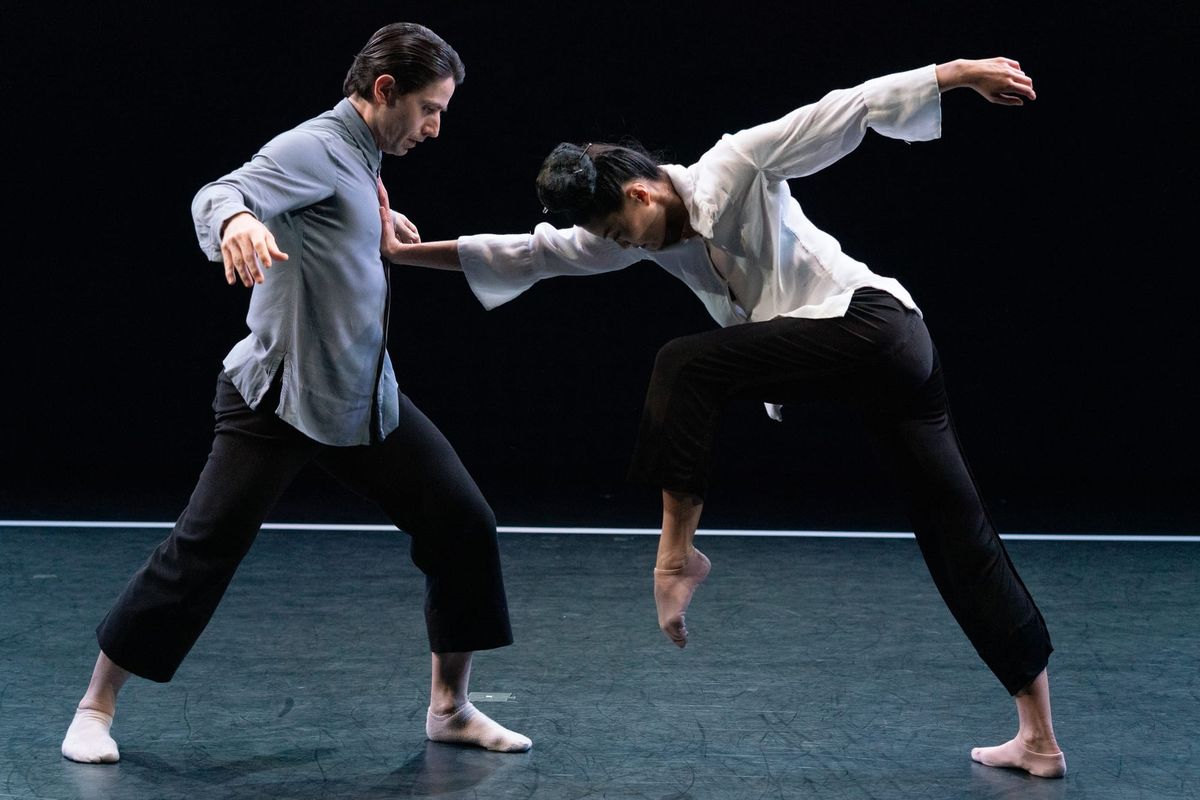
The evening’s most interesting work was also the shortest, an excerpt from Armitage’s “You Took a Part of Me.” White tape was laid to evoke the Noh stage-on-a-stage, a kind of fighting ring to surround the revolving love duels of the 15C. Japanese ghost play, Nonomiya. To a haunting score by Reiko Yamada, two women, Megumi Eda and Sierra French, warily moved around each other, the doubles of self and ghost, before shifting into erotic partner dances. In the “Memory Duet,” Eda moved seductively with her partner, Christian Laverde-Koenig in a breathy, erotic contest, their push and pull a mix of imbalancing and recovery; the delicate capture of her face in his hands evoked both love and memory.
In addition to showing these four works on opening night, three works by other women were also woven into later programs of the festival. Seven women is a small sampling, when held up to a field of the many women who are choreographing powerful work; it is still a struggle for women to be seen, to be recognized.
In the on-stage opening introductions of “Women/Create”, the choreographers celebrated their collaboration in every aspect of the festival – funding and management, as well as the stage. These artists are here to create community as well as art. And if some of the work was more compelling than others, that too seemed an apt message: that women can work things out that aren’t entirely successful, on the way to bigger and better things. Just like men do all the time.
copyright © 2019 by Martha Sherman



