How Great It Is
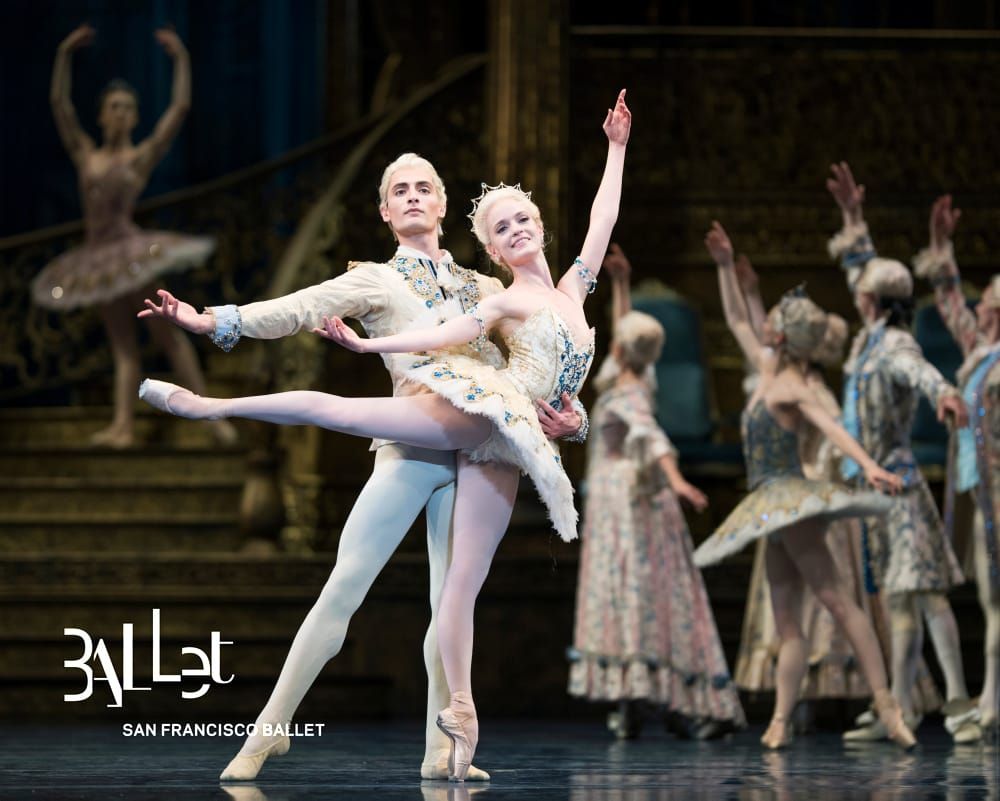
"Sleeping Beauty"
San Francisco Ballet
War Memorial Opera House
San Francisco, CA
March 9, 2019
Why do we keep going back to see “Sleeping Beauty” when we can almost hear the music’s next section before it hits the air? Of course, this is Tchaikovsky's greatest ballet score, here sensitively conducted once again by Martin West. Yet we may have seen the ballet many times, sometimes live, sometimes on screen. Some of us even make a point of seeing different casts of any one production. Those are the kinds of questions which floated in my head in anticipation of this year's reprise of Helgi Tomasson’s 1990 (slightly altered) version. Though it was most recently seen last season, here is a welcome back to an exemplary work of classical dance, particularly one as cohesively and well presented as Tomasson’s tribute to Petipa and Tchaikovsky.
So what if the Prologue’s short siding dance, the epitome of old-time Russian decorum, looked like a gallop, and the Lilac Fairy’s attendants took their time getting into sync, this performance showed San Francisco Ballet capable of embracing classicism at its finest even though its reputation is largely based on new work. It takes both to make a great company.
What I hadn’t noticed before: Lighting designer Craig Miller’s brilliant touch to animate a storybook tale. Seen darkly through the scenic curtain of every act, its dancers in place, we looked at a European genre painting — or a page from a storybook — which the rising light animated. It was magic. The Prologue’s pre-European Russian court, in heavy brocade and deep red velvet costumes, inspired hierarchical processional entries of nobles and clerics. Even the Fairies' tiny gift-bearing pages got into the measured walking. Wanting Zhao as the Fairy of Darkness tore through the place like a tornado, threatening not just a princess but an entire social order. Her white facemask called up some Chinese demon; her fury not only included clawing fingers, hands and wild hair but a thrusting chin that could kill.
The Fairies’ divertissements left little to be desired. I was again struck again how the Fairy of Tenderness (Elizabeth Howell) opened the quintet on such a lovely, though short adagio, most clearly addressed to the new baby. Norika Matsuyama’s Fairy of Courage's Finger Variation had just the right note of flippancy and assertiveness. In the Waltz, Jennifer Stahl’s Lilac Fairy with huge embracing rond de jambes also offered one of my favorite steps, the sissonne which to me always looks like a teasing catch–up-with-me. Stahl’s superb technique, which embodies grandeur and power with such warmth, impressed as much as her dramatic and tortured Zeena Frome in Cathy Marston’s “Snowblind.” This is a dancer with an impressive range. Lilac’s six cavaliers’ splendidly timed entrechats and tours en l’air served as a reminder how in this ballet even smallish parts need to meet exacting standard.
Everyone’s favorite part of “Sleeping Beauty”, the Spell, looked just fine. Sasha De Sola has enhanced her young Aurora a bit without losing any of her truly spectacular dancing. Here she is a young girl, slightly puzzled but also intrigued by all the attention she gets from these exotic princes. The Garland Dance, which included six students from the school, was charmingly danced. What a chance this must be been for these youngsters, smiles properly frozen on their faces, to participate in this ballet.
The second act’s hunt, which leads into the Vision scene, still looks awkward, not withstanding the rather forward Countess (Elizabeth Mateer) just about throwing herself at Prince Désiré (Carlo Di Lanno). Somewhat clumsily he is trying to be polite yet unwilling to engage his courtiers on a more than a minimal level. In this ballet’s most extended, well-done mime the Lilac Fairy steps in gently but clearly to explain to Désiré the reason for his melancholy. The choreography for the white ballet allowing for a gradual rapprochement between the ghostly Aurora and the love-struck prince is beautifully developed. The nymphs' ethereal dancing, carried along by a unified sense of style and musical response, is one Tomasson’s highpoints in this “Sleeping Beauty.”
In the Wedding, the ten Polonaise couples elegantly set the scene for the splendid ceremony to which the divertissements serve as introduction. Esteban Hernandez and Benjamin Freemantle, two very different dancers, shine with their light footwork as the Jewels Cavaliers. Who would want to miss ‘The White Cat and Puss in Boots,’ a gem of charm and wit, not all that common in classical ballet? Elizabeth Powell and Sean Orza did the honors. Clearly Koto Ishihara as the Enchanted Princess, with pristine footwork and beautifully fluttering arms, successfully taught Lonnie Weeks to fly. His rocking brisés volants, justifiably brought the house down.
Would additional divertissements, these days rarely seen, unreasonably prolong an audience’s anxious await for the glorious finale? With De Sola and Di Lanno in the leads, that anticipation certainly made sense, particularly for balletomanes. Both artists are handsome, expert performers, nailing difficult steps with consummate ease. With her soft arms, De Sola’s pinprick point work, impeccable balances, piqués and chainées, she had it all. Di Lanno beautifully supported his bride and showed off his long lines through barrel turns, tour jetés and cabrioles. Yet this grand display of Classical dancing didn’t end with the spectacular “no-hands” fishdive but with a Mazurka in which everyone participated. It’s a royal wedding celebration but everyone is invited to the party, presided over by the Lilac Fairy. It’s just one of the many reasons that “Sleeping Beauty” may be the greatest of all classical ballets.
copyright © Rita Felciano 2019



