Holiday Comedy
"The Nutcracker"
Kansas City Ballet from Missouri
Opera House
The John F. Kennedy Center for the Performing Arts
Washington, DC
November 22, 2017
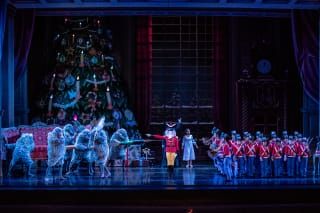
This time, DC's visiting version of "The Nutcracker" comes from Missouri's metropolis - Kansas City, located on the state's western border with Kansas. Like such guests in previous years, the company is wanted back home for Christmas so that its seven performances here are scheduled as a Thanksgiving treat. Credited as choreographer is Kansas City Ballet's current artistic director, Devon Carney, a familiar name since his days as a leading soloist at Boston Ballet. Carney's solution to the quandary of having a "Nuts" that's both traditional and like none other is his take on the well known story. Even though what happens is much as in many other versions of the ballet, few opportunities for farce are ignored. Moreover, behavior is hyper and often highly so.
Do any ballet’s grandparents dodder more foolishly than Carney’s pair? Their grandson, Fritz, is as much a rascal as in other productions. However, the chief vector for a comedic approach is Dr. Drosselmeier, the magician whose tricks and toys trigger much of the action. He reminded one viewer here of Charlie Chaplin. As portrayed by guest artist Ryan Jolicoeur-Nye, the good Dr. D bundles klutz and skill, obtuseness and insight, plus being a loner and trying to act like a friend into one entity. The first scene shows him busy in his workshop assembling life-size dolls, animating them, punishing them when they and he collide by miniaturizing them and boxing them up as gifts. Drosselmeier takes these gifts to the Silberhaus family’s Christmas party. In company, he proves to be a good sport who entertains all the children at the gathering. He has, however, a special present for his hosts’ daughter Clara: it is a military Nutcracker doll. Yet there’s no hint of romance with Clara when the Nutcracker, after winning a battle in which he leads a regiment of toys against an army of mice, turns into a handsome human Prince. The age gap between young Clara and the grown up Prince is just too great. The strongest relationship in this version of the ballet is Drosselmeier’s avuncular one with Clara.
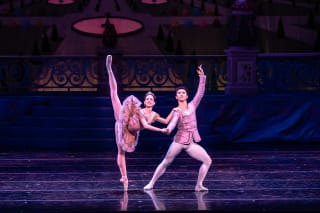
Even so, Clara and the Prince are sent off together through a wintery forest inhabited by a Snow King and Queen, Ice Crystals and Snowflakes. At first the duo travels by a reindeer drawn sleigh. Then it boards a balloon boat in order to fly to the Land of Sweets. Drosselmeier soars there by himself and, once arrived, acts as emcee for its larder of divertissements – chocolate, coffee, tea, marzipan, ginger, etc. However, the Sugar Plum Fairy and her Cavalier seem royalty in their own right. The ballet ends conventionally, with Drosselmeier sending Clara and the Prince back by balloon. Back to what? Presumably it is to waking up from Clara’s dream.
The music, of course, remains Tchaikovsky's. It was played by the Kennedy Center's Opera House Orchestra with Ramona Pansegrau conducting. Some of Alain Vaes's storybook sets for the ballet’s several scenes recalled another “Nutcracker”production he had designed. Holly Hynes' costumes evoked the 19th Century or fantasy. The dancing by a cast of just under half a hundred – members of Kansas City Ballet’s first company plus a few trainees and some members of the second company - had commendably clear lines and a propulsive dynamic. Particularly the women displayed classical nuance. Carney had worked hard to diversify the balletic choreography. That for the Sugar Plum (Amaya Rodriguez) had sweep and a touch of grandeur. The dancing for the Waltz of the Flowers’ Rose (Taryn Mejia) was filled with lively caesuras. Flexibility was the hallmark of how Coffee (Molly Wagner) moved. Brio characterized the steps for Marzipan (Tempe Ostergren), and a sculptural consistency those of the Snow Queen (Danielle Businger). Credited for the quality of the solo and corps dancing were Kansas City’s ballet masters – Kristi Capps and Parrish Maynard. Rhodie Jorgenson meticulously rehearsed the DC children who took part. All three repetiteurs – Capps, Maynard and Jorgenson are names familiar as dancers in the past. Among the male roles were those for the Russian Trepak (Kevin Wilson, Charles Martin, Cameron Thomas) sometimes known as the dance of the Three Ivans, the Snow King (James Kirby Rogers), the Sugar Plum’s Cavalier (Lamin Pereiera dos Santos) and the Marzipan Cavalier (Michael Davis). The important part of Clara was taken by Maggie Crist, presumably a student at Kansas City Ballet’s school.
Carney’s version of “The Nutcracker” is busy, gets laughs and keeps the dancers going. What it hasn’t is mystery, nor magic of the heart. The written story, which started as one of E.T.A. Hoffmann’s tales, left one wondering about the nature of reality. That sense of awe waned and waxed as the plot passed to a second author, Alexandre Dumas Sr. and then to choreographers Marius Petipa, Lev Ivanov and yet other ballet masters. Hoffmann’s personal creation has become today’s folk art.
copyright © 2017 by George Jackson



