Hive Mind
“Emergence”, “Silent Screen”
The National Ballet of Canada
Four Seasons Centre for the Performing Arts
Toronto, Canada
November 19, 2026
When Karen Kain commissioned “Emergence” by Crystal Pite in 2009, Pite was in the early years of running her company Kidd Pivot and creating works mainly for contemporary companies and individual dancers. With “Emergence”, Pite had the opportunity to work with a large classically trained cast of 36 dancers and develop a distinctive style using precision, repetition and phrasework that has become her hallmark seen in subsequent large scale works such as “Angels Atlas” and “Flight Pattern”. It helped pave the way for Pite to collaborate with other major ballet companies, among them The Royal Ballet and Paris Opera Ballet. “Emergence” was an instant hit and remains a modern classic, as captivating now as it was 17 years ago. It was paired with a more recent acquisition, Sol León and Paul Lightfoot’s 2005 work “Silent Screen”, which entered the National Ballet of Canada's repertoire in 2024. Whereas “Emergence” features a large collective, “Silent Screen” feels intimate and individual, allowing time to explore a lush silent film with sweeping landscapes that the dancers weave in and out of. The two works complimented one another and showed the company’s commitment to celebrating Canadian talent while being in conversation with important European dancemakers as well.
The program opened with “Silent Screen”. The curtain rises on a scene of three figures standing by the shore. There is gentle movement in the water, while the people are still. It is not immediately clear which dancers are part of the film and which are standing on stage. Throughout, the film is more than a passive backdrop. The dancers interact with and inhabit the film as a living organism. “Silent Screen” is one of the most successful works in the NBoC repertoire when it comes to using film in novel ways to enhance the choreography. The film uses close ups and wide angle shots to give the piece a scale beyond what an audience would typically see on stage, allowing the viewer to zoom in and out of a scene. Moving from black and white to colour and back again allows the viewer’s attention to shift to different visual elements. The film even plays with tempo, slowing down and speeding up in time with the dancers on stage.
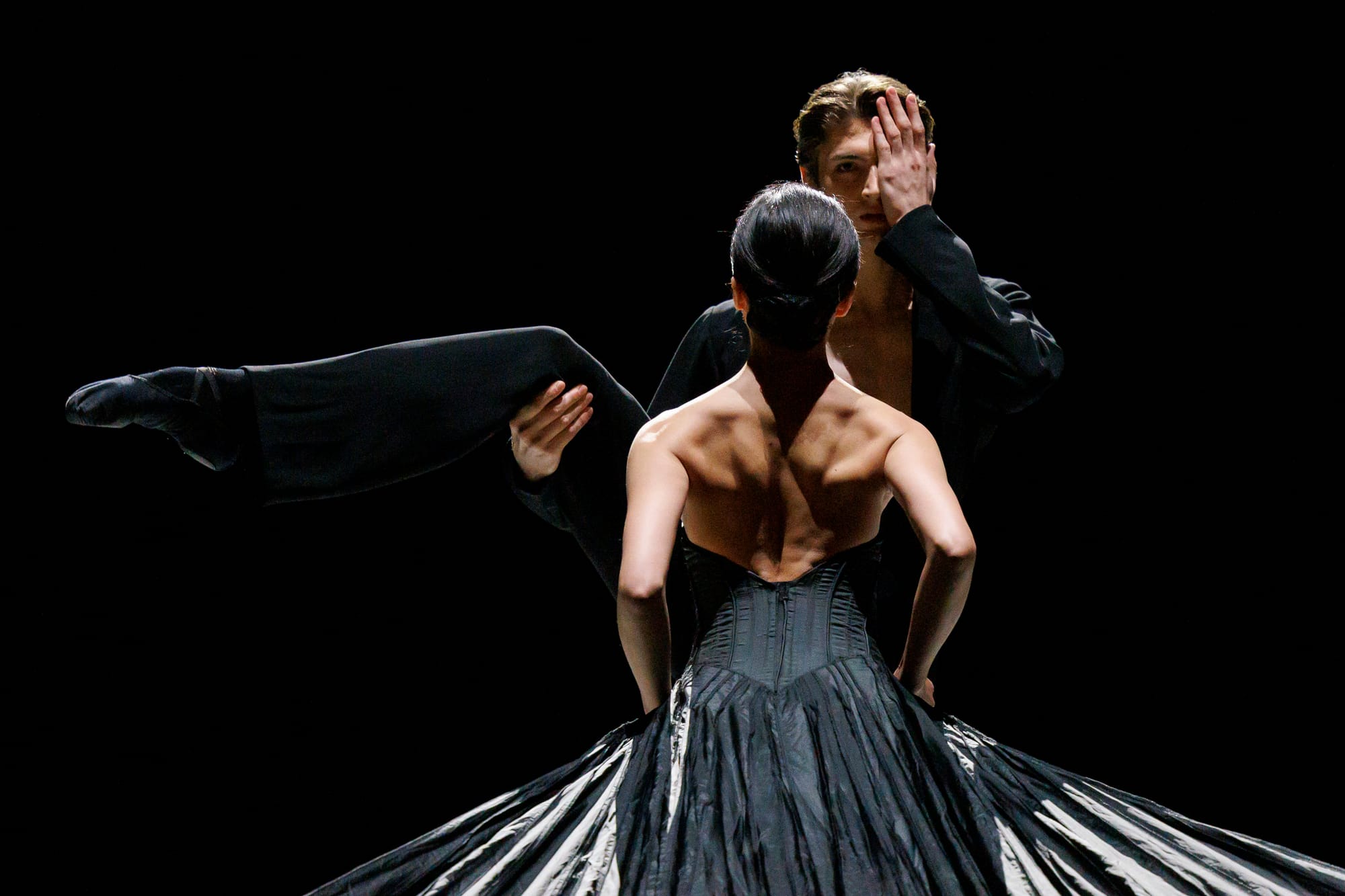
As the central trio, Josh Hall, Alexander Skinner and Alexandra MacDonald sensitively portrayed individuals coming together and breaking apart. The specifics of their relationships are left ambiguous but the emotions conveyed are still tangible. It could be a love triangle or something entirely different. Homage is paid to the silent film tradition which relied so heavily on facial expression. There is a recurrent motif of the silent scream, with chin dropped down and lips stretched apart. But there are also moments that the silence is broken with audible breath or when Skinner vocalizes. Erica Lall and Shaakir Muhammad stood out in their pas de deux that featured energetic acrobatic movements with more controlled, legato moments. One of the most striking images occurs with retired NBoC principal Xiao Nan Yu rising up from steps in the orchestra pit wearing a dramatic tent-like black gown with a long train. We do not see her face, but her poise and presence are unmistakable. She walks so slowly and purposefully, one expects something to come out of that tension but then she’s gone. Perhaps she’s meant to be mysterious, but it felt like a missed opportunity. At 50 minutes, “Silent Screen” does start to drag on at times. Philip Glass’ music is beautiful and evocative, but the endless figured arpeggios do not help. The final scene calls back to the opening, like a video being rewound. It provides symmetry but for some it may provide just too neat of an ending, particularly for work that is otherwise quite abstract and ambiguous.
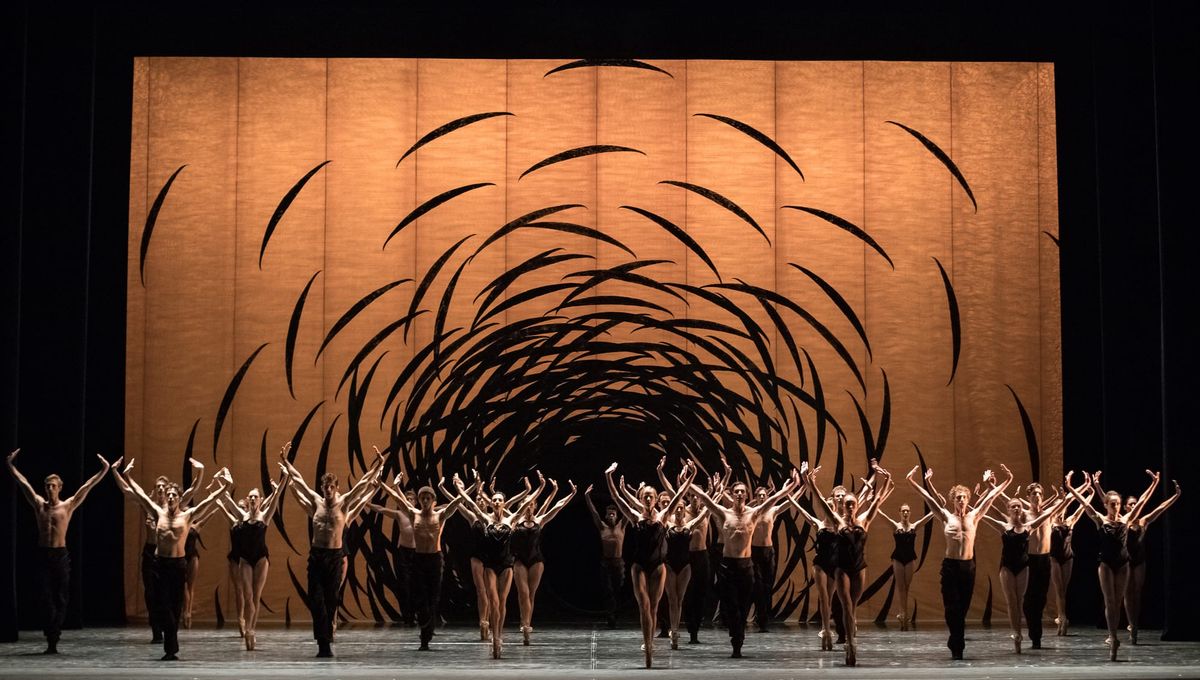
The title of “Emergence” alludes to the life cycle of honey bees and the moment when an adult bee completes metamorphoses and chews through its cocoon. The ballet begins with a birth sequence with Hannah Galway and Spencer Hack appearing, bare, slightly awkward and twitching with new life. The score, by Pite’s frequent collaborator Owen Belton, adds to this imagery with buzzing and humming sounds as the scene shifts to a tunnel that opens up into a nest-like space. Jumping off from the insect swarm references, Pite masterfully moves the bodies on stage in and out of orderly formations and draws parallels to other group structures. The title also references Steven Berlin Johnson’s book “Emergence: The Connected Lives of Ants, Brains, Cities and Software”. It asks how order can arise out of chaos and how decentralized decision making can exist within a heirarchical structure.
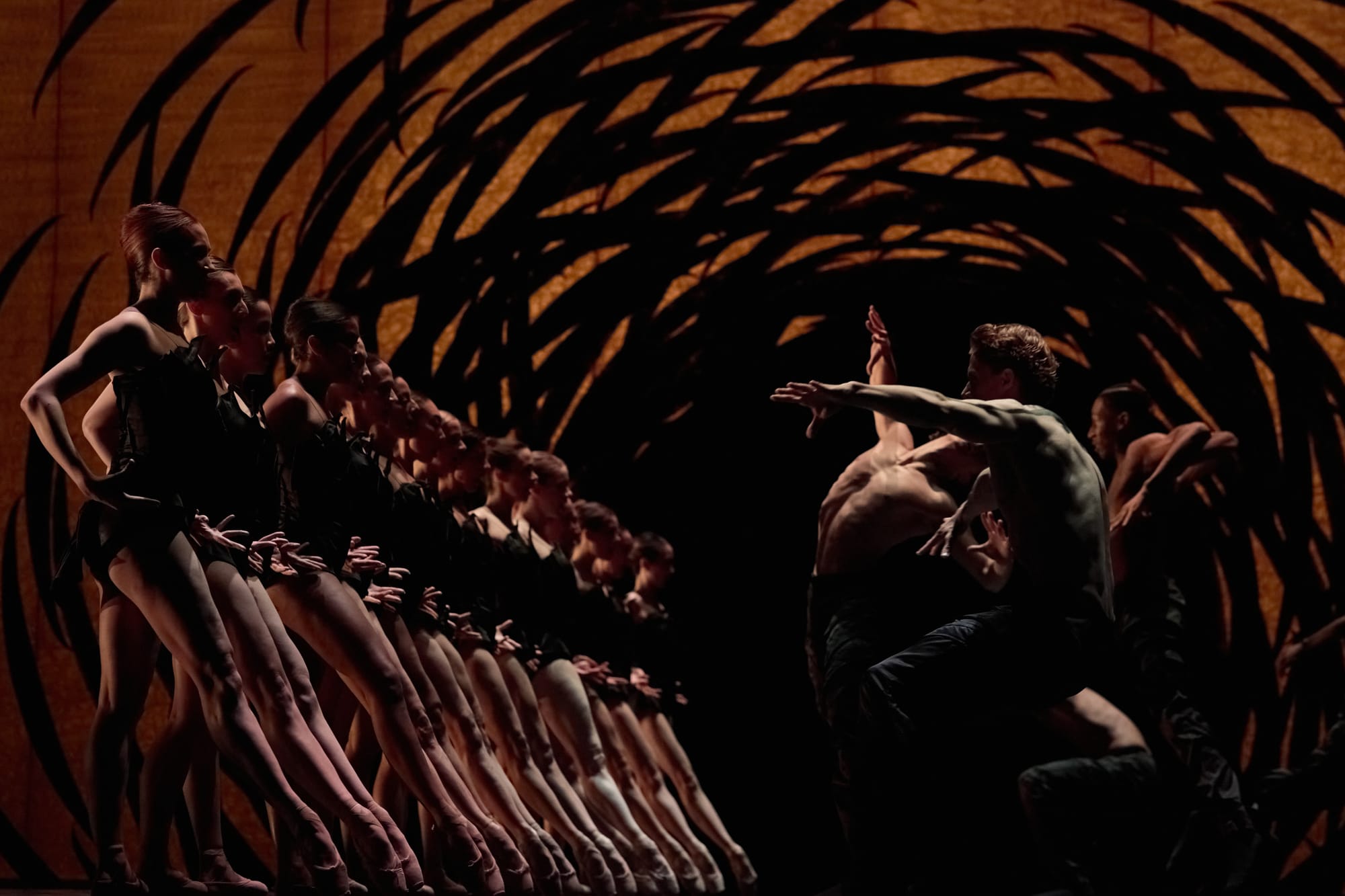
In this ballet, as in a bee colony, the whole is greater than the sum of its parts and the hive has its own internal logic and wisdom. The strength of the ballet is in the tight ensemble work. At times the dancers even wear headpieces, so they become anonymous and the point is to look at the group moving as one body. “Emergence” is also a ballet about ballet and how the inner workings of a company mimic that of a been colony. The corps de ballet dancers are certainly the worker bees of any company. At times, Belton’s music sounds like marching soldiers and at other moments, the dancers whisper their counts in unison as if in rehearsal. A particularly striking image occurs when the female corps line up and advance across the stage with tendus, creating an impenetrable wall preventing the men from crossing. It feels like a moment out of the second act of “Giselle”, as the willis thwart Albrecht. Creating precise formations is something so instinctual for ballet dancers and Pite wisely used that.
Of course, despite the cohesiveness of any collective, it is still made up of individuals. Pite brings different dancers or groups in and out of focus to spotlight the unique perspectives and experiences someone can have that often get hidden or swallowed up in the larger group. There is a daring pas de deux for Shaakir Muhammad and Genevieve Penn Nabity with push and pull as Penn Nabity is dragged across the floor on the tip of her pointe shoe and Muhammad engages in grounded, capoeira-like movements. Another distinct figure is Heather Ogden, who starts out as one of the worker bees in a tight bun, pointe shoes and a tough shell-like corset but breaks away and returns in a different guise with black pants, a nude bodysuit, socks and loose flowing hair. Pite has a good awareness of how to shift the focus so the audience does not tire of watching the same thing. In a recent CBC radio interview, she spoke about how she has been able to refine and edit “Emergence” over the years, shaving off 4 minutes from the original iteration. “Silent Screen” is a strong work but could probably benefit from similar editing.
Copyright © 2026 by Denise Sum