High Energy
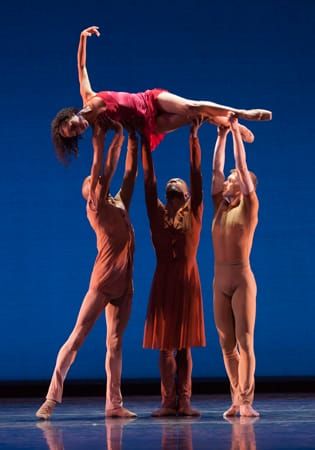
"Agon", "Coming Together", "In the Mirror of Her Mind", "Return"
Dance Theatre of Harlem
City Center
New York, NY
April 10, 2015
The Dance Theatre of Harlem returned to City Center with a smaller company (18 dancers) than the one led by Arthur Mitchell (who, of course, graced the City Center stage with New York City Ballet for years). The new company, rapturously received by the audience, looked strong, happy and stylish, adjectives which unfortunately could not be applied to all the ballets, despite the applause they received. Balanchine's "Agon" (set by Richard Tanner), is certainly strong and stylish and DTH gave it a casual elegance and electric energy. There was no "I am dancing a masterpiece and mustn't make a mistake" hesitation in any of the dancers, who all approached it with a fearless joy.
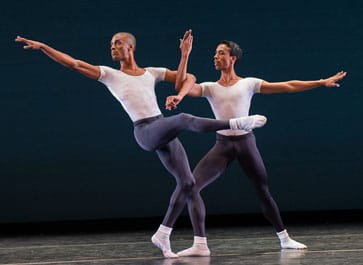
Wilson's Sarabande was limpid and fluid, a cousin to "The Four Temperament's" Phlegmatic (Balanchine choreographed both for Todd Bollender, a dancer with modern roots). Chyrstyn Fentroy sailed through the difficult balances of the Bransle Double with astringent wit, acknowledging her partners with a brief triumphant and endearing smile before resuming her high-fashion strut; I have always loved that little chink in the fourth wall, which seems to have been lost of most other versions.
The pas de deux, danced by Emiko Flanagan and Frederick Davis, is a challenge for any pair to make fresh, since its off-center, high-kicking moves have become something of a cliche. Much of its original impassive mystery, where the woman seems to be moved into those shapes by some outside power, has turned into a somewhat overheated romp, as if the woman were a modern Black Swan. DTH avoided this overtly seductive interpretation; Flanagan was somewhat kittenish, with a sweet and warm presence, which, though lacking in mystery, had its own distinctive charm. Davis was a supportive partner with an impressive ability to galvanize the audience just standing still.
Nacho Duato's "Coming Together" had no still moments. Set to the repetitive, insistent music of Frederick Rzewski, overlaid with a spoken text (eight sentences from a letter by Sam Melville, a prisoner who later died in the Attica riot) the movement tumbled on and on, as the dancers hurled themselves energetically through what seemed to be a unending aerobic workout, broken up by incomprehensible props--a soccer ball, a gold plate, and hand-held lights. The dancers gave it their all and the audience ate up the energy but nothing really seemed to come together.
"In the Mirror of Her Mind", by Christopher Huggins to music by Henryk Górecki, was a more emotionally involving work featuring Ashley Murphy's memories of three men (Da'Von Doane, Anthony Savoy and Samuel Wilson). It was by turns lyrical and impassioned; at times almost overly so (Murphy burst into audible sobs at the end) but the dancers, especially Murphy, were compelling.
Robert Garland's "Return", to songs by James Brown and Aretha Franklin, is a pop ballet, and most successful when it ignored ballet and let the dancers relax (double tours and turns a la second, no matter how elegantly done, don't match James Brown).
The women, led by Jenelle Figgins, danced with an innocent swagger, and even the butt-wagging moves and slightly tawdry costumes didn't look vulgar. It seemed as if they were just winking to the audience. Da'Von Doane, in "Superbad", was the hero of the piece, exuding an energetic and all-encompassing joy as he boogied his way through the rhythm.
This warmth and generosity, even in less than perfect works, combined with an engaged energy, seems to be the hallmark of the revived company, and certainly the audience approved.
copyright © 2025 by Mary Cargill



