Here's Looking at You
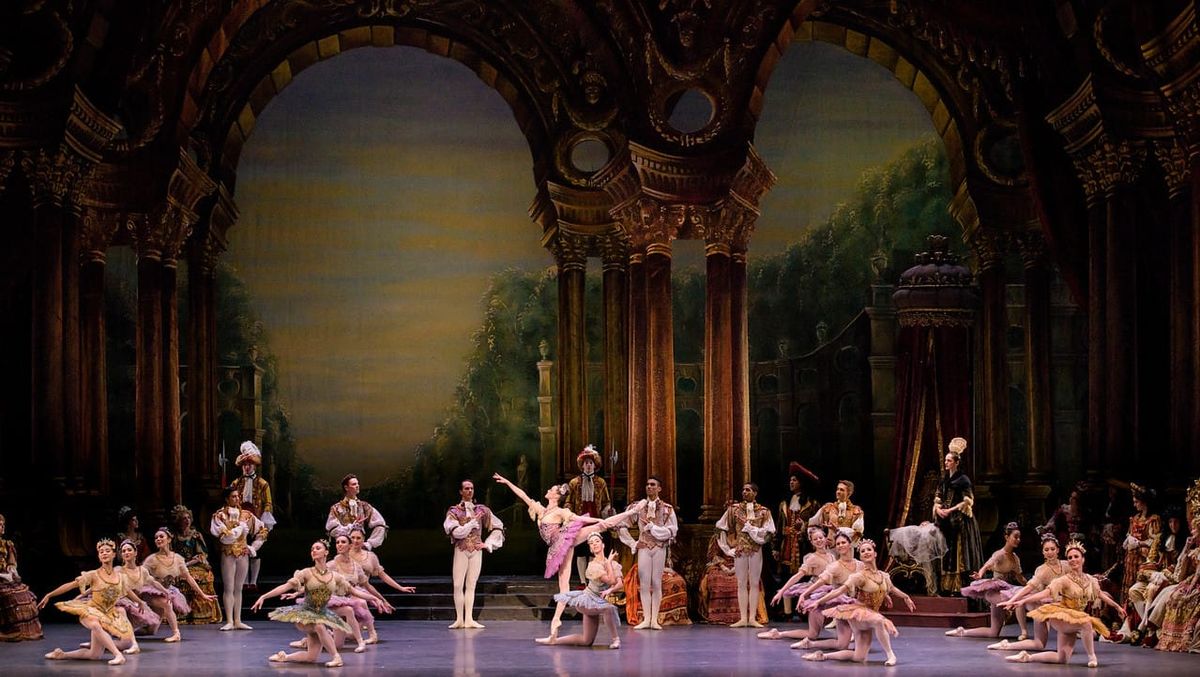
"The Sleeping Beauty"
Boston Ballet
Boston Opera House
Boston, Massachusetts
May 6, 2017, matinee
Boston Ballet's production of Petipa's "The Sleeping Beauty" has a distinguished pedigree. The company acquired the 1977 Ninette de Valois version for the Royal Ballet; de Valois had danced in the famous 1921 Diaghilev version based on the Mariinsky original and she had produced versions for the Royal Ballet in 1938 and 1946 using Nicholas Sergeyev notations of the Mariinsky production. De Valois, however, did not produce a detailed recreation of the original choreography but rather a version informed by it with additions by various hands, notably Sir Frederick Ashton. Petipa would, I expect, be the last person to object since he spent a great deal of his life revising other choreographers' works, most famously "Giselle" whose current wilis (courtesy of Petipa) would be strangers to 1841 Paris. The most important question in not "Is it original?", but "Does it work?" and Boston's version works very well.
The Boston dancers certainly looked comfortable in the rigorous, precise, and musical choreography. The stagers were not credited, unfortunately, but they should be saluted. The dancers, especially the corps, were notably light and delicate, making their dancing quiet and otherworldly. (The production has a lot of demi pointe, which shows off their expressive feet very well.) They didn't strain for big effects or stretch the shapes out of proportion. But more impressively, their dancing was not just about style, it had purpose, as each dancer reacted to each other, acknowledging the royal family; I loved the way the good fairies hovered around the cradle with a delicate fervor to protect Aurora.
The sets (by David Walker) were painted flats with an airy perspective extending the horizon and combining architectural detail with plenty of space for dancing, a true fairy tale illustration come to life. The costumes (again by Walker) had elegant details, though they were a bit pale, possibly as a reaction to the one it replaced. (This production was preceded by a short-lived, quite garish one which, rumor had it, was so vulgar that Sol Hurok refused to bring it to the US I saw it and rumor was right.)
De Valois kept the sublime architecture of Petipa's Prologue. The fairies, most of the corps members, danced with a gracious aplomb, acknowledging the court and their partners. Dawn Atkins as the Crystal Fountain fairy (the first one – de Valois went back to the magical 1946 names) was especially elegant, and Sarah Wroth as the Golden Vine fairy (the fifth, finger-pointing one) avoided the frequently seen go-for-broke attack and curved and softened her arms to make what can be over-emphatic jabbing into gentle grace notes. Rachel Buriassi was a fine Lilac Fairy, negotiating the Italian fouettés calmly and using her face and upper body so powerfully in the dramatic mime scene where she contracts Carabosse's curse. (She didn't get a wand though, for some reason.)
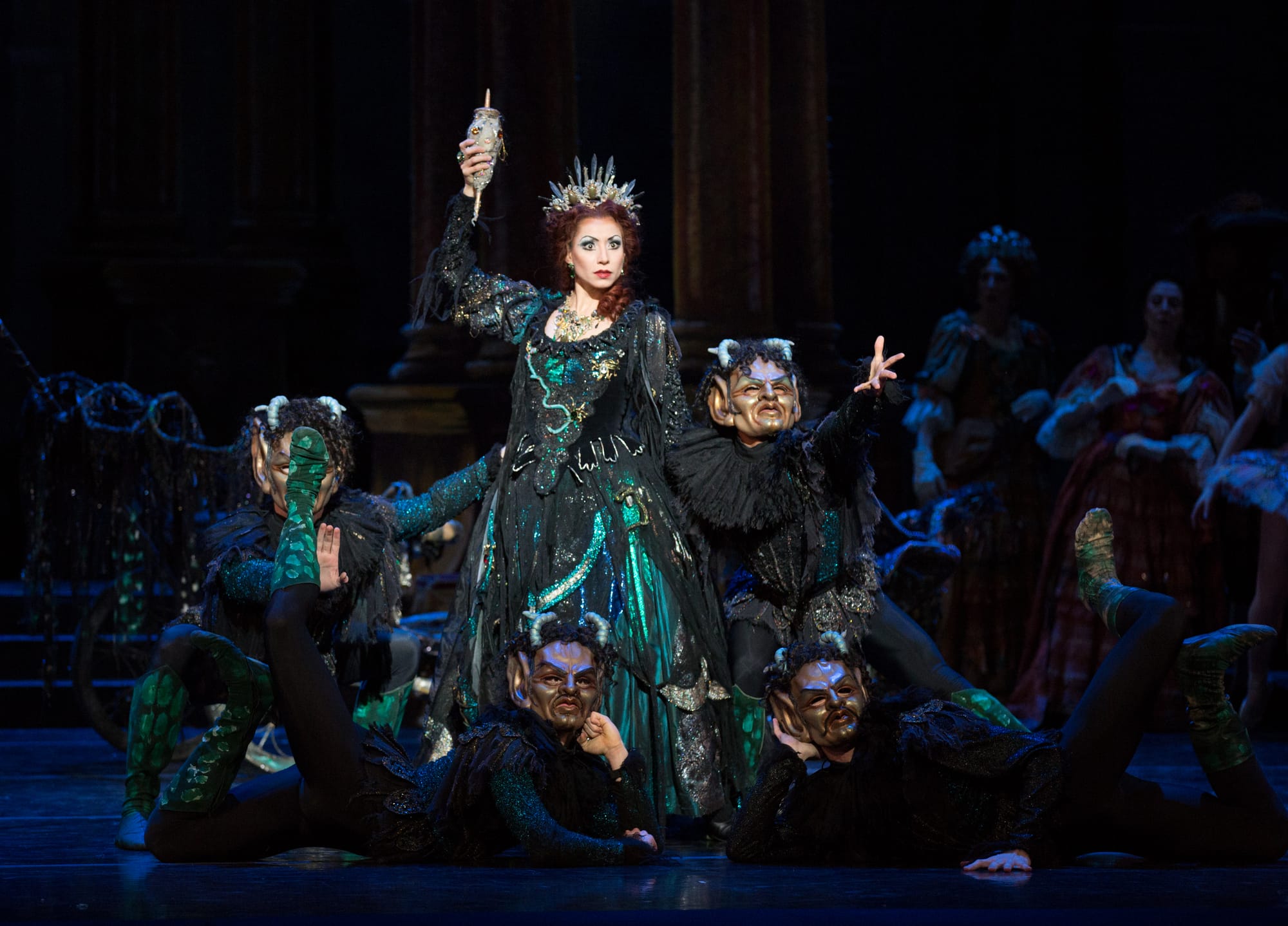
Erica Cornejo made Carabosse a glittering outraged tornado. I did miss the smirking sarcasm that some other Carabosses season their anger with, and Cornejo didn't rip off Catalabutte's wig and feed it to her creatures, but her mime was clear and vivid.
The Aurora, Ji Young Chae, had a bit of a white-knuckle Rose Adagio and was concentrating so hard that she couldn't include the princes, but she held those balances with a delicate triumphant finish. Once they were over, her Aurora was joyful and detailed. I loved the way she phrased the three diagonal jumps with rond de jambes in her Act I solo; she started with low jumps and built the height so that it seemed if the stage were larger she would have flown off. This arc is so much more impressive than treating them as if they were broad jumps where the highest one wins and helps show her growing confidence. She gave her solo a crystalline purity and had the ability to hold a pose so that she looked like she was inside the music. This was radiantly evident in her vision scene where she made the reverse développés into a continuous ribbon. (This production uses Ashton's glorious vision scene.)
It also included the languorous solo for Désiré which Ashton choreographed in 1968 for Anthony Dowell. Patrick Yocum danced it securely (there are lots of little changes in direction) and it suits his elegant line. For me, though, the hyper-romantic melancholy of the solo doesn't fit the formal classical restraint of the rest of the ballet.
The third act had some classical Ashton with the flowing pas de trois that he choreographed to the jewel fairy music for a man and two women (sometimes called Florestan and his sisters, but named or not, it is sublime). The man and two women combination brought some variety to all those female fairy variations and the brief male variation (danced with a smooth, juicy elegance by Irlan Silva) has Ashton's characteristic musical inevitability -- once seen, nothing else fits that music so well. Daly Parrondo sparkled through the Petipa Silver Fairy variation and Diana Albrecht danced the rarely heard 5/4 Sapphire variation which Ashton choreographed for Georgina Parkinson She had a wonderful snap, showing off the unexpected rhythms of the music, and, though she didn't have all the contrast between the sharp jump and the melting arms that Parkinson had, it was an elegant performance.
Maria Baranova and Mamuka Kikalishvili were stylish Bluebirds (those soft Boston feet were especially lovely) and Kikalishvili had a soft and powerful jump. The coda, with its fast footwork, was a bit subdued but the shapes were clear. The final pas de deux for Aurora and Désiré was also impressively shaped, elegantly danced, and most importantly, truly alive. It was a private conversation with steps, full of eloquent little pauses and lingering glances that never looked studied or artificial. The fish dives were fearless (Yocum did need two hands for the first one, but recovered and the next two were confident singles, a feat not always achieved by many more famous princes). The slow, expansive arabesque after the bravura had a special poetry, as Chae slowly lowered herself with complete confidence. Boston Ballet obviously has complete confidence in its dancers, as, with the exception of Cornejo, all were soloists or corps members, and this confidence was more than justified.
Copyright © 2017 by Mary Cargill



