Here Comes the Sun
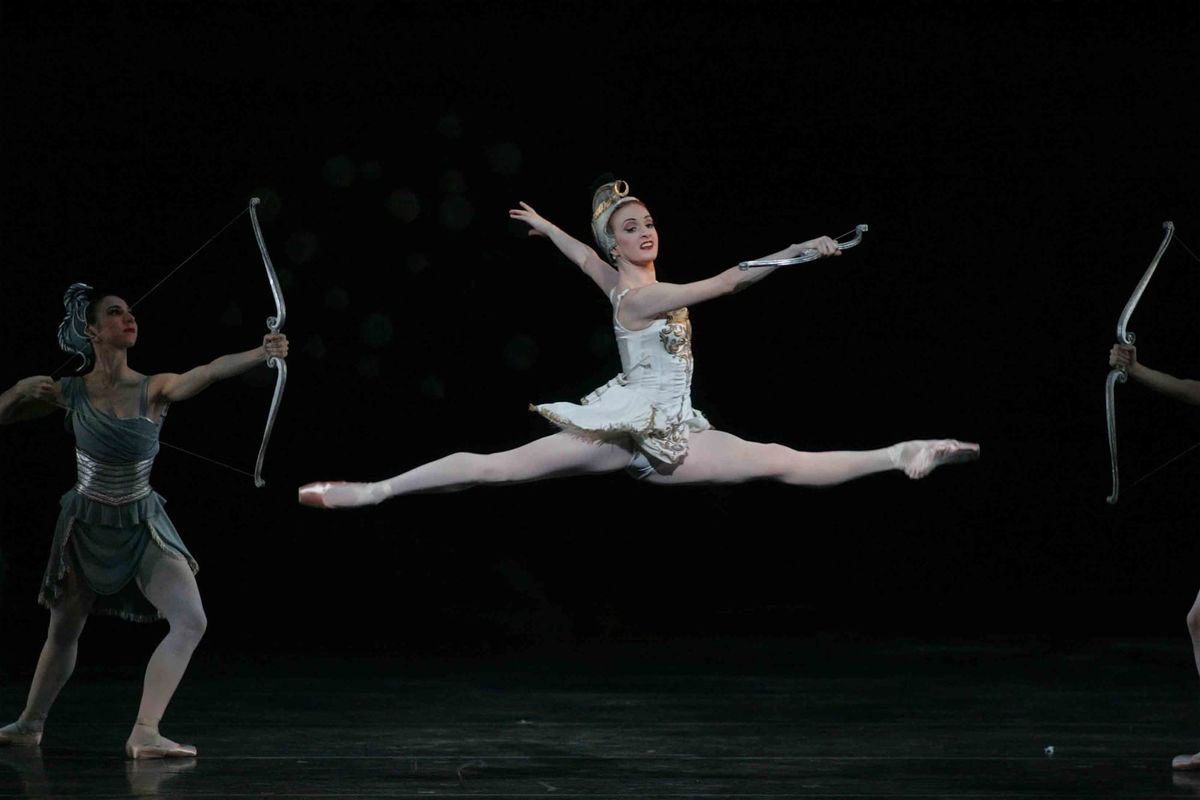
"Sylvia"
American Ballet Theatre
Metropolitan Opera House
New York, New York
June 24, 2013
Michael Mayer, the director of the new "Rigoletto" at the Met, explained his decision to set the opera in 1950's Las Vegas by saying "It gives the audience a chance to recognize these people in a way that doesn't require a giant imaginative leap. I'm not totaly sure where Manuta is in Italy, it's not one of those beautiful places I've visited." Fortunately, Ashton's "Sylvia" shows far more respect for the music, the story, and the audience, as he set his ballet firmly in Arcadia, a place I am sure he nor the audience ever visited. And so far no one at ABT seems to be worried that Endymion, Ceres, and Persephone might be Greek to Today's Audience. "Sylvia" is multi-layered; a 21st century revival of a 20th century ballet, set to a 19th century score for a ballet based on a 1573 poem by Torquato Tasso, "Aminta", set in an idealized classical Greece. But, as in "The Sleeping Beauty", the 18th century, with its belief in harmony and reason and the essential beneficence of nature, also illuminates the work; both heroes have only to trust in a diety to be rewarded. To modern eyes, this can make both heros look rather passive (so many versions of "The Sleeping Beauty" try, all unsuccessfully, to beef up the Prince's role and give him something to do, rather than just trusting in his essence). But there is a rare and unusual beauty in the idea that goodness must prevail in the natural order of things, and the audience has only to reach out to be taken into this world, a world where the effortless and innocent nobility of both Désiré and Aminta can be transcendent. Though the stories are very different, the same suns shines on both works.
The sun, the moon, and the stars were all out for ABT's opening night performance, led by Gillian Murphy and Marcelo Gomes. Murphy was commanding in the opening "I am woman, hear me roar" jumps, and with her defiant gestures, made her disdain for the god Eros clear. Her fellow huntresses were cast from strength (most were soloists) and sailed through the difficult choreography--turning fouettes in unison while holding a bow over your head can't be easy. She conveyed Sylvia's changing moods very well, and used her eyes so beautifully as the smitten victim of Eros's arrow bourréing back on stage to find Aminta's body.
She danced the seduction scene in Orion's cave with a delicate touch--this was not a pole dancing exhibition, and it took a whole lot of acting to convince the audience that life in a cave with Cory Stearns and all his jewels was a Bad Thing. But she managed, and her desperate plea to Eros to save her was tear-inducingly eloquent. The final triumphant pas de deux is one of Ashton's most musical, and quite difficult, with the quick changes of direction and fast footwork of Sylvia's pizzicato variation. Murphy's shoes don't allow her feet all the flexibility the little prancing steps need, but her jumps were sharp and clear. The flying fish-dives into the waiting Aminta's arms were fearless and flawless, but the moment afterwards, when Aminta gently pulls her head into his cradling arms were for me, even more breathtaking, an absolutely beautiful moment of perfect trust and harmony.
Gomes, with his forthright, dramatic dancing, is probably more temperamentally suited to Orion, but his Aminta was a model combination of restraint and urgency from his first yearning solo, begging Eros for help. His dancing in the final solo an explosion of pure joy, beautifully modulated. I especially remember his series of jumps across the stage, each one getting bigger until he seemed to fly, so much more effective than going for everything at once. And the final pose, as he seemed to morph into a Greek statue, timeless and enduring, was one of the most beautiful moments I have ever seen in a ballet.
The supporting cast was equally fine. Cory Stearns could have been a bit more menacing lurking on the bridge in the first act, but he was elegantly threatening during the orgy scene, and his lunge ro summon Diana was full of passion. The role of Eros has enormous challenges, not least having to stand completely still for about twenty minutes, and all that body paint is probably no fun. Daniil Simkin can stand with the best of them, and caught all of the little god's varied characteristics. He seemed to change physically from prancing, jokey scamp to the generous, forgiving, powerful god, letting his upper body expand into a truly noble being. The walk down the grotto steps carrying the torch to light Syliva's way home created a magnificent symbol of generosity, and his defeat of Diana, as he conjured up her lost love, was the incarnation of love triumphant.
Kristi Boone, with her fierce, expressive eyes, made the most of Diana's brief scene, remembering her lost love for Endymion, so essential for the underlying seriousness of the ballet. As in "The Sleeping Beauty", the final pas de deux is the choreographic high point, but the ballet continues; the moral high light in the Petipa ballet is the crowining of Aurora and Désiré, symbolic of the restoration of peace and order, while "Sylvia" ends with Diana bowing to the overwhelming power of love, sending the audience out walking a little taller and a little more hopeful. The dance of Orion's slaves (Grant DeLong and Arron Scott) is not crucial to the story at all (other than allowing Sylvia time to change into her hoochie-koochie outfit), but it is one of the friskiest, most enjoyable dances of the ballet, and that is saying a lot, since the sun shines on every minute of it.
copyright © 2013 by Mary Cargill



