Hedda, Get a Gun
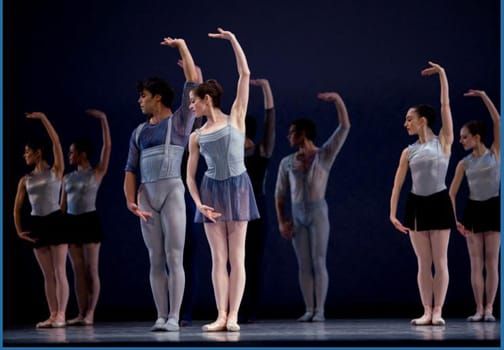
"On a Theme of Paganini", "Ibsen's House", and "Double Evil"
San Francisco Ballet
City Center
New York, NY
October 14, 2008
Program C of the company's brief visit were three New York premieres, showcasing the many new ballets created for the company's 75th anniversary. As new choreography tends to go nowadays, the dancers were great. The director Helgi Tomasson's new ballet "On a Theme of Paganini" to music by Sergei Rachmaninov, opened the program, and showcased the company's many strengths. The male dancers, especially, looked uniformly stylish, with neat, compact jumps, elegant upper bodies, and a gracious, slightly retiring demeanor, not coincidentally, I expect, the characteristics that defined Tomasson himself. The work itself was pleasant, but somewhat predictable; loud music=jumps, tinkly music=turns, and slow music=lifts, and the steps were both decorous and finicky. The three men, Joan Boada, Pascal Molat, and Davit Karapetyan, jumped cleanly but to little purpose. They jumped around two women, Maria Kochetkova and Vanessa Zahorian, who wore slightly different costumes, but did basically the same steps in unison. Kochetkova, though, did stand out in her solo, playing with the phrasing and making the choreography look almost musical.
Val Caniparoli's "Ibsen's House" tried to condense five of Ibsen's heroines into one ballet to some pretty music by Dvorak. Antony Tudor could probably have translated Ibsen successfully, but I expect he would have known what to choose. Five glum heroines, all apparently with very bad headaches and differentiated only by the color of their dresses, each danced the same solo, and then were joined by even less specific men, who had to do innumerable turns while wearing long frock coats. There was no subtlety, no nuance, no ambiguity, basically no Ibsen. He did avoid the obvious cliche of the dancer known as Nora shutting a door, but long before it was over, I was hoping that Hedda would put everyone out of their misery.
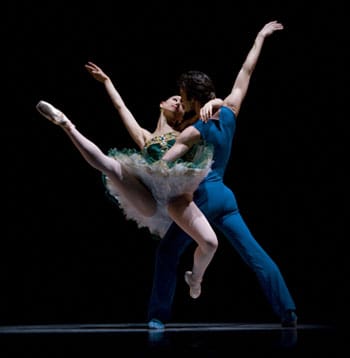
Jorma Elo's "Double Evil" (the title was irritatingly obscure, since there were eight dancers and no evil to speak of) was essentially the same ballet other companies have brought, but danced in lovely tutus by Holly Hynes. The men wore turquoise instead of the usual black leotards. But the choreography was his usual series of tics. To their credit, the dancers didn't seem capable of the sullen aggression of his typical work, and danced with a deadpan quirkiness. But it seemed like such a waste of fine dancers. Ballet is a living art, and does need new work, but instead of something green, the dancers got a bunch of artificial Forsythia, which wasn't fair to them or to the audience.
Copyright 2008 © by Mary Cargill




