Heart and Brain on Same Wavelength
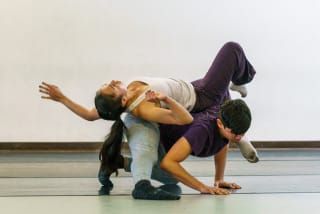
"Speaking Ill of the Dead" "Trapdoors/Trickbags/Painted Corners (Excerpt),
"Lucifer's Prance" "Bootstrap Tales"
Robert Moses' Kin
Yerba Buena Center for the Arts
San Francisco, CA
February 25, 2018
During the twenty-three years of creating for his Robert Moses’ Kin company, the former Twyla Tharp/ODC Dance ensemble member has embedded formally demanding works into contexts that might range from fairy tales to American and African American history, families of whatever denomination, world peace to the horrors of war. Moses’ remarkable career has been particularly noteworthy for the constant change of perspectives – both formal and emotional – with which he keeps challenging himself. In his most recent creation, “Bootstrap Tales”, presented with three repertory pieces, he is drawing on a Robert Moses initiative to engage foster children in the performing arts through on-site performances and workshops.
“Bootstrap” is edgy, fierce and often makes you hold your breath because of the way these dancers veer towards each other, sometimes despite themselves. Phrases are short and exact. Images of falling and popping up weave throughout the piece. The dancers congregate in small unisons and reach for each other. In one section they engage in a one-on-one ballroom type of social dance. When one woman is given to uncontrollable shaking, other dancers pick up on it. Does she have a communicable disease or a community of support? Moses doesn’t tell.
Perhaps “Bootstrap’s” most stunning choreography was given to the company’s senior women, Norma Fong -- who all evening danced as if she there was no way to stop her -- and Crystaldawn Bell. Fong had engaged a quartet of women in a spiffy individualized circle dance. Next, she emerge upstage alone, pushing her body in every which direction, when the majestic Bell, a good head taller, invited her in a limb on limb pretzel duet that ebbed and flowed like a storm. It’s a mark to Moses’ eye intelligence that these so differently magnificent dancers have developed so beautifully under his tutelage.
The first half of the evening afforded a welcome look at earlier work. “Speaking Ill of The Dead” (2006)is an ensemble piece with a message that no one wants to hear: “we regret to inform you…” While the lines are all too familiar, and Moses and David Worm’s musical (both military and jazz) and verbal score speaks eloquently about loss in wars, Moses also had in mind another war in which freedom, liberty and finally dignity get lost. Perhaps he was listening to the voices of those unheard.
Vincent Chavez both whips and supports Fong and then passes her to a trio of men who raise and lower her like a blanket. But the women get their own as they skip over the domino-like prone men, until Bell gently kicks them back to life. “Speaking” is dark, full of broken connections, jerking arms and legs but finally ends in a double row of dancers into a dark horizon. Maybe they were an image of hope (community?); I couldn’t see it that way.
An excerpt of the 2017 “Trapdoors/Trick bags/Painted Corners” was set to a set of interviews with won and featured Bell as a soloist. Unfortunately, the women voices were difficult to decipher; they seemed to recall challenging moments in their lives. But just having the voices sound so differently was enough to get a sense of how Bell’s liquid yet ever so strong body, with movements that could slide and stretch, leap and turn, responded to the score. Her articulation, speed and sense of containment and command will not easily be forgotten.
The return of the 2000 “Lucifer’s Prance” to an excerpt from Philip Glass’s opera “Akhenaton” uses the music’s propulsive rhythms to utmost effect. From the moment Fong and Vincent Chavez engaged each other’s physical expressiveness of leaping, rolling and interlacing, Moses seemed determined to squeeze out every ounce of chaotic energy – balancing it with stillness – from these formidable dancers. More than anything this kaleidoscopically, pulsating piece of small ensembles that could echo each other, or unisons that became canons, showed how strongly Moses insists on challenging this splendid ensemble with formal demands.
copyright © Rita Felciano 2018



