Happy Birthday
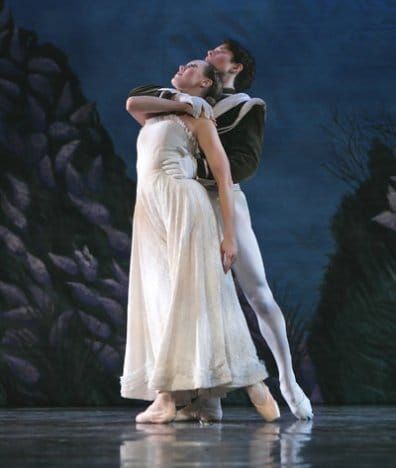
"Suite from Mazurkas", "Jardin aux Lilas", "Little Improvisations", Pas de Deux from Romeo & Juliet", "Judgment of Paris"
New York Theatre Ballet
Florence Gould Hall
New York, NY
April 4, 2008
The enterprising New York Theatre Ballet celebrated two 100-year anniversaries in their recent performance of works by Jose Limon and Antony Tudor. The company has long been known for its dignified revivals of Tudor works (Sallie Wilson, the famous Tudor dancer, has worked extensively with the company), but any excuse to see anything by this great choreographer is welcome.
The evening opened with a rarity, a selection of mazurkas that Jose Limon set to Chopin in 1958, in honor of a successful visit to Poland. It turned out to be an early sighting of the 1970ish piano ballet, with all the now familiar aspects--the piano on stage, hand-behind the head movements, and even a solemn man touching the stage. It was a bit like watching the ur-Dances at a Gathering (it seems quite improbable that Robbins wasn't familiar with it), but even without the anthropological angle, it is a beautiful piece. The four women and three men, in simple black and gray, dance in various combinations, portraying a range of emotions, yet always turning to honor the pianist, Ferdy Tumakaka. The emotions ranged from playful to profound, with a slight sarcastic detour; the mazurka from "Les Sylphides" (much more familiar to audiences in 1958, possibly, than now) was danced by a group of men, leaping to their heart's content. The dancers had a delicate, improvisational style and they conveyed a true sense of community, of dancing with and for each other. It was a very welcome find.
Jardin aux Lilas, or Lilac Garden, is not as rare, though its perfume is hard to recapture. It is more comfortable on the small Florence Gould stage than at City Center, much less the Met, and the performance was quite moving. It is a ballet of loss, Caroline's loss, of course, but also this performance made it clear that The Man She Must Marry (Terence Duncan, who avoided the mustachioed villain approach for a more nuanced though still dominating approach) is also losing some freedom. He is obviously losing Julie-Anne Taylor, as An Episode in his Past, who combined a dignified desperation with a clear-eyed realism; she seemed resigned to a new episode as she made her final exit with the men at the party.
Caroline, Elena Zahlmann, could have possibly shown a bit more strain in her body, but she avoided "acting" with her face and was able to convey feelings and emotions. Rie Ogura, as the sympathetic friend who knows and understands, was able to make so much out of her brief effort to give Caroline and her lover (the young and elegant Kyle Coffman) their private farewell.
Zahlmann and Coffman danced another pair of doomed lovers in a pas des deux from Tudor's one-act "Romeo and Juliet". He choreographed this in 1943, to music by Frederick Delius, a welcome respite from the more bombastic Prokofiev. This was the "nightingale and not the lark" scene, and even out of context, on a bare stage (there was a bed, but nothing else of the reportedly large and expensive Beman sets), this was lyrical, musical, and, like all the Tudor I have seen, had a magical ability to convey meaning through steps. Final pose, with Juliet in arabesque on her knee, perfectly summed up the desperate yearning of the scene.
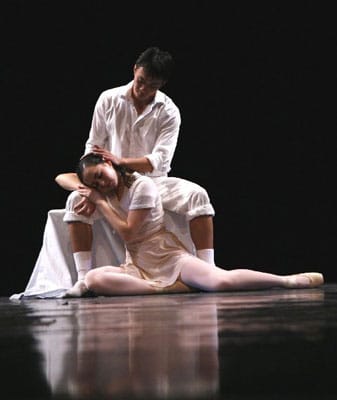
"Little Improvisations", to Schumann, danced by Ogura and Mitchell Kilby, also has two young lovers, but their ending is much happier. It was a gentle, witty Tudor, with a couple playing with a piece of cloth, turning it into a toga for a mock heroic dance for the boy, a baby in swaddling clothes for a tender dance for the girl, a wedding dress, and several other imaginative variations, all so sensitive to the mood of the music that it did seem like the dancers were making it up. It was a little gem.
"Judgment of Paris" is in more familiar Tudor territory, with its over-the-hill prostitutes and drunken anti-hero. His sardonic, dispassionate approach to human weakness is a perfect match for the Kurt Weill music. The prostitutes, Christina Paolucci as Juno, Elena Zahlmann as Venus, and Diana Byer (the director of the company) as Minerva, do their pathetic little dances, which are alternately very funny (the musical accents are perfect) and almost grotesque, without degenerating into caricature. Byer, especially, with her gyrations, is almost triumphant. But there is no "almost" about this triumphant program.
copyright © 2008 by Mary Cargill



