Half Awake
"The Sleeping Beauty"
American Ballet Theatre
Metropolitan Opera House
New York, NY
June 19, 2008
Once upon a time, in far away Russia, there were three brilliant men who loved France and devised a wonderful world based on French ideals of harmony and reason, set in historical periods of the seventeenth and eighteenth centuries. To make the world more real, the composer used melodies and harmonies from those periods, the costume designer based his designs on the same periods, and the choreographer came up with some of the most beautiful configurations ever seen, as a visual metaphor of the power of beauty. But that, as they say, was then. Other lesser men came along through the years with silly ideas, few sillier than the production that ABT offered last year. Many of the more egregious changes have been excised, but until the sublime architecture of Petipa is back (ABT for some reason based its choreography on the 1952 Konstantin Sergeyev mish mash), it is just reupholstering the chairs on the Titanic.
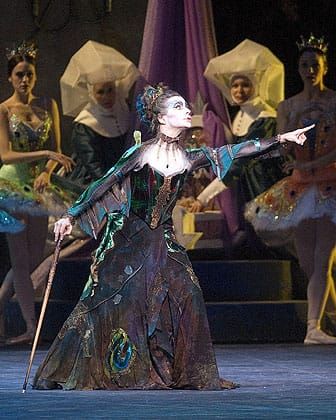
But the more straightforward production does show some of the majestic simplicity of the Petipa original in the performance of Maria Bystrova as Carabosse. She still enters and exits in a Disneyesque burst of fireworks, and is still accompanied by ludicrously colorful bugs, but she isn't tossed around, and has time for her powerful mime scene. Bystrova was magnificent, full of concentrated fury and outraged dignity, and the curse was gripping. Her nemesis, Lilac, was Maria Riccetto, who gave a crisp and efficient performance, adjectives that should never be applied to that most luxurious and radiant of roles. The poor fairies are still hoisted on to the scene like so many bags of flour, and still don't get to dance a proper Prologue, but the Songbird Fairy (here misnamed the Fairy of Joy) doesn't impose herself quite as much. Melanie Hamrick, as the first fairy, had an especially lovely line.
Sarah Lane and Herman Cornejo made their respective debuts as Aurora and her Prince. Lane, a pretty, petite dancer, who seemed to have no fear, nailed the balances, and didn't try to over hold them, so that she could slowly offer her hand to the next prince (whose costumes have fortunately been redesigned, and the purple feather boa has apparently been sent off to the Hall of Shame). She should realize, though, that three incomplete pirouettes to music with room for two is not a pretty sight. Nor is the constant shifting and posing of Aurora's friends behind the Rose Adagio, but that is one "improvement" that has remained. The "river of tears" that poor Susan Jaffe had to produce as the warm and noble Queen, though, has gone, and Aurora's parents no long get turfed out of the castle.
Prince Désiré also does not have to drink from the river and sleep in the fog, but he still has to make his entrance to the overture, jumping around with a bunch of men presumably auditioning for Etudes. This makes a mockery of the the dignified loneliness that Petipa and Tchaikovsky so carefully set up. He still doesn't get to see a vision of Aurora, just that tatty castle in the distance, but at least the vision scene is in its proper place, even if it doesn't have the poetic choreography of more familiar versions. Cornejo, despite his comparatively small frame, was able to give the poor Prince weight and dignity.
The final act still takes place in the tacky blue setting, with the courtiers in their unflattering white duds, which make them look like rejects from a meringue factory. A reasonable facsimile of Petipa's Jewel Fairy choreography has been added for the Prologue fairies, which needed to be danced with more precision, cohesion, and style than they showed. The Blue Birds, though, Gennadi Saveliev and Yuriko Kajiya, were sparkling. Saveliev didn't have all the beats that some (like Cornejo himself) have managed, but he didn't try to push too hard, and Kajiya was elegant, precise, and utterly charming. Cornejo, in his final solo, came into his own, and his impeccable tours and precise landings seemed to be a metaphor for complete perfection. If only he had a better Beauty to dance in.
copyright © 2008 by Mary Cargill



