Half a Loaf
"Raymonda, Act 3", "Paquita, Grand Pas", La Bayadere, Act 3"
Kirov Ballet
New York City Center
New York, NY
April 1, 2008
A reduced contingent of the Kirov danced on the inconvenient and unfamiliar City Center stage offering outtakes of three of Petipa's wonderful ballets; not the ideal way to judge a company's artistic strength.
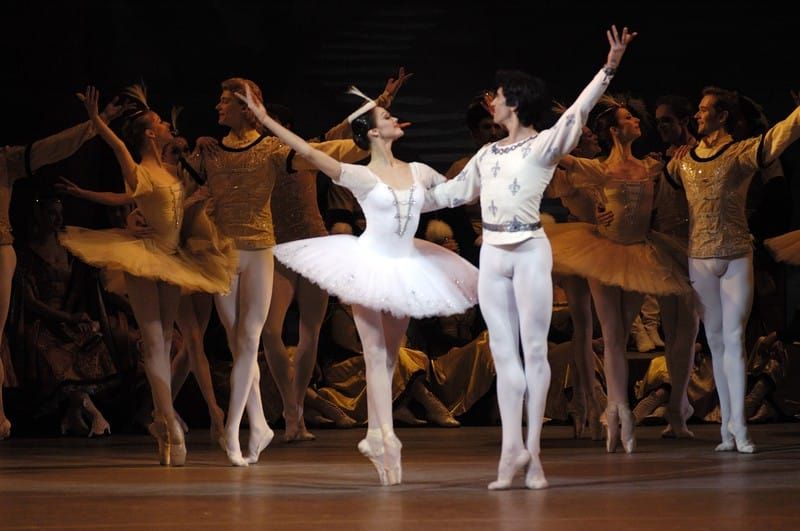
But the opening scence of "Raymonda", with the magnificent Vladimir Ponomarev summoning the dancers with a majectic sweep of his arm, promised much. And how wonderful it was to see the Kirov walk, as only they can, in their heeled boots, and dance their mazurka and their czardas with a melodic flair and confident grace. Alisa Sokolova, with Andrey Yakovlev, leading the czardas, especially, were a reminder of how a great choreographer can develop and embellish simple steps into an increacingly exciting climax. The conviction, and unfamiliar, to Western eyes, epaulment of the corps guaranteed after the first 10 minutes that whatever happened, the visit would be an artistic joy.
What happened, however, was that Uliana Lopatkina danced Raymonda's variation with a pristine and radiant presence. She is not perhaps, at first glance, a natural classicist, with her long, rangy body, but her control, her complete lack of mannerisms, her inner joy made true majesty seem as natural as a walk around the block. I do miss the folk-influenced claps of Petipa's brilliant distillation of Hungarian folk dancing in the solo. Frederick Franklin, who worked with Alexandra Danilova (who knew the original pre-Soviet version) on a revival, says that there were real claps, not the vague hand washing gestures that the Russians do, and certainly Balanchine (whose version so closely matches the Petipa choreography) has his ballerinas clap voluptuously, but this is only a minor complaint compared with Lopatkina's radiance.
The grand finale of Raymonda was followed by the grand finale of "Paquita", substituting Spain for Hungary. And how Petipa loved the Spanish rhythms, and how delicately the Kirov corps dance on their demi-points; the "Paquita" corps, with the demi-soloist "sequin girls" (after their most noticeable attribute) set a wonderful stage. "Paquita" is a feast of solos, among whom the soulful Ekaterina Kondaurova and the sunny Ekaterina Osmolkina stood out. Diana Vishneva danced the lead; her dancing is familiar to New Yorkers, and she certainly has her fans. I find her technique admirable, but her stage presence a little too knowing, too conscious of the audience to be able to make the stage disappear, as Lopatkina can.
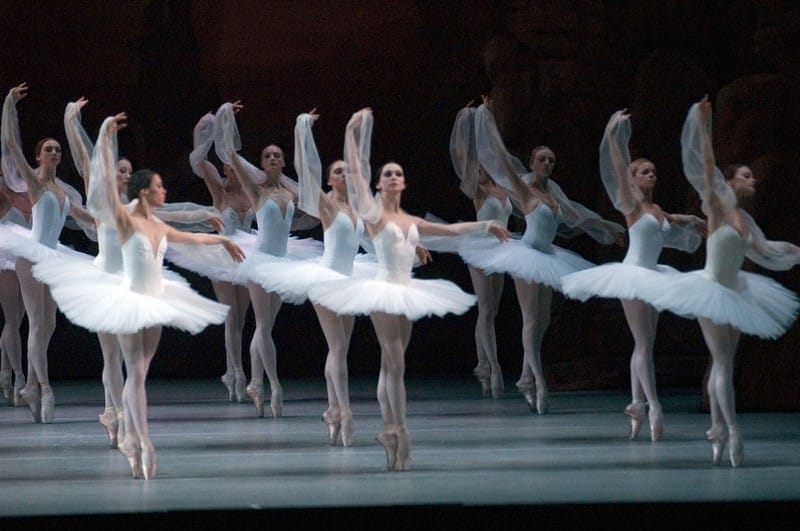
Petipa's choreography for the Shades scene in "La Bayadere" is certainly has that quality, and even with no ramp, no moon, a limited number of shades, and the truncated choreography, time was suspended, and those glorious white visions arabesqued their way to eternity. It is a shame that the Kirov seems to have abandoned its revival of the older, pre-Soviet version, with its wonderful costumes, but Solor was back in his sequined turquoise pajamas. Leonid Sarafanov, one could say, is a dancer born to wear turquoise, and he seemed to be having a ball throwing in as many tricks as he could; in between fancy turns, though, he brought a real urgency and yearning to his dancing.
Unfortunately, the Nikiya, Alina Somova, was not worth the effort. A dance writer really isn't qualified to write about her, since it would probably take an etymologist to understand what seemed to be the mating call of a giant stick insect. She can hike her leg up in preposterously unclassical forms, but there is no strength to hold a position, no shape or musical form to her movements, no interpretation of Nikiya's emotions at all. There wasn't the slightly distant coldness of a ghost, nor the warmth of a soul trying to reach and forgive a faithless lover, just a blank stare and aimless movements. However, the three shades, especially the luxurious Kondaurova, reminded the audience what dancing was.
copyright © 2008 by Mary Cargill



