Hail and Farewell
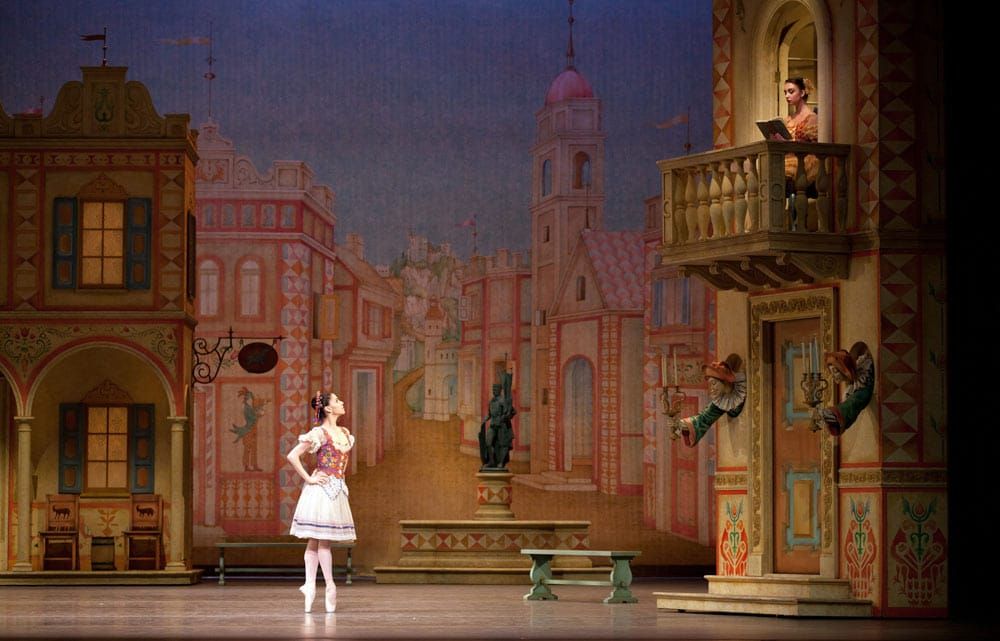
"Coppélia"
American Ballet Theatre
Metropolitan Opera House
New York, New York
July 5, 2014, Matinee and Evening
The final ABT performances this year celebrated (or mourned, as it were) the departure of soloists Yuriko Kajiya (in her debut as Swanilda) and Jared Matthews, who are leaving to join the Houston Ballet. Since Paloma Herrera (Matthew's Swanilda) has announced that she will retire next year, every performance of hers is also a small farewell. Kajiya's Franz was Joseph Gorak, recently promoted to soloist, was also making his debut, and fortunately, he isn't going anywhere, except, I hope, up.
ABT's "Coppélia", staged by the late Freddy Franklin, is a traditional take, with lots of energetic youngsters living in what appears to be a village without adult supervision somewhere between Poland and Hungary (they are equally at home in a mazurka and a czardas). The dark undercurrents of the original Hoffmann story have been scrubbed clean; Franz and his buddies don't even attack Dr. Coppélius (he gets quite roughed up across the Plaza at NYCB), they just seem to ask him politely for some money to go drinking. The poor doctor is played as a doddering old geezer with a funny walk, with few of the eerie "I could dare I say, rule the world" delusions that make the City Ballet's version so rich. ABT has also dropped the metaphorical aspect of the final act, with twelve little girls filling in for the twenty four hours, and only Dawn and Prayer stop by--the Spinner, symbolizing work, is apparently a concept foreign to the rambunctious inhabitants. But there is still the glorious Delibes score, some very pretty choreography, a lot of detailed mime, not to mention the evergreen second act to brighten up anyone's day.
Kajiya, a translucently delicate dancer, was completely winning as Swanilda. As a soloist, her dancing has always been reliable and musical, but this was the first time I had seen her in a leading role, and she conquered the stage with luxurious timing, detailed acting, and unforced charm. There were so many beautiful moments, but I remember especially her balances, where she seemed to stop the music before bringing her arm slowly and generously down to the waiting Franz. She was truly contrite at the end of the second act, when she realized how she had hurt Dr. Coppélius, making the lovely ballet into a gentle moral lesson. She carried this lesson through to the third act, bowing so graciously to the Doctor to ask for forgiveness, and seeming to be transfigured in to final pas de deux--the heedless girl had grown up to be a generous, happy woman, acknowledging both the Burgomaster and Dr.Coppélius in her solo. The woman also had killer turns, as she threw in some unusual and very steady fouettés in her coda.
Herrera, an experienced Swanilda, was more of a scamp, tugging firmly at Coppélia's skirt in the second act to make her pay attention, and shoving the Doctor out of the way to get to Franz. Her dancing in the first act sparkled as she sculpted some beautiful shapes, making the footwork look so easy. Her doll wont to go limp at all the wrong moments, flopping down whenever the doctor thought he had managed his magic. She kept it all deadpan until he activated her soul, when her face lit up, a witty and telling detail. Matthews, unfortunately, had a injured calf, and wasn't able to dance his final solo, so Herrera had to whip up some extra excitement, which she did gloriously, luxuriating in the choreography and playing with the timing. She made the final act Swanilda still an excited young girl, happy with her friends, and thrilled to have Franz all to herself.
Franz is truly one of the least appealing heroes in 19th century ballet; he makes Albrecht seem to be a paragon of consistency and maturity, but comedies are not meant to be taken seriously, and any concerns for his later life (his fondness for drink is a bit worrying, not to mention his cruelty to insects and complete lack of financial stability) are irrelevant. Both Gorak and Matthews gave him charm to burn, thrilled to think that two of the most beautiful women in the village wanted him, and perfectly happy to stomp through a mazurka with any woman available. Gorak's incisive dancing was beautifully controlled, and he seems completely at ease on the stage, reacting to everyone in the village. He matched Kajiya in the final act, seeming to grow up, asking for Dr. Coppélius' forgiveness. He was clearly able to settle down with Swanilda.
Matthews' future was a bit more iffy--he and Herrera seemed more embarrassed by their behavior, and relieved that they were pardoned. His eye might wander a bit, still. Despite his injury, he flew through the coda with a thrilling set of turns, and valiantly gave the audience his very best. They responded with a generous ovation, joined by the dancers on the stage; Kajiya, too, was cheered and surrounded by flowers.
This was their triumph, but there were some very fine supporting roles. The Doctors, Alexei Agoudine in the afternoon, and especially Roman Zhurbin in the evening, made Coppélius a sympathetic crank. Zhurbin's reaction the his magic, as he knelt in awe before Coppélia, gave a hint of the depth he could have. Stella Abrera as the evening's Dawn, was beautifully evocative, calm and serene, and then breaking through to a bright day. Her control was magical, and she seemed to float above the ground as she revolved in arabesque, turning on her flat foot. Zhong-Jing Fang was a warm, generous Prayer. This dancer, who had made an indelible impression years ago as one of the side girls in "Symphonic Variations", was out for several years with a serious injury, and has only recently been dancing soloist roles. She is blessed with a perfect classical body, and Dawn shows off her immaculate arabesque, but her dancing was more than a demonstration of classical beauty, it was as if she were blessing the audience, opening her arms to embrace them, a fitting memorial to the departing dancers.
copyright © 2014 by Mary Cargill



