Graffiti Tango
Tangos Vivos
Rascasuelos
Carnegie Hall
New York, NY
November 2, 2016
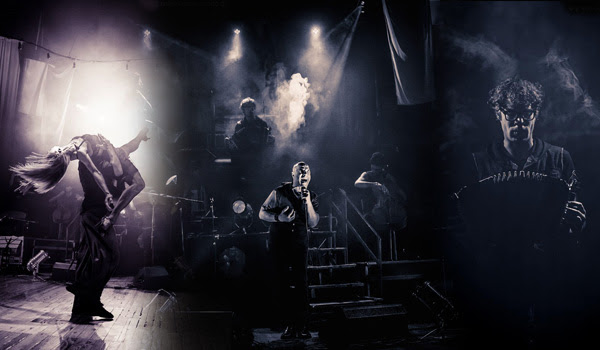
It’s unusual to see dance at Carnegie Hall, but in the context of deconstructing and reimagining the great Astor Piazzolla’s tango music legacy, in a “Rock meets Mozart meets Tango” context, as billed by the program, the chosen space actually worked well. The men behind Rascasuelos, the group bringing the program, musical director and bandoneonista Patricio “Tripa” Bonfiglio and singer Limón García, masterfully delivered their take on reimagined tango, and it would have been difficult to see their vision of their music without the eloquent dancers.
The program, lasting just under two hours, was a conflation of music, song and dance that brought together rock, classicism, and even African-inspired percussions thanks to the guest artist Will Calhoun, all in the context of tango. At times this reimagining felt odd, especially at the very beginning when the tango music was presented by six musicians on classical instruments with all of them jerking and shaking their heads, particularly Bonfiglio on the bandoneon, like rock stars to the music chords’ percussion-like sound. The swift introduction of the two dancing couples, the program’s choreographers Micaela Spina and Manuco Firmani, and dancers Soledad Buss and Cesar Peral, helped place and anchor the musical deviations in tango, even as the dancers took liberties of their own: little time was wasted before the audience saw same-sex partnering and many floor-bound, modern and jazz inspired departures in the steps.
The dancers’ most remarkable achievement was the displayed range of their imagination within this newly defined context. Their dancing told stories: there was a love triangle, a failed relationship, a breathtaking, lyrical duet. The departures from classical tango were commonplace, but even with the most acrobatic of lifts and modern spins on the floor, like the one where one of the men used his hip as the rotational axis, the grounding tango basics like back positioning and the precision of the leg flicks were still there.
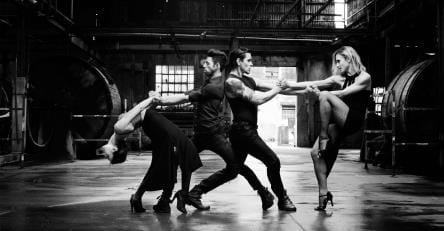
In the dancers’ first appearance, García’s singing combined with the dance to add color and a sense of reality to the performance by resembling a real life milonga – a gathering of live music and tango dancing. Though it was on stage, this tango actually felt almost as free and uninhibited as what one might see at the current-day milongas of Buenos Aires. The dancers performed around García, with traditional and less so steps, sequences where women were dragged along the floor and pulled up passionately, and many perfectly executed lifts that showed the training and refinement of these performers.
Later in the show the structure got looser. The costumes sometimes were just tops with leggings and skirts or shorts and knee pads for women and combat pants for men, and the steps were equally freer. In one dance to erratic piano music, a woman stood on the side of the stage looking away as her partner came over to wrap her in his arms and the dance as well, frequently lifting her off the floor, with the most interesting passage being when facing away from him her knees gently lifted to her chest, suggesting both intimacy and distance. After some minutes of this great dancing and seemingly growing chemistry, the duet ended, and he walked away, leaving her once again standing alone to the piano music. In contrast to this, a more classical, lyrical duet by Buss and Peral to piano and cello almost had hints of ballet in the lingering and rotating lifts with rondes de jambe and some arabesque positioning. There was tenderness in more than just the broader movements, like in the moment when he held her close, as though whispering in her ear.
The signing was all but completely absent from these and other dances after the initial scene, but as the program went on the separation made sense, as it allowed for the expression of tango music to be more focused, its nuances more apparent. The purely musical and vocal parts of the program were just as rich in expression, and some moments, like a song at the beginning of Act 2 when García stood alone in the middle of the stage singing about “azul de cielo” – the blue of the sky – with arms wrapped around the air in front of him, as if holding a partner, left lasting impressions. There was a common thread weaving throughout the night, with the performers using the tango to paint their stories, in different colors and styles, and with differing intensity.
copyright © 2016 by Marianne Adams



