Gracious Living
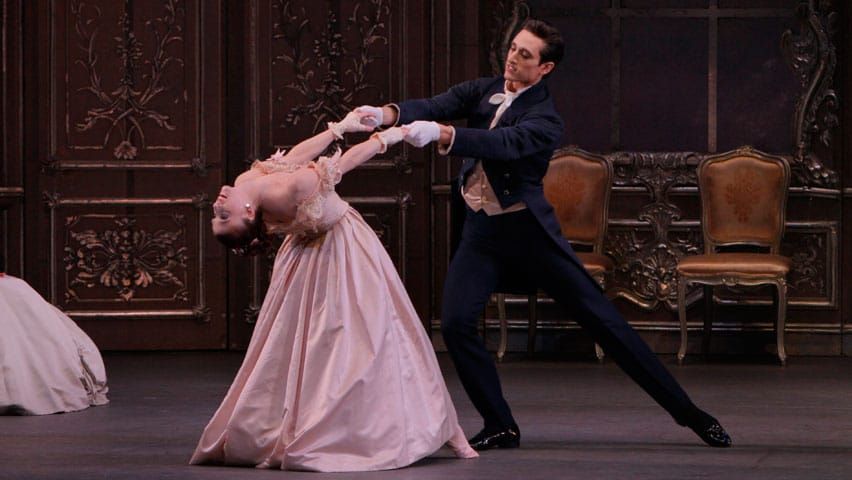
"Liebeslieder Walzer", "Tschaikovsky Suite No. 3"
New York City Ballet
David H. Koch Theater
New York, NY
October 1, 2015
For its first non-gala program of the Fall New York City Ballet honored Balanchine, and its audience, with two of the choreo- grapher's most potent works: "Liebeslieder Walzer" and "Tschaikovsky Suite No. 3". "Liebeslieder Walzer" is an ensemble piece which works only when all four couples (Sterling Hyltin and Jared Angle, Ashley Laracey and Justin Peck, Sara Mearns and Ask la Cour, and Jennie Somogyi and Tyler Angle) create a unified, harmonious, civilized nineteenth-century world. The program doesn't list the coach, unfortunately, but the performance was rich, nuanced and captivating; though the ballet never gets a raucous ovation, its gentle candlelight aura lingered.
The four couples have distinctive personalities though they can vary with different casts. Mearns gave the Diana Adams role, often danced as a youthful romantic swoon, an unusual undertone of hesitancy, pulling back a bit from her partner and making the little fluttering kicks seem like a plea for freedom; she seemed to have found Odette in the role. She made a convincing case for this approach, unexpected though it was.
Hyltin and Jared Angle were the more conventional lovers, seeming to echo each other's thoughts. I missed the intense musicality that Wendy Whelan gave the role, but Hyltin had a gentle dignity of her own.
Laracey, in her debut, danced the Jillana role. She used her fragile beauty and long, delicately expansive line to suggest a young woman with a hidden sorrow, looking away from her partner as if she wanted to see someone else; she was elegant, subtle and persuasive. Somogyi, too, in the Verdy role, was hiding a secret and the pas de deux, where she seemed to lie in the grave, was heartbreaking. Somogyi has always been an eloquent and incisive dancer – few can give a backbend such nuance, – but her injury-haunted career is coming to an end. As I watched her float through the second act looking only at Tyler Angle in what seemed a gentle farewell, so many memories of earlier performances came back. Yes, there were too few of them, but it is better to remember what was than to regret what might have been.
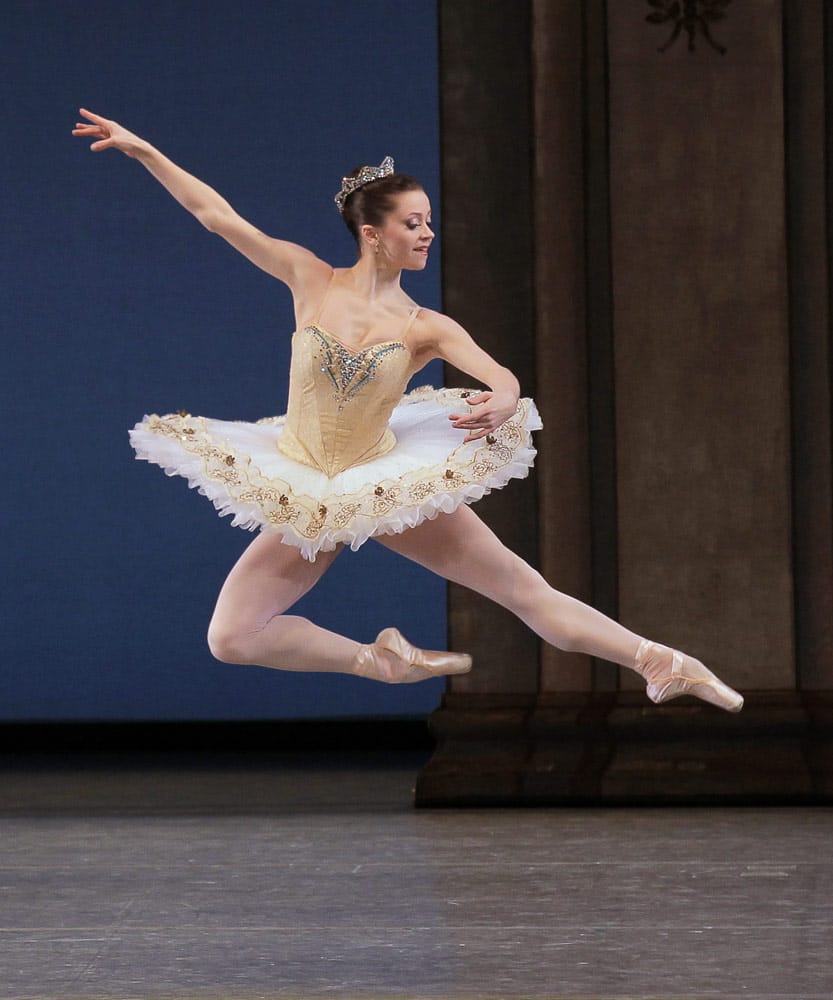
The opening movements of "Tschaikovsky Suite No. 3" are drenched in what might have been, full of Romanitc yearning. Russell Janzen was an eloquent poet in the opening "Élégie", combining a noble carriate with an almost raw vulnerability. Teresa Reichlin was a bit cool as his elusive beloved, pulling away at times as if she were a Giselle who couldn't really forgive Albrecht. The contrast between them was gripping and the push and pull had real bite.
The "Tema con Variazoni", Balanchine's abbreviation of "The Sleeping Beauty", could have used a bit more contrast, as the main couple, Megan Fairchild and Joaquin de Luz are about the same height, so Fairchild looked much was taller than de Luz when on pointe; the smoldering pas de deux, where the man hovers so protectively behind the ballerina, had little impact.
De Luz, a fearless technician, is also a subtle and dignified dancer and understands that at times less is more. He controlled his power to flow effortlessly (apparently) and stylishly through his solo and combined noble generosity with impeccable double tours.
Fairchild, a scrupulous dancer, sailed through the fast footwork but her upper body seemed a bit pinched, and I missed the sence of communication, of secrets being shared with her partner. They seemed like good-natured pals rather than Petipa's royalty. But the gracious architecture of the choreograpy makes this an enchanting place to visit at any time.
copyright © 2015 by Mary Cargill



