Good Friends
Roberto Bolle and Friends Gala
City Center
New York, New York
September 17, 2012
2013 is, apparently, the Year of Italian Culture in the United States, and to help celebrate this, the Italian Roberto Bolle brought his magnificent presence, along with some dancer friends, for a one-night performance of various solos and pas de deux. This was not your usual gala-fodder (with the exception of "The Dying Swan") since most of the dances were unfamiliar. Unfortunately, most of them deservedly so, but the dancers were generally first rate.
There were few overtly Italian works, though the evening opened with what purported to be a pas de deux from the long-lost "Excelsior", a 19th century extravaganza celebrating, among other things, building the tunnel under Mont-Cenis. The pas de deux, credited to Ugo Dell-Ara after the original choreographer Luigi Manzotti, featured Bolle and the Russian Alina Somova, and looked a bit like a combination of the famous "Corsaire" pas de deux and the equally athletic "Diana and Acteon". Bolle ran around in his skimpies, bare-chested and pantherine, while Somova flung herself through a series of fouettes with enthusiastic vulgarity.
Two Stuttgart principals, Alicia Amatriain and Jason Reilly, danced John Cranko's "Romeo and Juliet" balcony scene, which could be considered Italian, I guess, since it is set in Verona. (Oddly the program attributed the Prokofiev score to Eric Gauthier and Jens-Peter Abele). Amatriain is a lovely, lush dancer who gave the steps an interesting touch of shyness, with just hints of the passion to come. There was plenty of passion in Twyla Tharp's "Sinatra Suite" (danced by ABT's Herman Cornejo and Luciana Paris), which since Old Blue Eyes had Italian parents, could be part of Italian Culture. Herman Cornejo's innate lyricism echoed the mellow singing, and Paris had a leggy energy, but for me the dancing and the singing runs in parallel lines, both strong on their own, but not merging into something greater.
"Jeunehomme", a pas de deux by Uwe Scholz to Mozart, did not add anything to the music. It was a black on black affair, strongly danced by Elisa Carrillo Cabrera and Mikhail Kaniskin from the Staatsballett Berlin. The choreography meandered gently and forgettably on top of the music to no great effect, though Cabrera looked lovely with the black neckband evoking one of Degas' little dancers.
"Le Grand Pas de Duex", to Rossini, showed the choreographer Christian Spuck channeling the Trocks, as Amatriain, in glasses, seemed more interested in her little red purse than in Bolle's hunky partnering. Bolle, shirtless, also appeared in an excerpt from Roland Petit's "L'Arlesienne", with the petite Italian charmer Erika Gaudenzi. There was no synposis, so Bolle's descent into what appears to be insanity made little sense, though it was certainly theatrical. Bigonzetti's "Kazimir's Colours", to Shostakovich, with Cabrera and Kaniskin, unofrtunately, was not, and the dancers did more meandering in black; they made the push and pull look as interesting as possible, and would certainly be welcome in more vibrant choreography.
Balanchine's "Tchaikovsky Pas De Deux" is certainly interesting, well-crafted and exhilerating. Cornejo danced with the San Francisco Ballet principal Maria Kochetkova, a small power-house. The complex, champagne-flavored musicality and the insouciant timing of the difficult steps do not appear to be the Bolshoi-trained Kocketkova's native tongue though her dancing was scrupulous and precise. Cornejo bounded joyfully. "Mona Lisa", by Itzik Galli, with Amatriain and Reilly, had no bounding, joyful or otherwise. It was a scratchy, vulgar exhibition of female anatomy, with Amatriain spreading her legs at every opportunity, which she did with verve.
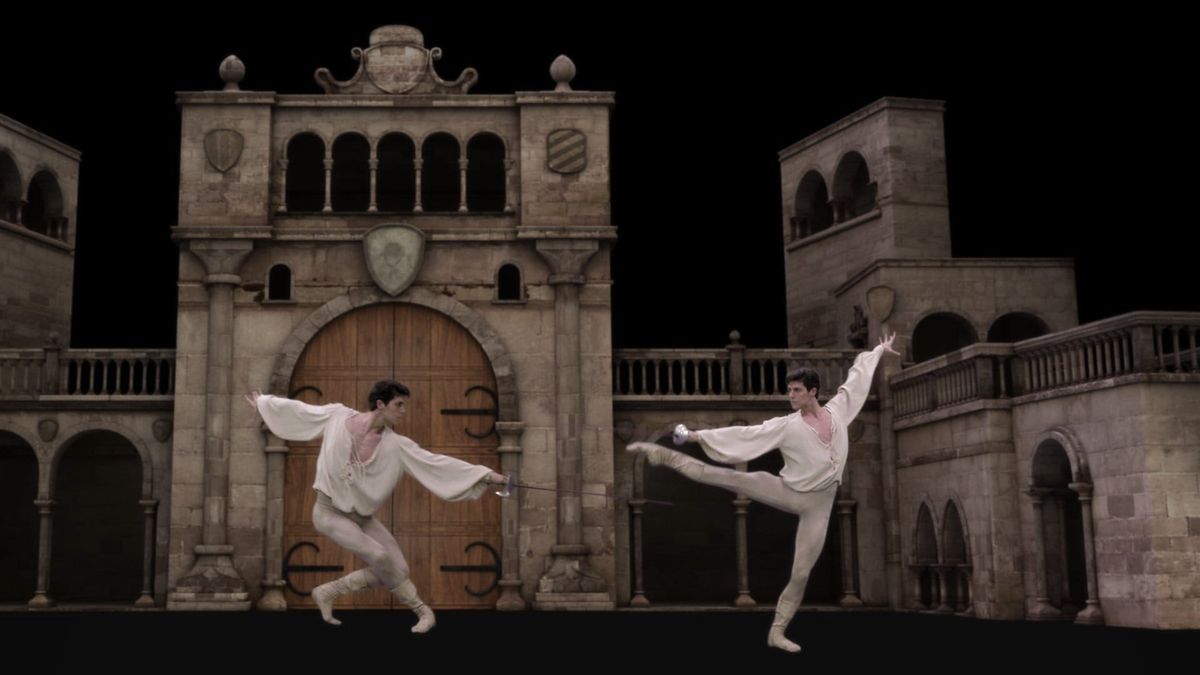
The final two dances were solos. Somova had her way with "The Dying Swan". Her youthful vigor was appealing, but she didn't have the elegiac magic that more romantic dancers bring. Bolle danced the final solo, a multimedia extravaganza called "Prototype", conceived (choreographed just doesn't cover it) by Massimiliano Volpini. Bolle danced with himself as the filmed scenery blended into some of his familiar roles, and eventually exploding into a magical light show, where he seemed to be juggling with the stars. It ended with multiple Bolles mutating on screen, almost as if he wanted to give everyone in the audience a souvenier. There was no feeling of arrogance or of vanity, just a sort of innocent generosity, as if his fantastic good looks and perfect body were something he wanted to share. And it was certainly generous of him to show off so many dancers.
copyright © 2013 by Mary Cargill



