Golden Oldies
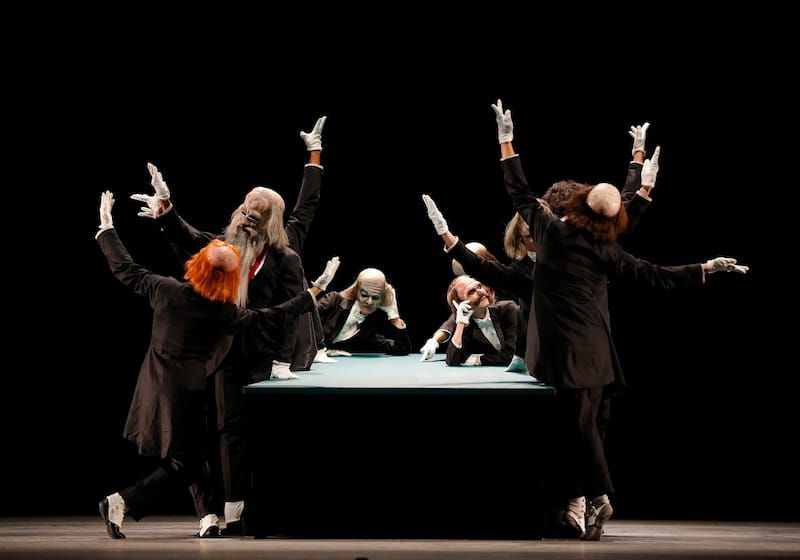
“Les Sylphides”, “Apollo”, “The Green Table”
American Ballet Theater
New York City Center
New York, NY
November 2, 2005
ABT gave a rock solid program to a rock solid audience (the season has been selling very well) on Wednesday night. Although each of these ballets is an acknowledged masterpiece with a capital “M”, the performances didn’t look precious or fragile, they looked alive.
None more so than Ethan Stiefel’s “Apollo”. Last year, the Guggenheim’s invaluable Works and Process series included a session with Peter Martins coaching Stiefel in “Apollo”. The insights were fascinating and generous—Martins insisted that Balanchine saw his god as a demi-caractère role, not the effortless perfection that Martins couldn’t help but convey. Martins stressed the wild, free, passionate angle, the unclassical feet forward, no classical turnout, position. The Balanchine Apollo that Martins described had an awkward, raw youthfulness that blazed through Stiefel’s performance from the very beginning. His birth scene was an off center struggle, until he could sense the handmaidens entry with the lute; his eyes had an unusual urgency. This was an emotionally, as well as a spiritually, developed performance. His first solo seemed to be about missing something, about an uncertain, almost desperate searching. All of the metaphors that Martins talked about were there—kicking the soccer ball, dancing on hot coals, the dramatic flash of the Piccadilly lights.
Unfortunately, his Terpsichore, Paloma Herrera, didn’t equal his dramatic urgency. She didn’t have the natural authority of the best Terpsichore’s, and her movements, whether fast or slow, seemed to be given the same somewhat placid accent. Gillian Murphy’s Polyhymnia, in fact, seemed to be the goddess for Stiefel, and her molten gold presence and carefree turns sparkled. Maria Riccetto was also effective as Calliope.
Riccetto, indeed, had a busy evening, since she was the lead sylph in the opening “Les Sylphides”. She is much better cast in the quicksilver Balanchine roles than in Fokine’s gentle ballet. She is a strong but brittle dancer, with large but effortful jumps—she made quite a clump in the mazurka; it is not the actual height of the jumps that Fokine needs, it is the effect, and a sylph that looks like she is in a broad jump competition lacks the necessary magic.
Maxim Beloserkovsky, the poet, certainly had the necessary magic—he is having a wonderful season. He danced with a delicate urgency, almost caressing each gesture. The iconic moment, when the sylph whispers in his ear, was so beautifully done. He lifted his arm, hesitated just a moment, as if to let the message register, and then reached out to infinity. Anna Liceica, dancing the waltz, had the same inner romanticism. She has one of the most mysteriously beautiful and irresistible faces on the stage today and she made the waltz a mournful poem. Kristi Boone is a more down to earth dancer, but her arms are especially lovely. Her prelude was very feminine without being finicky.
The evening closed with Kurt Jooss’ 1932 “The Green Table”. This was the first time I had actually seen it, and a note in the program credits funds from the New York State Council of the Arts; it made me look forward to paying state taxes. It has been described as an anti-war ballet, as a protest statement, but it both more and less. Protests tend to be hopeful—just change and everything will be fine, they shout. There was no hope in this piece, and no anger, just despair. Like Nijinska’s "Les Noces," it is both of its time and timeless. The German Expressionist style, with stark and generalized emotion rather than subtlety or characters, black and white, with no shades of grey, make its period instantly recognizable, but the emotions are timeless.
It opens with the green table, surrounded by a group of striped pants diplomats, dancing a grotesque pavane. The music, by F. A. Cohen, has a light irony here, and the opening is almost funny. Then the scene shifts to the various aspects of war, dominated by the figure of Death, a black and white skeleton, with a stylized Roman helmet and tunic, prefiguring in a horrible way, the Third Reich’s use of classical imagery. David Hallberg was magnificent. He had weight combined with a classically beautiful form, making Death seem almost perfectly inevitable; never has fifth position looked so frightening.
As in the medieval Totentanz, which partially inspired Jooss, many types of people encounter Death, the young and the old, the innocent and the venal, and Jooss illustrates their stories in a series of vignettes. Two soldiers fight over a flag, one wins, but both die. A woman, Carmen Corella, dancing like a scream in red, laments and dies. A profiteer, Carlos Lopez, romps through the destruction, taking whatever he can, including a young girl, whom he forces into a brothel. The choreography is always clear, but never sensationalized—we know what is happening to the girl, but we see only her horror and helplessness, not the tawdry details. Death claims her too, as well as the profiteer, and finally all the victims are led around the stage by Death, like ghosts from the trenches of 1918.
The final scene repeats the opening prancing movements, but now the consequences of the diplomatic greed and stupidity are too dire for laughter and too grim for hope. It is one endless cycle of despair and we can only witness it and remember.
copyright ©2005 by Mary Cargill



