Golden Oldies
"Raymonda Divertissements", "Jardin aux Lilas", "Fancy Free"
American Ballet Theatre
David H. Koch Theater
New York, NY
October 23, 2014
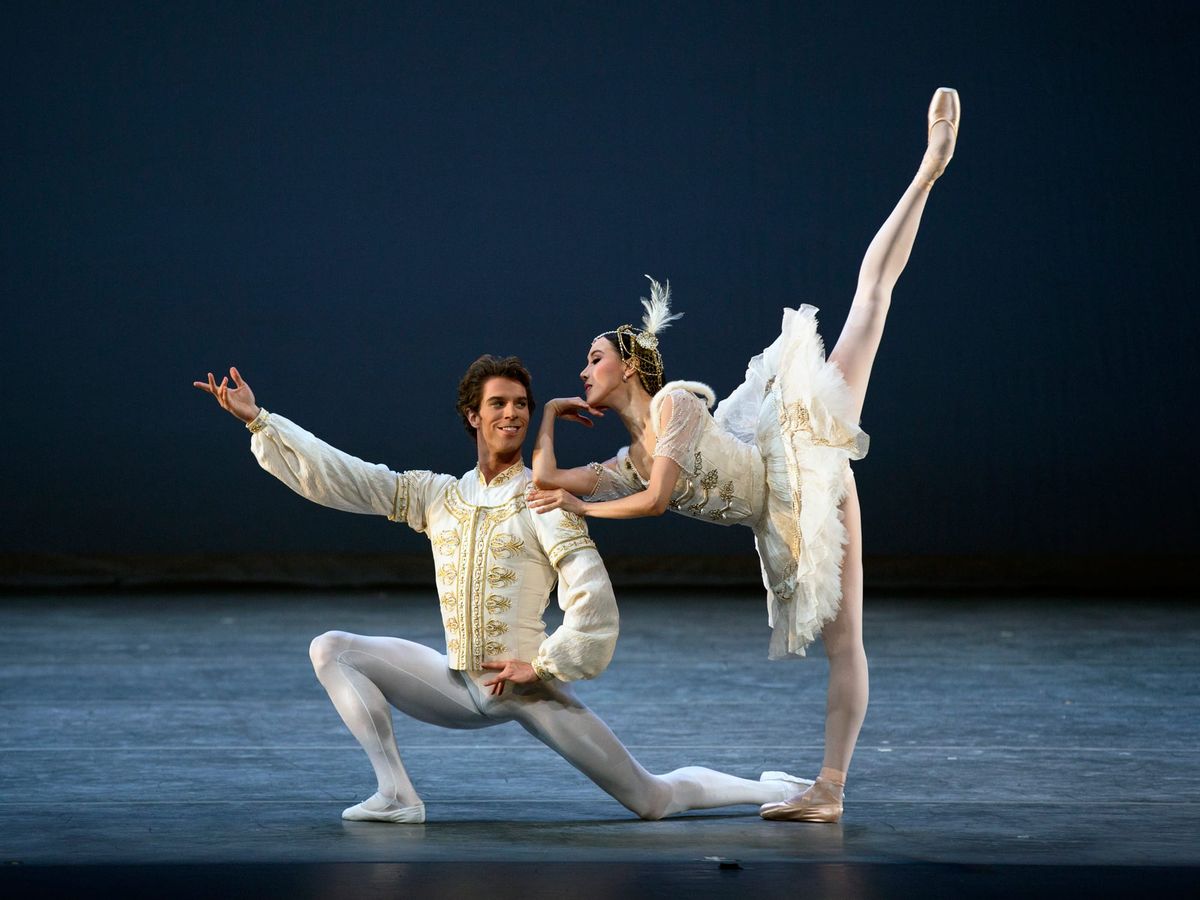
ABT opened its regular season with a fine triple bill, a set of ballets in contrasting styles. The so-called premiere was a collection of Petipa dances to the Galzunov music for "Raymonda" curated by the former Kirov ballerina Irina Kolpakova. There was nothing really new in the choreography--this is not a criticism, since the Petipa (or what we recognize as Petipa) suits the music so perfectly. The "Raymonda" score is one of the most melodic, danceable and luxurious collections of ballet music ever written. It originally was attached to a somewhat obscure and rather undramatic story, which companies, in their search for full-length blockbusters, keep trying to punch up. ABT tried a version a few years ago, but basically "Raymonda" works best as a suite of dances and producers just need to reach into the Petipa/Glazunov trunk and pull out any assorted jewels to create a beautiful necklace. ABT's newest version has pulled out many of the classical jewels from "Raymonda's" final act which celebrated the marriage of our heros with a Hungarian flavor. (One of the guests was the historical King Andrew II of Hungary, which was all the excuse Petipa needed to add some paprika.) The folk dances stayed in the trunk, and so, unfortunately, did any kind of setting, so the dancers had to create their own castles.
Hee Seo led the festivities. The famous solo, one of Petipa's final and greatest homages to femininity, was a bit decorous; to clap or not to clap seemed a bit up in the air, as sometimes she gave her hands a polite smack and other times just an indication, though she never gave the sense (as some modern Raymondas do) of just wiping something icky off her hands. The simple steps, mainly bourrées, showed off her beautiful feet and her slightly illusive presence gave the solo a private, contemplative feel, and she danced with a pearl-like lustre.
Her consort (formerly known as Jean de Brienne) was James Whiteside. He was a gracious and confident partner, but his dancing, while enthusiastic, was a bit forced and strained; it isn't how high a dancer actually jumps, it is how easy he makes it look. The famous male pas de quatre (danced by Sterling Baca, Thomas Forster, Alexandre Hammoudi, and Sung Woo Han) with its tricky timing could have used more rehearsal, and by the end the double tours seemed to have minds of their own, but the opening had a stirring panache.
The female variations were very well danced. Misty Copeland and Sarah Lane danced a sparkling duet; Lane especially stood out for her gracious upper body. Skylar Brandt and Christine Shevchenko danced individual variations. Brandt, a dancer of porcelain and steel, combined delicacy with an engagingly open upper body. Shevchenko sailed through her difficult variation, all controlled turns and hops on point, looking as if she enjoyed it as much as the audience.
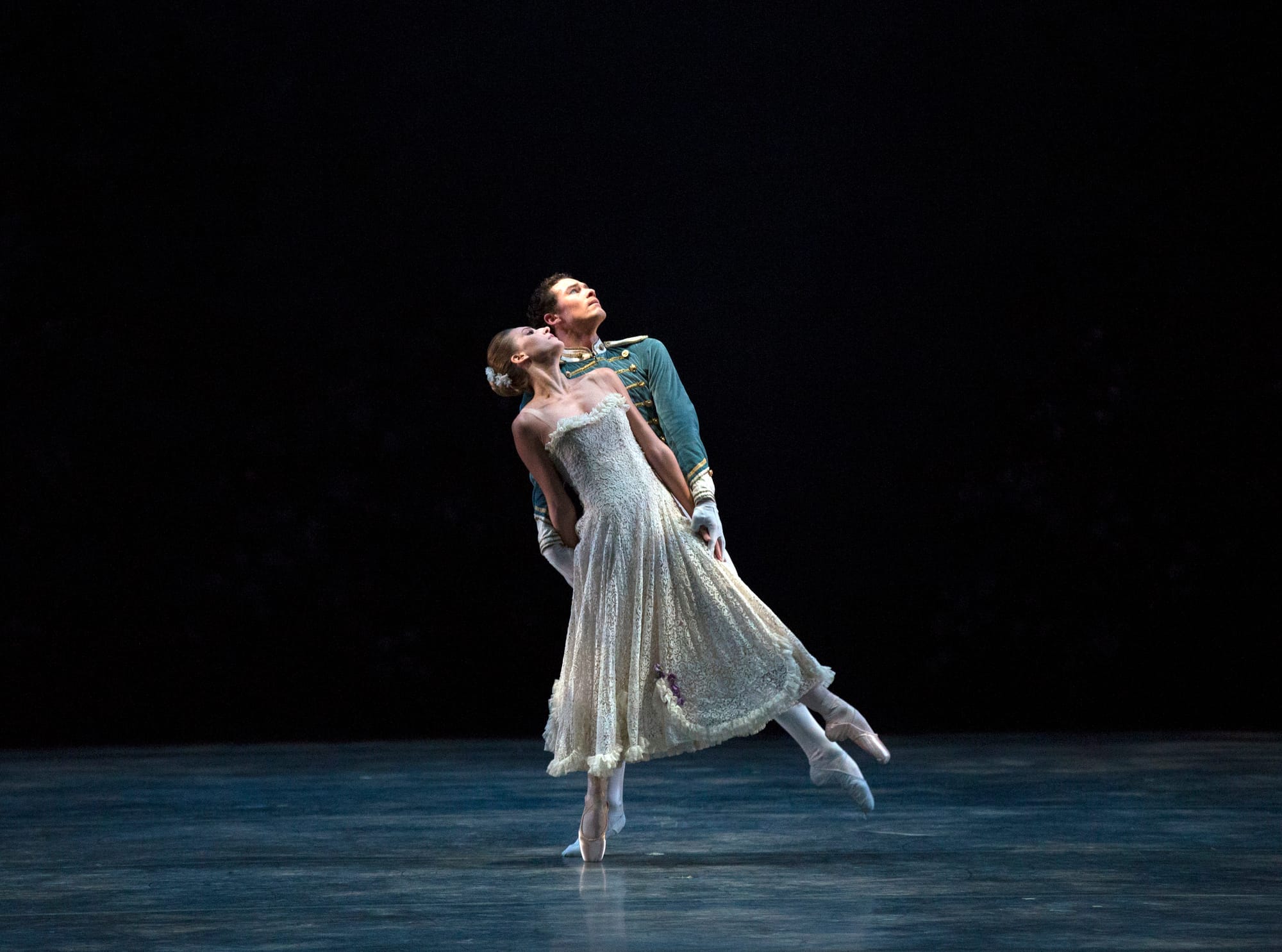
In 2007 Shevchenko danced "An Episode in His Past" in the ABT Studio production of Antony Tudor's "Jardin aux Lilas"; Devon Teuscher was Caroline. Teuscher made her ABT debut as the oppressed girl, with Roman Zhurbin as "The Man She Must Marry", Veronika Part as "An Episode", and Cory Stearns as "Her Lover". In 2007, Teuscher was technically fine, though the hidden emotions remained by and large hidden. She is often cast in strong roles--she was a majestic Myrtha, and her Caroline now used that strength to create a complex woman, not a fragile heroine under everyone's control. This strength gave her dancing an interesting dimension and the audience could imagine how she had fought against her fate and feel her final, dignified but still rebellious resignation.
Zhurbin, one of ABT's finest actors, was stiff and hard as her future husband, but moved thorugh the group with a slight awkwardness, as if he knew he did not quite fit in; he was an unsympathetic, but not a melodramatic villian, and his heavy, prosaic movements, the outward manifestation of his inner being made Caroline's misery more believable. This passionate, loving woman was going to be yoked to this unsympathetic, callous man, when she needed love. Sterns was magnificent as the Lover, reticent and proper when surrounded by the other guests, but letting his misery pour out through his dancing in his solo.
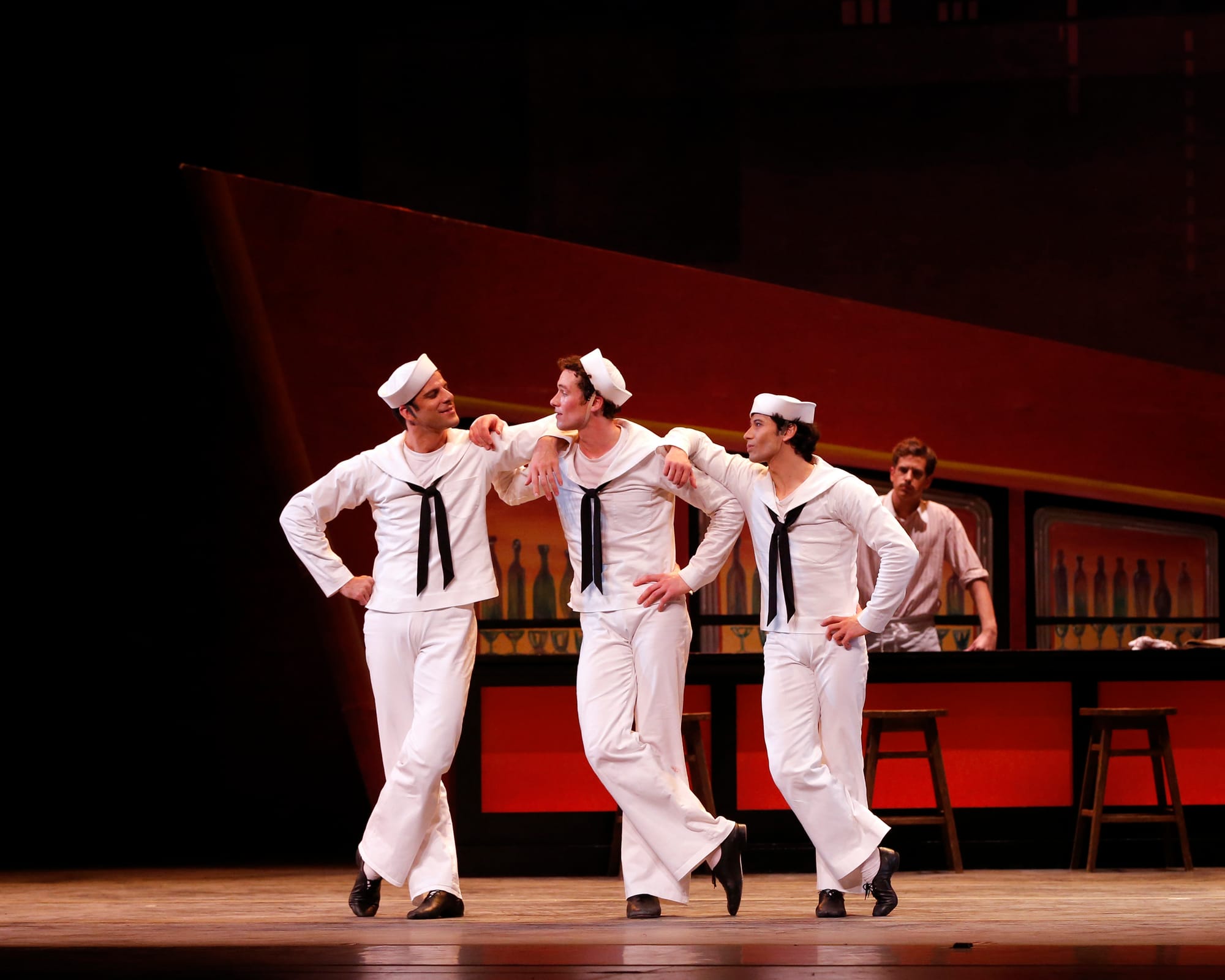
Stearns got to wear another uniform in "Fancy Free". He changed far more than his uniform, as his movements changed from the stylized, formal dignity of Tudor to the looser, natural gait of Robbins' sailors. He made each style speak clearly in its own language. He danced the middle, shyer sailor, and the pas de deux (with Julie Kent as a slightly sardonic, wannabe sophisticate) was all innocent, barely articulate desire without ever pretending to be a lasting romance.
His buddies were Herman Cornejo as the feisty bantam cock and Marcelo Gomes as the lady-killer rumba king. They danced with a friendly spontaneity and youthful bravado that gave a gentle bitter-sweet tinge to the ballet as those boys and their chewing gum were headed for war. "Fancy Free", like "Jardin aux Lilas", is anchored by its setting, but the emotions are timeless, as these performances proved.
copyright © 2014 by Mary Cargill



