Golden Boy
"Le Corsaire"
American Ballet Theatre
Metropolitan Opera House
New York, NY
July 2, 2012
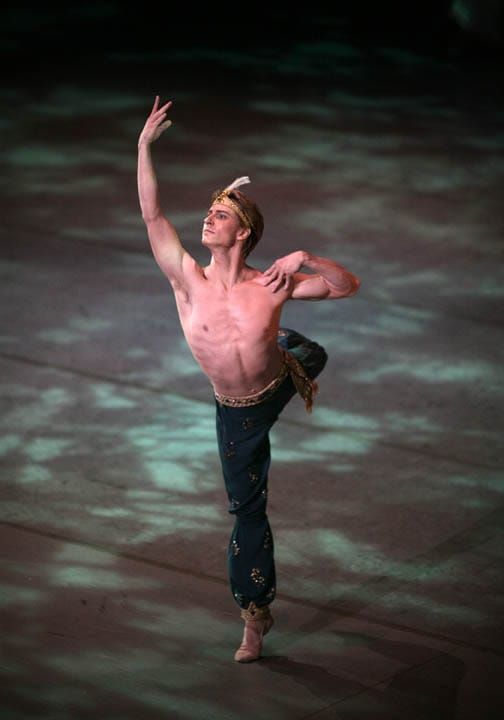
ABT premiered its version of the Petipa/various hands "Le Corsaire" in 1998; its pirates and pashas owe more to Gilbert and Sullivan than to Byron and it was great fun then, and it is great fun now. Ethan Stiefel was Conrad, the pirate king, in the second performance, and among the corps were Gillian Murphy, Marcelo Gomes, and Stella Abrera. These three were among the leads as Stiefel gave the first of his final two performances at ABT as Ali, the loyal slave to Conrad, who gets the turquoise harem pants and one of the most famous men's solos in ballet. Stiefel, one of ABT'smost exciting men (and that is saying a lot), has been curtailing his dancing for the past few seasons, due to injuries, and these two Alis were his only roles this season, so the audience was packed with Stiefel afficianados. He looked incredibly youthful, and danced the solo with the clarity and sharpness of old, with beautiful, soft landings, and some extra hops in the turns a la seconde.
The rest of the cast was certainly on their game, with Marcelo Gomes as Conrad, Gillian Murphy as his beloved Medora, Stella Abrera as her buddy Gulnare, Craig Salstein as the traitorous Birbanto, and Sascha Radetsky as the cowardly Lankendem. Conrad doesn't have much to do--Petipa's hero was the old stand-and-look-noble type, and his choreography was added later, by lesser hands, and consists of jumping, and miming "well, here we are in the middle of the square, so lets dance". But Gomes, just this side of a cartoon, made him lively and fun, and his partnering was noble and generous. Medora gets a number of solos, and Murphy was scintillating. She has always been a scrupulous dancer, clear and sharp, but this season she seems much warmer, opening her face to the audience, without any arch over-acting. She was playful with the Pasha, ardent with Conrad, and whipped off some killer fouettes, throwing in triples and bringing her arms up in a perfect en courant shape seemingly at will.
Stella Abrera is a bit tall for Gulnare's little flicks and kicks and delicate changes of direction, but she got the gentle pathos of her solo (which apparently lasts until she can rip of some glorious turns, after which she cheers up.) Craig Salstein gave Bribanto a weight and a brooding menace that the rather generic choreography denies him. (If ever there was music that said "mime scene", it is his.) And Sarah Lane, as one of the odalisques, gave her solo a beautiful, fluttery accent. The most unforgettable section of the ballet, the Jardin Anime, with its luscious Delibes music, may be utterly extraneous to the convoluted plot, but is one of the most beautiful of abstract ballets, and is always welcome.
But the audience really wanted to cheer Stiefel, to thank him for so many fine performances. His open-hearted, direct performance style seemed so fresh, and I especially remember his shy sailor in "Fancy Free", with his slightly awkward braggadocio, and his "Apollo", with his brashness tamed by art. He was elegant in abstract roles, as well, and was so effortlessly gracious as the partner in Balanchine's "Allegro Brilliante". There are so many other memories--the unbelievably handsome Solor, his heart breaking in the last act, and the remorseful Albrecht, dancing his heart out, and the poor, deluded Siegfried, so buoyant in the third act. If there is one word to described his dancing, for me it would be honest; there was never anything fussy or finicky about his movement, just clear, unadorned dancing; a truly golden performer.
copyright 2012 by Mary Cargill