Going Everywhere With Peck

“In Creases,” “Solo,” “Partita,” “Everywhere We Go”
New York City Ballet
David H. Koch Theater
New York, NY
October 12, 2024
Ten years is a long time to be doing anything, and when it comes to serving as Resident Choreographer and creating ballets at a rate of up to four per year for one company, it’s an especially admirable feat. It was thus fitting that New York City Ballet celebrated Justin Peck’s big anniversary as a resident creator with a program of all his works, ranging from the more classically Peck “In Creases” and “Everywhere We Go,” to his more experimental “Solo” and “Partita.” Whether these were the most representative ballets, or the best ones to show Peck’s range, is perhaps a matter of taste and certainly a matter of opinion, but the company danced them well, and it was clear that if there is a legacy heir to fit the shoes of Balanchine and Robbins as the company’s era-defining choreographer, Peck is starting to fit the bill.

Appropriately, the evening began with a short celebratory film, detailing Peck’s beginnings as a choreographer and his creative process and including the obligatory laudatory comments from many critics, dancers and fellow dance makers. A tad longer than it could have been, it was enough to whet the audience’s appetite or perhaps make it wish the programming would cut to the chase in showing the actual dancing.
That happened with an eloquently danced “In Creases,” and the company’s promising corps de ballet dancers took on the twelve-year ballet with expert ease and not a pattern or a step amiss. There, Dominika Afanasenkov was the standout, with presence, control and beautiful lines, but the more demure Mary Thomas MacKinnon, with her deep-thinking style, also made a mark. Amid a solid cast, these two women here, and in other programs this season, are showing signs of having unique personality and presence, and here, in a ballet of colliding uniformity, they brought it to the stage just enough to impress but not overshadow the rest of the cast.

The middle of the program with Peck’s more recent works showed him as he is trying to step outside of the body of work of craftily assembled group dances that are intricate, light spirited and very obviously fun to dance. The Pandemic-era “Solo” to Samuel Barber's "Adagio for Strings" fared modestly as danced by Naomi Corti making her debut. It was brooding, sentimental, but overly introverted. While the steps and motions were all there, and filled with the right amount of energy, the emotions never projected out of Corti. We were witnessing the dance, rather than going through it with her or truly understanding what her solitary plight felt like and meant. All body waves, without meaning attached, even her slap of the hand against the wing wall failed to ignite real emotional resonance.
More or less the same could be said of the 2022 sneaker ballet “Partita.” While on its own it is at least an interesting exercise in setting movement to a Pulitzer Prize winning all-vocal, no instrument accompaniment of Caroline Shaw's eponymous work, amid the rest of the programming it felt out of place and an example of a less interesting direction, despite the fact that it belongs in the sneaker-dance family of Peck greats – “The Times Are Racing,” and this year’s Broadway sensation “Illinoise.” That a lot of the steps feel recycled from “Times” and expanded upon in “Illinoise” didn’t help it leave a worthy impression on this night.

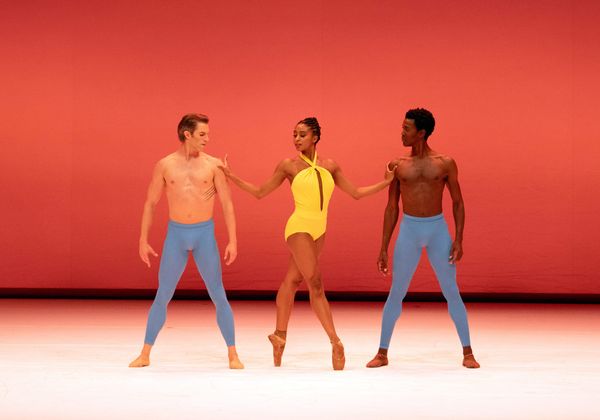
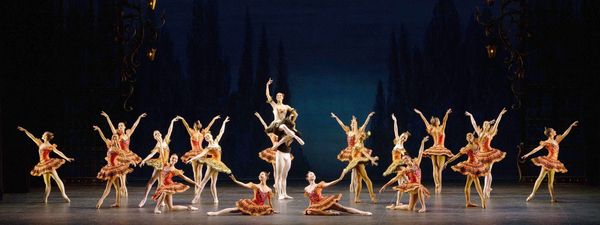
But wherever you go in Peck’s body of work, you cannot go wrong with “Everywhere We Go,” which ended the evening. Here Miriam Miller dancing with the elegant Paul Walker dazzled with command of the roles, their taller statures helping give us more, literally, of the great choreography. Despite some shaky partnering by Walker in certain spots, you could not take your eyes off of them, and it seemed they really enjoyed the choreography and the music, and didn’t just dance it well. Whenever they were not onstage, Emily Kikta delivered some of her best dancing in recent years with soaring jumps and stage filling presence. She was so light on her feet, so full of exuberance, that she overshadowed by measures Megan Fairchild and Taylor Stanley, dancers who traditionally are magnets for attention, particularly in their trio. In all, while this ballet is a frequent fixture in the company’s programming, the night proved that ten years in, it is a classic, not a staple.
copyright © 2024 by Marianne Adams