Gods, puppets, and a joker
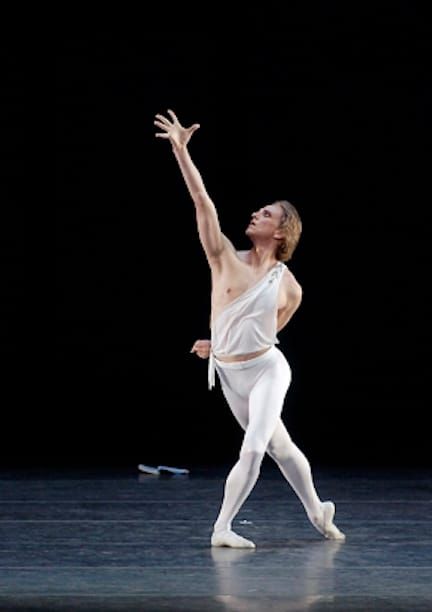
“Apollo”, “Jeu de Cartes”, “Petrouchka”
American Ballet Theatre
Metropolitan Opera House
New York, NY
June 1, 2006
“All-Star Stravinsky” is the title of ABT’s evening of short ballets, presumably designed to entice a triple-bill-shy audience into thinking it will see an assembly of star dancers. It may have been a gimmick, but it was also accurate. The evening opened with “Apollo”, with the new principal David Hallberg, with Veronika Part (Terpsichore), Michele Wiles (Polyhymnia), and Stella Abrera (Calliope) as his muses. Hallberg is a blond god of a dancer with a classic physique, which ironically, works against Balanchine’s choreography; many people, including another blond god, Peter Martins, have said that Balanchine saw his Apollo as a demi-caractère role. But great parts can thrive on many different approaches, and Hallberg gave a very good performance.
ABT does Balanchine’s original version, with the Expressionist birth scene, and the exalted stair-step ending. The swaddling clothes bit can be awkward, and the mixture of styles, from Expressionistic to neo-classical, can seem jarring, but the complete version makes the contrast between the young and the mature god so clear. Hallberg was an especially gentle young god, awkward at times, but not harsh. Part was a very confident Terpsichore, dancing her solo as if it were obvious she would be chosen, and with her lush movements and beautiful dancing, it was obvious to the audience as well. She did tend to smile a bit generically during the pas de deux, and could have danced a bit more for her partner than for the audience, but the tricky partnering bit went well, and they looked very good together.
John Cranko’s 1965 “Jeu de Cartes” is new this season. He choreographed it for the Stuttgart Ballet, and it may be that German humor doesn’t translate well, but it came across as heavy-handed and obvious (but shorter than his equally heavy-handed and obvious “Taming of the Shrew”). The ballet is in three parts, with the dancers enacting various playing cards, interrupted by a Joker (Carlos Lopez, frisky in a pink leotard and red Bozo the Clown wig). The dancers were all very good indeed. Irina Dvorovenko, as the Queen of Hearts, gamely sent up her diva image in the First Deal (as the movements are so cutely called), which appears to be some sort of a take off on the Rose Adagio, since it has one women partnered by four men (or rather over-partnered, since she’s upside down quite often.)
The Second Deal has five men, Julio Bragado-Young, Arron Scott, Grant DeLong, Jared Matthews, and Gennadi Saveliev, and is set in what appeared to be the Jesters’ Graveyard, where the ghosts of dancers in Soviet productions of “Swan Lake” endlessly spin and turn; if I have to watch jesters, this group would be the ones to see. The Third Deal had the winsome and charming Sarah Lane as the Two of Diamonds, who wanted to play with various Spades. Lopez then appeared in a skirt, which he lifted lewdly many, many times. And then, with some tooing and froing, it was over, except for the Joker bossing around the curtain calls.
Michel Fokine’s brilliant “Petrouchka” was the final ballet, the perfect example of how powerful a combination of story, choreography, and sets can be. Though the figure of Petrouchka is crucial, the ballet is a group effort, and the smaller parts add so much. I did miss Guillaume Graffin’s exuberant and slightly seedy spirited merchant; Victor Barbee looked a bit like a villain in a melodrama, leering through his cape, and almost twirling his moustaches. But Anna Leceica’s poor, freezing street dancer, desperate for her pay yet so happy with a few bright ribbons, is an unforgettable portrait; her face is made for this role. Gary Chryst was the Charlatan, giving a grim, vicious, and masterful performance. His eyes gleamed at the idea of enticing the poor superstitious peasant woman with his flute. Isaac Stappas gave the Moor the proper brutish strength.
Herman Cornejo was the poor puppet; he emphasized the half-human, half-toy aspect; the scene in his cell was really about Petrouchka realizing that he had a heart and this allowed for his ultimate triumph. This worked very well with Xiomara Reyes’ Ballerina, which was an astounding performance. Her ballerina was not a stiff-armed automaton; she did not look like Swanilda imitating a doll, she looked like she was made of wood, moving with a slight wobble, as if she had pegs instead of joints. There was nothing cute about her, and her wide-eyed, expressionless stare was almost frightening. It wasn’t only that she had no heart, she had no soul. It would be worth sitting through any number of “Jeu de Cartes” to see performances like that.
copyright ©2006 Mary Cargill



