Girl Power
“Les Sylphides”, “Afternoon of a Faun”, “Paquita”, “Rodeo”
American Ballet Theater
New York City Center
New York, NY
October 22, 2005 Matinee
ABT’s women were front and center at this matinee, beginning with a sprightly “Les Sylphides”, led by Irina Dvorovenko and Gennadi Saveliev. The conductor, Ormsby Wilkins, kept things at a lively clip, and, from reports, it was a much more vibrant performance than earlier in the week. Dvorovenko danced the Mazurka with a delicate and playful flirtatiousness, which suited her somewhat grand approach; this was a ballerina having fun, not some wispy dream of lost illusions. She by and large avoided flirting with the audience, though she did seem to enjoy the bursts of applause. Saveliev, though not built along romantic lines, gave his solo an introspective lyricism. Their pas de deux, though, did look a bit under-rehearsed and the “message from the other world moments” seemed more about complicated partnering than whispers from the mysterious deep.
The two side sylphs were Yuriko Kajiya, who danced the waltz, and Zhong-Jing Fang, who danced the prelude. Kajiya was chiffon to Fang’s velvet, and both gave truly lovely performances. Kajiya has lovely feet, fleet and strong, and it was almost an effort to watch the rest of her, though it was an effort well worth making. Fang has one of the most perfectly formed dance faces on the stage, like a rosebud perfectly balanced on a stalk, but she also has a quality of resonate stillness. The air seems to vibrate around her as she is pulled by the music, and the slight hesitation, with no hint of mannerism, creates a magical tension just before she moves.
Jerome Robbins’ “Afternoon of a Faun”, too, is full of hesitations. It is also about self-absorption and misconnections. Stella Abrera and David Hallberg were both making their debuts as the two dance students. Hallberg could have made a bit more of the moment when he reaches out to himself and connects only with the mirror, but his careless, lazy, sensuous movement caught the tone of the music. Abrera was a bit knowing, a bit lardaceous, almost leading him on, and then almost regretting that she was unable to stay. It was a very valid approach, and suits her elegant beauty—this woman would have certainly attracted attention before.
The “Paquita” pas de deux, choreography apparently a very long way after Petipa, was danced to its considerable hilt by Paloma Herrera and Jose Manuel Carreño. It is slightly Spanish, but the Minkus music is not at his “Don Quixote” best. The “Paquita” we usually see is a suite of dances, with lots of soloists, and the pas de deux really looks better in its frame. However, if we are going to have war horses, a new one now and then is welcome. Herrera used her extraordinary feet and legs to whip up a phenomenal set of fouettés, and Carreño seemed to be having the time of his life making up steps. However, his natural elegance, perfect placement, and solid landings kept the proceedings solidly this side of vulgarity. He is simply irresistible.
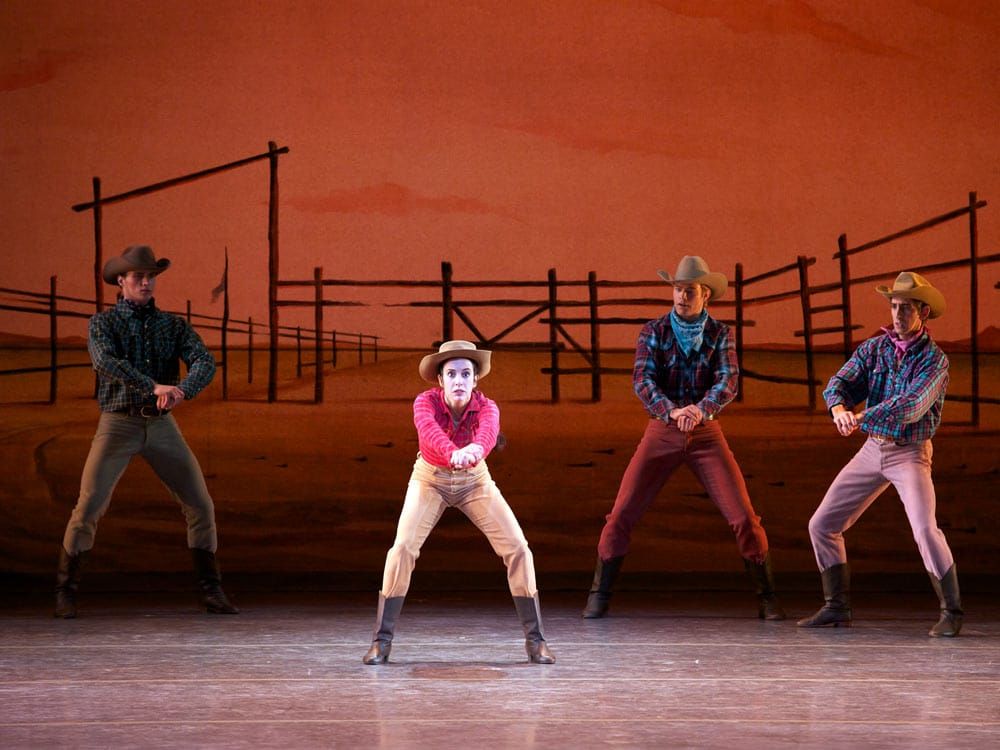
So too is Agnes de Mille’s “Rodeo”, in which Xiomara Reyes made her debut as the Cowgirl. She was a very sweet-natured tomboy, and, though the story is a bit hard to swallow, de Mille does create characters the audience roots for. (Though the drop cloth of the horses plunging through the waves during the scenery change would probably make Freud blush.) Sascha Radetsky was the Champion Roper, who sees through to the inner girl, and he gave a winning performance. Kelley Boyd, as the Ranch Owner’s Daughter, deserves special notice, too, for despite a wardrobe malfunction, which left her costume town down the back of the bodice, she gave a thoroughly professional and polished performance. As did the entire cast.
copyright ©2005 by Mary Cargill



