Ghosts
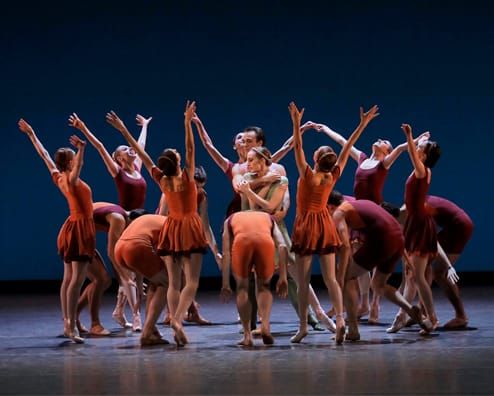
"Concerto DSCH", "Sonatas and Interludes", "In Creases", "Stars and Stripes"
New York City Ballet
David H. Koch Theater
New York, New York
June 4, 2013
Ballet choreography grows from past works, which is one of its strengths, but this can also be limiting. The shadows that Balanchine cast have at times seemed to limit new growth, as choreographers either imitate or react to him, and his ghosts (some paler than others) have appeared in many new ballets. The Russian trained Alexei Ratmansky is one of the few new choreographers whose work shows no Balanchine influence--there are none of those ghosts here. His assymetrical informality does not produce princes or poets, and his dancers, stunning athletes though they are, appear to be real people dancing somewhere on earth.
In his 2008 "Concerto DSCH" to Shostakovich's "Piano Concerto No. 2" (DSCH is an abbreviation of the composer's name), the emotions range from exhilleration to eligiac. The centerpiece is a pas de deux for Wendy Whelan and Tyler Angle, exploring Whelan's brand of dramatic lyricism. She has a way of pausing slightly before a move, no matter how simple, looking foward and then letting her body follow her thoughts, which gives her dancing a richness and a unique nuanced quality. Though she appears to have given up many of her roles, her dancing here was strong and elegant. Angle, in the less developed partner's role, was a fine support.
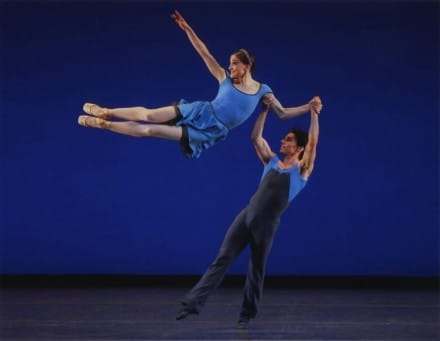
There were fireworks on either side of the lyrical center, as Ashley Bouder, Joaquin de Luz, and Gonzalo Garcia tore into some of the fastest jumps and turns I have ever seen. But these did not look like applause generating tricks, as they seemed to bubble up from the scintillating music and were leavened with a feeling of pure joy. The dancing and the choreography were simply intoxicating.
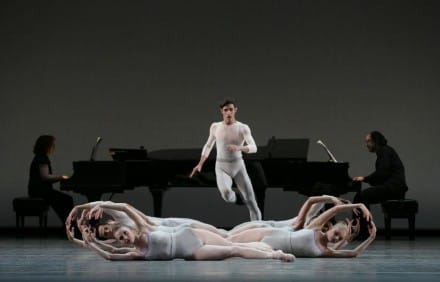
Richard Tanner's 1982 "Sonatas and Interludes", on the other hand, was an extended visit to the "Agon" pas de deux, with nothing new to add. It is structured like a formal pas de deux, with an adagio, variations, and a coda, but, unlike the classical and Balanchinian originals, there is no rhythmic or choreographic variety in the different sections, as the dancers jerk, kick, and twist to the sounds coming from the piano. Tiler Peck made her debut, dancing with Amar Ramasar, and each did all they could to make the moves look interesting. The cut-off tights, so redolent of the 1980's, did no favors for Peck, making her legs look short and blocky, and the heavy gold belts pouched out like some glit-edged fanny packs; not an elegant look. Peck was more astringent than Sara Mearns, but lacked her mystery, while Ramasar's quirky lightness and floating arms were lovely to see. However, the ending, where the dancers stare glumly at the audience to signify "This is Profound" was just irritating.
It did serve to make Justin Peck's "In Creases" look even better the second time around, though the black shoes and socks for the men chopped their line unnecessarily. The frisky groupings and youthful air seems to have been inspired by Robbins, but the interesting shapes show an intriguing individuality.
Balanchine's "Stars and Stripes" is all about shapes, as this all-American romp is structured like the most formal of Petipa ballets. Balanchine even ends the first two movements with an explosion of emboités, looking as if they had pranced over from the Jardin Animé across the plaza. Lauren King led the first movement with a great deal of spunk, though she bailed on actually twirling the baton (which is used to animate the groups of dancers, rather like the Lilac Fairy's wand). She also bailed on holding her heel in her hand and prancing on one foot, as she seemed to ad lib to the music. But she didn't let this faze her, and gave a spirited show.
Teresa Reichlen and Chase Finlay, in his debut, were Liberty Bell and her Capitan. She is taller than he is when on point and some of the partnering was a bit tricky. Reichlen toned down the mugging, and let her legs do the talking, which they did with crystaline elegance. Finlay, too, avoided some of the showboating, and didn't exaggerate the flatfooted jumps--his feet apparently are made for pointing. He seemed to run out of steam a bit at the end, and the final melange wasn't as crisp or as fast as some dancers. But though on a purely technical level, I have seen better danced "Stars and Stripes" the verve and joy of all the dancers (the men's corp, led by Troy Schumacher, were especially vivid) brought all the Petipa ghosts alive.
copyright © 2013 by Mary Cargill



