Getting to Know You
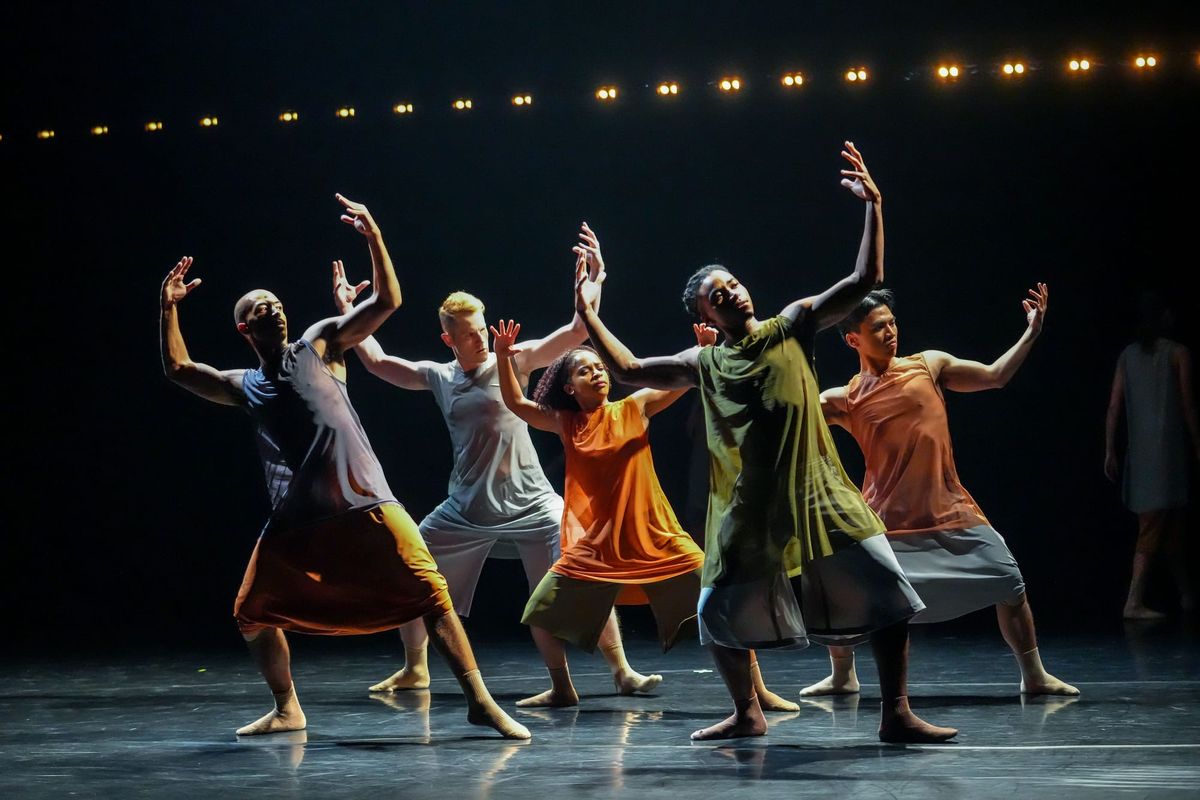
Program A: "Fibers", "Images and Reflections", "Hope is a Thing with Feathers", "Profiles", "Aureole"
Program B: "Tracer", "Events II", "A Call for Softer Landings", "Profiles", "Aureole"
Paul Taylor Dance Company
Joyce Theater
New York, New York
June 17, 2022 (Program B) and June 18, 2022 matinee (Program A)
The Taylor Company's brief Joyce season was a history lesson of sorts, featuring several early Taylor works, some not seen since their original performances, and a possible glimpse of the future, with two new pieces by two choreographers in an effort, as the program notes by Michael Novak, the current Artistic Director, say "to commission a new generation of American choreographers". The season was a portrait of early Taylor, but also an introduction to a number of new dancers--about half of the present company have joined since Taylor's death.
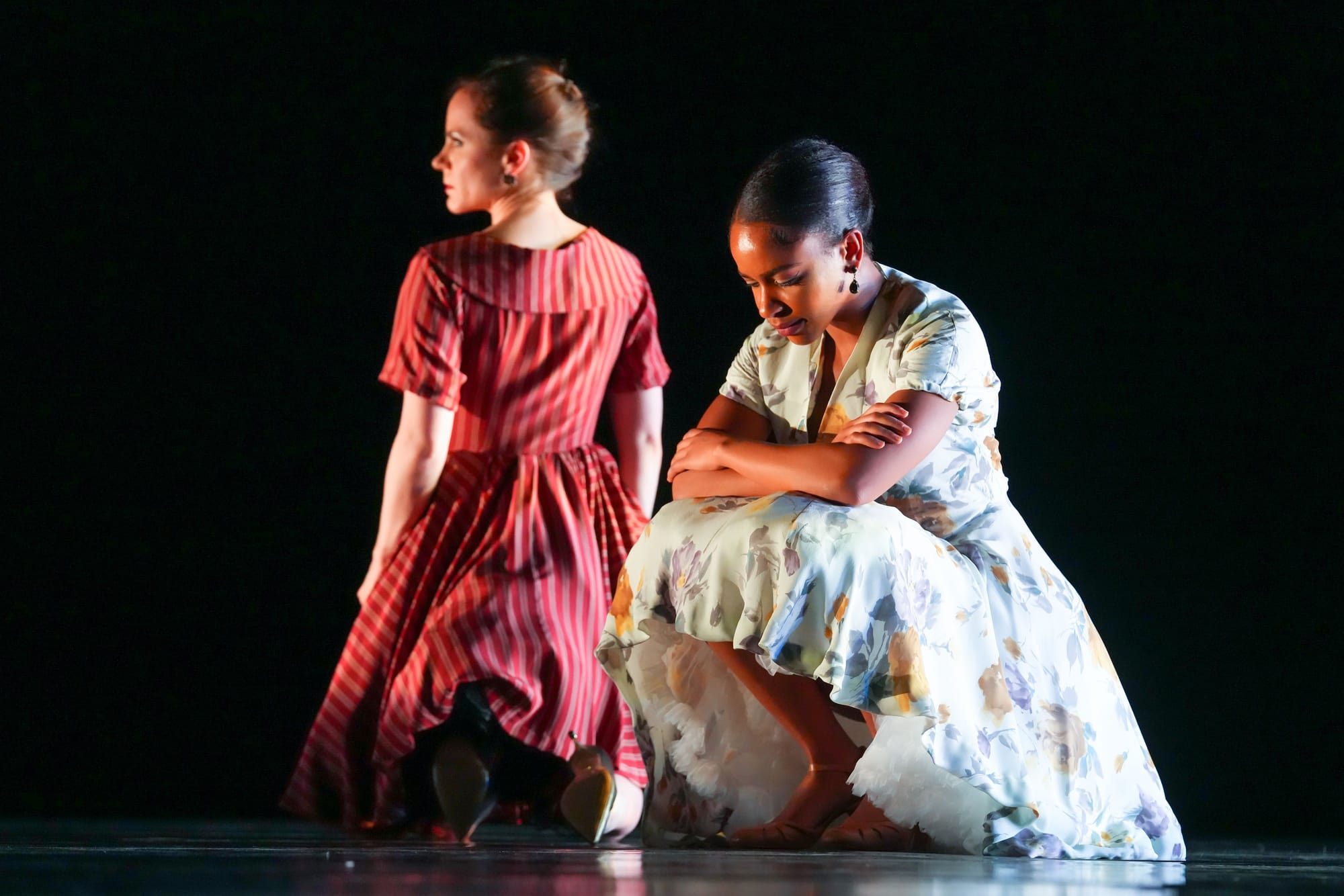
The earliest work performed was "Events II", from 1957, which was originally part of the famous, or notorious, first full evening of Taylor's works where Taylor, to a rapidly diminishing audience, explored movement, or rather lack of movement, as an expressive form. "Events II", set to the sound of pounding rain and performed (one cannot say "danced") by two women, Eran Bugge and Jada Pearman, had the haunting ambiguity of an Edward Hopper painting. The two women, in 1950s dresses, appeared to be waiting for something or someone, and occasionally shifted positions or folded their arms. Nothing else happened. The end. But somehow the dancers created such a vivid image that these two women seem alive to me, waiting still.
The three excerpts from "Images and Reflections" (1958) had more movement, a modern, spiky score by the American experimental composer Morton Feldman, and distinctive costumes by Robert Rauschenberg. These costumes, including a silvery horse's mane-like fringe down the back of John Harnage and the exploding pink chiffon on Kristin Draucker, were striking, and their softness was a subtle counterpoint to the exploratory, often quirky moves.
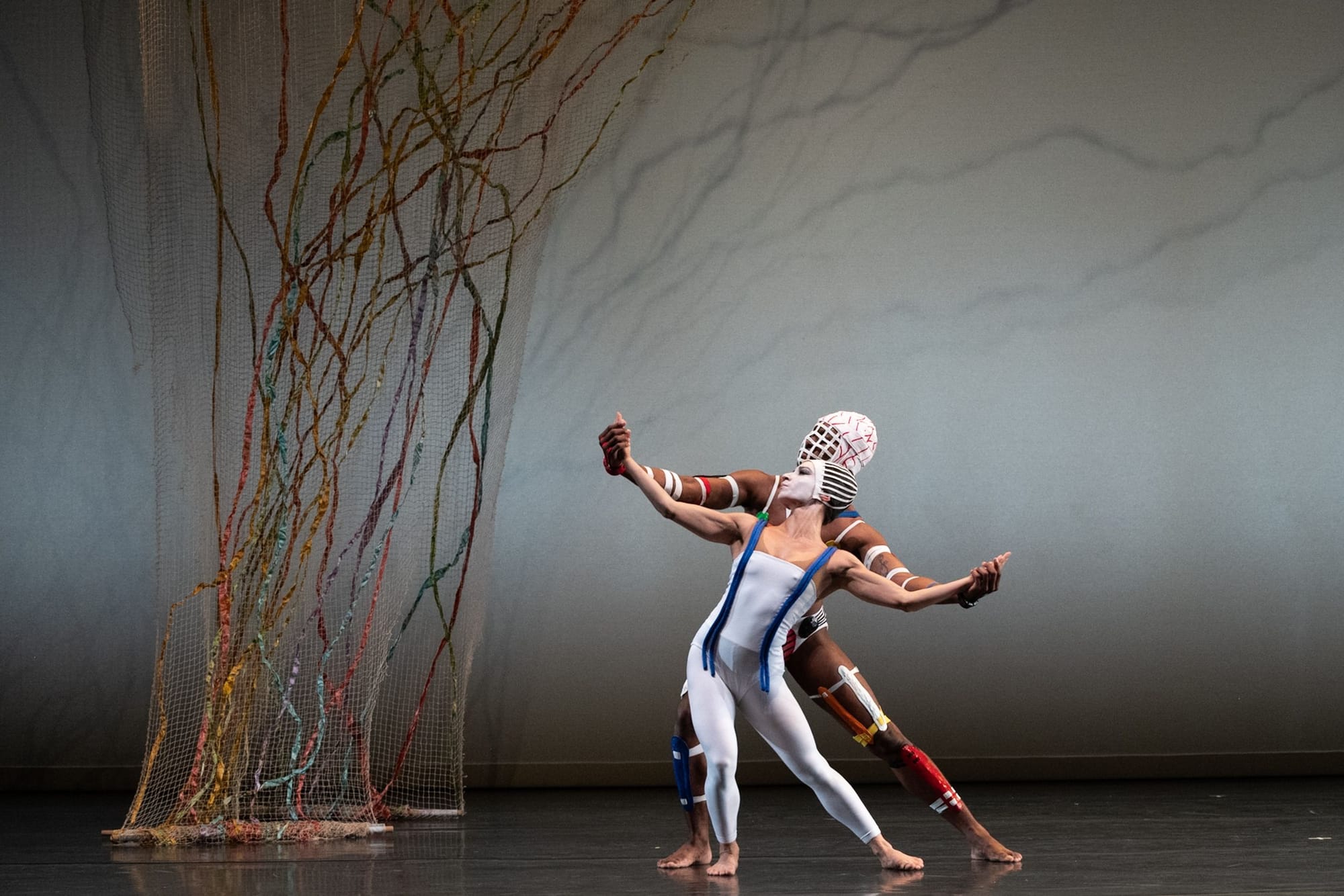
Costumes, this time by Rouben Ter-Artunian, along with a stylized, candy-colored tree, played an important part in "Fibers" (1961), set to some rather cacophonous music by Arnold Schoenberg. This was the earliest ensemble work on the program (the two lonely ladies of "Events II" didn't really interact) and seemed to hint at Taylor's god/demon compositions, as strange creatures with masks or makeup hiding their faces made odd, jerky, and sometimes ominous connections. The dancers' weighty, deliberate moves and fierce concentration had the odd logic of a slightly surreal dream, though through slanted eyes it could have looked like a send up of Martha Graham.
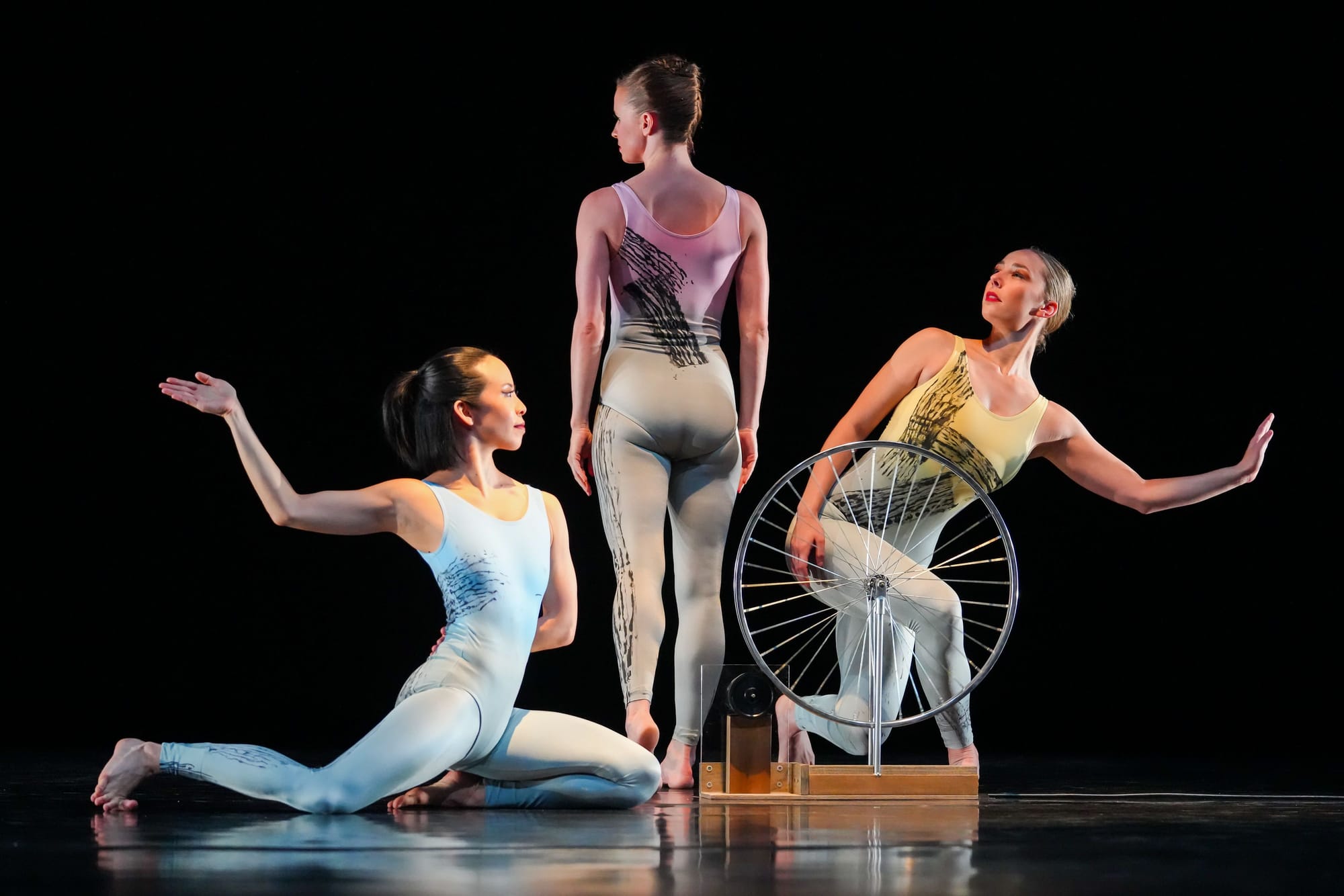
"Tracer" (1962), designed by Rauschenberg, had another prominent prop, a wheel which would spin seemingly at random (and which is an echo of Marcel Duchamp's 1913 wheel), and another modernist composer, James Tenney. The four dancers (Lee Duveneck, Madelyn Ho, Kristin Draucker, and Jessica Ferretti) danced in bursts, alternating between balances and shards of movement, with an intense concentration and a hint of emotion (at one point Duveneck and Ho tentatively hold hands).
It was also the last work Rauschenberg designed for Taylor, as his next work "Aureole" (1962) broke all the modernist rules and Taylor was effectively stricken off the list by the dedicated avant-garde because he used music by a dead classical composer (Handel), and choreographed a bright, happy dance which was instantly and enduringly popular. In its own way, it may have been a rebellion against a rigid set of rules.
Of the five dancers, Austin Kelly stood out for his effervescent joy and smooth, weighted jumps as he bounded through his difficult choreography, leaping up from his deep plies into bouncing sideways jumps and looking very happy doing so. Jada Pearman, too, danced with a luscious lilt and lit up the stage. For all the joy in "Aureole" there are shadows too. The famous male solo, originally danced by Taylor, with its long, stretched line and precarious balances, is a private moment separate from the buoyant crowd. Lee Duveneck (June 18 matinee) and Devon Louis (June 17) both performed with a steady flow, making the shifting shapes look easy, though Louis, for all his height, is a much lighter dancer than the traditional Taylor type. And both dancers were stoic and reserved, so the piercing, aching, and exposed heart of the solo was missing.
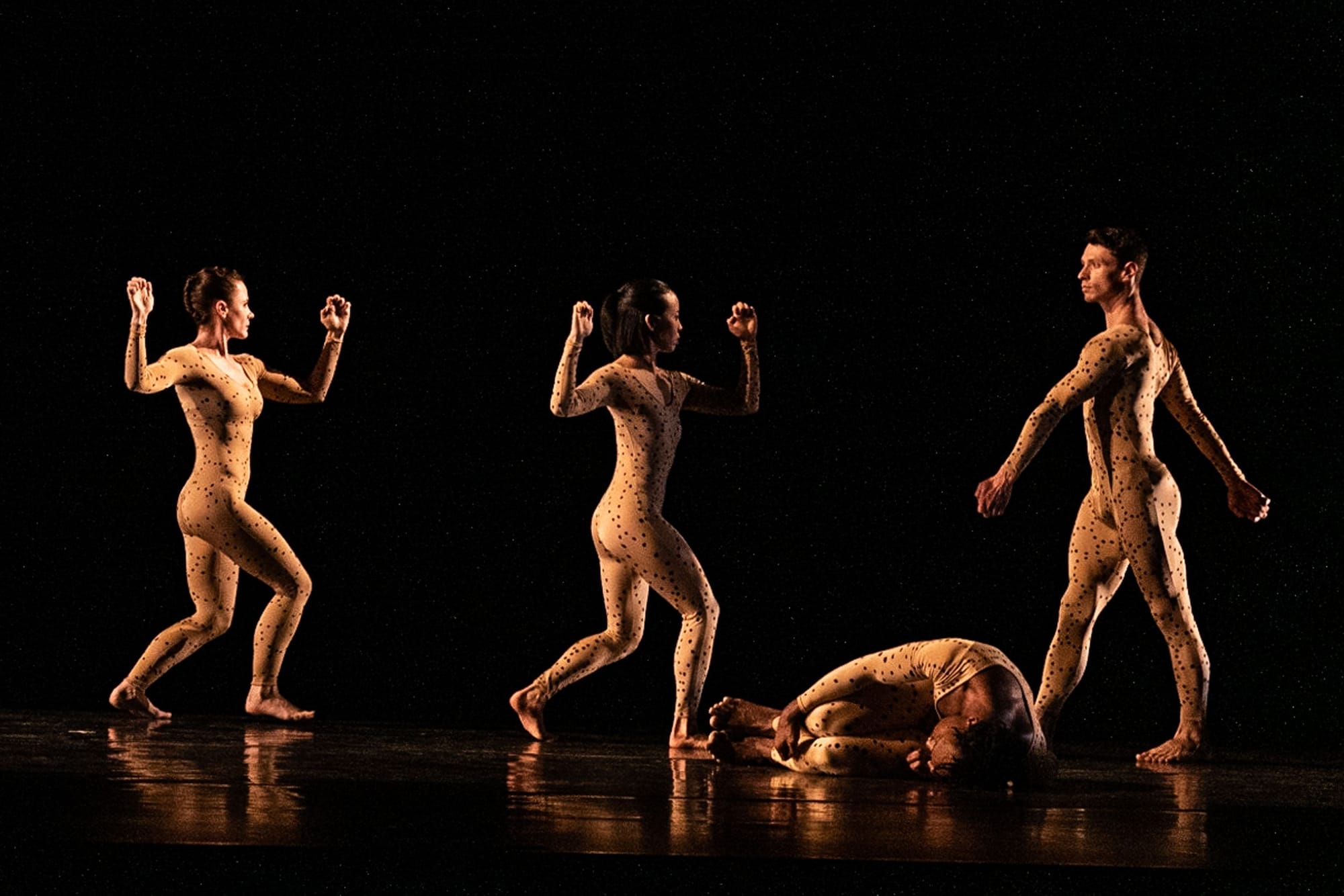
"Profiles" was made later in Taylor's career (1979) but was possibly included in this brief overview as a reminder that Taylor's use of austere modern music never disappeared. The four dancers (Eran Bugge, Alex Clayton, Madelyn Ho, and John Harnage) wore sand-colored leotards with their fingers folded so their hands looked undeveloped, like a child's attempt at drawing, and moved in profile as if they were carvings from an archaic bas relief. The final moment when those statues seemed to attempt to come to life as a man opened his hand and a women responded, fingers finally free to touch another person, was a small but powerful statement of the human need to connect.
Dancers also need to connect to new choreography and the programs offered two new works, "A Call for Softer Landing" by Peter Chu and "Hope is a Thing with Feathers" by Michelle Manzanales. Both choreographers used various composers for different sections, which tended to give the works a slightly disjointed air, and the vigorous choreography often confused movement for meaning. The opaquely titled "A Call for Softer Landings", with its aggressive lighting shining in the audience's face and baggy, unisex outfits was energetic but unfocused and appeared determined to hide any sort of human emotion, other than a stylized violence. It was a grotesque inversion to watch the tiny Madelyn Ho pound the much larger Lee Duveneck. The anonymous energy resembled an aerobics class mixed with a self-help revival meeting; at one point Christina Lynch Markham exhorted the audience (some of whom obeyed) to chant "I am enough", which all things considered was a bit of an exaggeration.
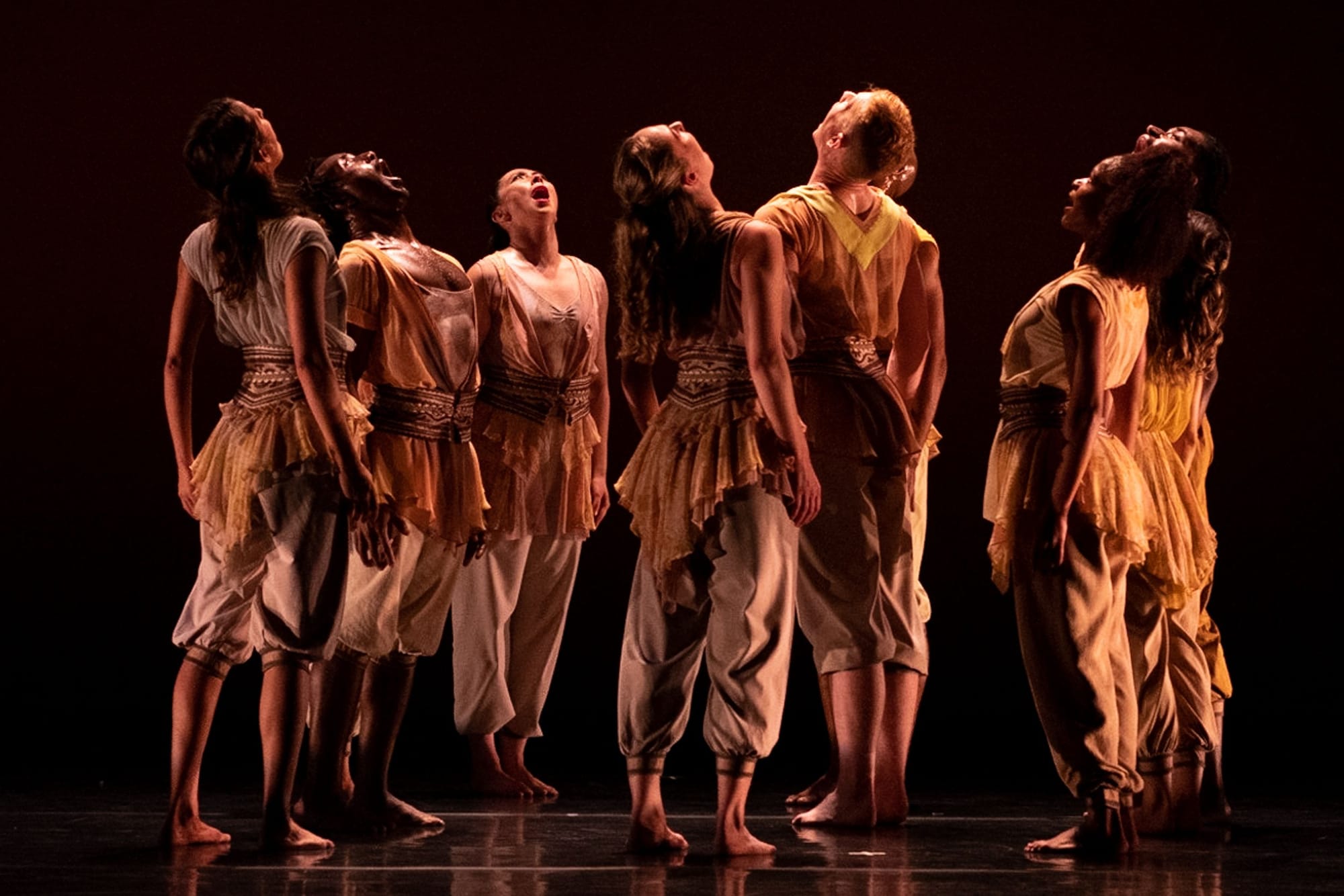
"Hope is a Thing with Feathers", set to a number of popular songs involving birds, was more fun, but the dancers were still just an anonymous group now and then imitating birds. There seemed to be no underlying theme, no exploration of human bird-like relations. The dancers were by and large anonymously solemn--even bop bop bopping to that red red robin barely raised a smile from the dancers. Some of the newer dancers, especially Jada Pearman and Austin Kelly, have the distinctive individuality of the traditional Taylor dancers, and certainly dancing more of Taylor's challenging, complex works will show the audience more about the dancers than their already stunning physical ability.
Copyright © 2022 by Mary Cargill



