Get a Gimmick
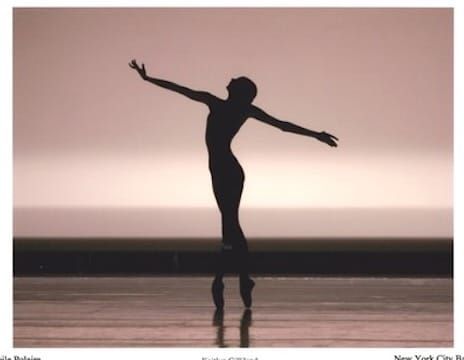
“Intermezzo”, “The Unanswered Question”, “Backchat”, “Étoile Polaire”, “Ugha-Bugha”, “A Stair Dance”
New York City Ballet
New York State Theater
New York, NY
April 29, 2006
The Diamond Project included a modest little solo for Kaitlyn Gilliland, an apprentice, in the middle of a generous (or indulgent) evening of Eliot Feld ballets, most new to the New York City Ballet. The evening opened with the NYCB debut of “Intermezzo”, choreographed in 1969 for Feld’s American Ballet Company. "Intermezzo" has much in common with Jerome Robbins’ “Dances at a Gathering”, also made in 1969, but, unless Feld was a very fast worker, he could not have been influenced by it. The simple piano pieces (Chopin for Robbins and Brahms for Feld) and romantic swoosh of both ballets was probably mutual reaction to the sometimes raucous 1960’s.
NYCB fielded some of its most romantic and lush dancers: Megan Fairchild, Jenifer Ringer, and Rachel Rutherford, with Robert Fairchild, Charles Askegard, and Tyler Angle as their gracious partners. The dances did not define the characters as precisely as Robbins does, nor do their relationships develop much depth. But Fairchild (dancing with her brother, still an apprentice) danced her folk inspired pas de deux with an airy delicacy and effortless precision. Askegard and Ringer were deadpan and very funny in their deliberately overly musical variation, and Rutherford, with Angle who has a remarkablestage presence, epitomized a sunny romanticism. If at times the piece seemed like an audition for Balanchine’s infinitely more complex and subtle “Liebeslieder Walzer”, it was a promising audition indeed.
Feld choreographed “The Unanswered Question” in 1988 for the New York City Ballet’s American Music Festival. It is full of gimmicky props—a man rolls on a drum throughout the ballet, a girl (possibly an angel) rides a huge bicycle, a ladder falls to the stage at the end, and the hero climbs it, reaching for a floating sousaphone worn by a man who probably symbolizes Art (definitely a capital “A”).
But for me, the oddball look of the piece captures the dreamy, slightly surreal quality of Charles Ives’ music, and it is a quirky, hypnotic examination of an artist’s struggle to avoid earthly temptations (the gamine Georgina Pazcoguin, and the sultry Maria Kowroski) and to reach out for his destiny. It was also a chance to see Tyler Angle in a starring role, and he was riveting, more lyrically innocent than the original, restless hero danced by Damian Woetzel, but it was a rich and commanding performance.
This was followed by four brief, recent Feld pieces, which seemed a bit formulaic and routine. "Backchat"’s gimmick was a grungy wall, made of wood and tar, and spiky metal, with three boys (Adrian Danchig-Waring, Craig Hall, and Andrew Veyette) slumming in biker shorts, climbing around like so much human graffiti to music by Paul Lansky. (According to the press notes, his is a “pioneer in the field of computer music”, and his “idle chatter” pieces are made up of tapes of people talking.) The movement quality had an intriguing underwater quality, but it did go on, and it was quite a relief when the boys finally climbed back up that wall.
“Étoile Polaire” was the Diamond Project premiere. It was a solo to Philip Glass for Kaitlyn Gilliland, a long, willowy dancer. Feld has made some fascinating solos for Buffy Miller, whose quality of movement and private stage presence merged and flowed through the steps. Gilliland began like a silhouette in the golden dawn (lighting by Mark Stanley) but then just bourreed and arabesqued somewhat aimlessly, like a well-bred pipe cleaner.
“Ugha Bugha” was a late addition, a solo danced by Wu-Kang Chen of Feld’s Ballet Tech Company, who showed what a Feld solo can be. This gimmick was little silver cans attached to his tights, which gleamed and clanked, complimenting the accompanying percussion. Chen had the floppy Feld upper body, which the more rigorously trained ballet dancers can only approximate, and let the movement continue through his arms and torso, back to his lower body to form a continuous loop.
Feld’s 2004 “A Stair Dance”— yes, the gimmick was a set of stairs—closed the performance. It would probably have looked better as an opening work; its lighthearted romping dancers seemed a bit insubstantial as a closer. The five dancers floated up and down the stairs to Steve Reich. It looked like fun, but Shirley Temple and Bill Robinson danced with much more elegance, wit, and economy.
copyright ©2006, Mary Cargill



