Geometry Lessons

"Divertimento No. 15", "Afternoon of a Faun", "Allegro Brilliante", "The Four Temperaments"
New York City Ballet
David H. Koch Theater
Lincoln Center
New York, New York
April 27, 2022
The three Balanchine ballets in this program varied musically and sartorial (tutus for "Divertimento", chiffon for "Allegro" and leotards for
"The Four Temperaments") but all three showed Balanchine's mastery of geometric shapes to create a hierarchy, with the corps and soloists weaving through the music and around the principals. These shapes can comfort or challenge or soar as required, and there is something magic about the shifting symmetries of bodies on stage.
"Divertimento No. 15" is a rigorous, filigreed homage to Mozart's world, which needs precise, elegant, and charming dancing. The corps looked wonderfully together, not dancing like over-trained mechanical metronomes, but as if they were all hearing the same melody and were very happy about it. The minuet, where the eight corps girls, in groups of two, get brief moments in the spotlight, looked carefully cast with matching pairs, a graceful and subtle touch. The occasional nervous frozen grins of earlier years have vanished, and the dancers seemed to be dancing with and for each other with a radiance that extended to the audience.
Sara Adams, Emilie Gerrity, and Indiana Woodward were all making their debuts, and they too looked well-rehearsed, dancing with a joyful confidence. Unity Phelan, in the third variation, was particularly impressive with her elegant line, and Gerrity's fourth variation, with all the hops on point, had a delicate control. Woodward danced the more prominent sixth variation with sparkling footwork supporting a serene and creamy upper body. She danced without extravagance or flash, and her beautiful positions seems to melt into unexpected details, an arm bend, a head nod, or a little bob that seemed to emerge from the music. It was a confident, gracious, and generously commanding performance.
Daniel Applebaum and Sebastian Villarini-Velez (in his debut) danced the first theme, with its understated and friendly competition and Joseph Gordon (also a debut) danced the central man. All three had a slightly breezy ease combined with a classical purity, as if Vienna were just around the corner, not some foreign city in the distant past where men had snooty manners and haughty expressions.
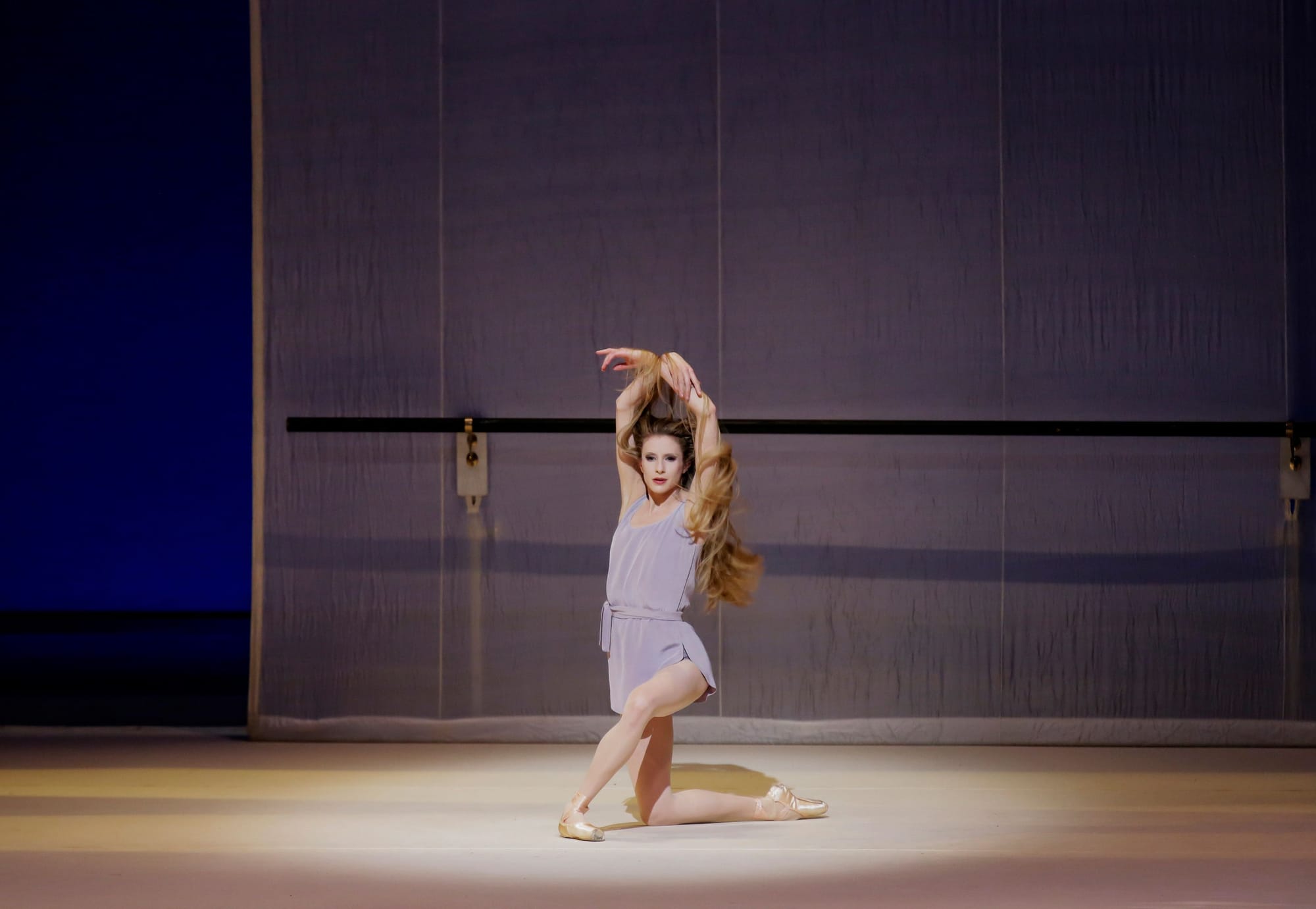
Jerome Robbins' "Afternoon of a Faun" is a long way from Vienna and the two self-absorbed dancers (Sterling Hyltin and Adrian Danchig-Waring in his debut) were clearly contemporary. Danchig-Waring caught the hazy, hot summer afternoon feel of the opening with his luxurious stretches and careful preening before the imaginary mirror. Hyltin was a bit more passionate and eager than some faun's partners and her regretful glance before she left has a romantic shimmer, as if Juliet had decided to tip-toe out of the ball after first seeing Romeo.
"Allegro Brillante" has no regrets in its blazing celebration of classicism. It opens in the middle of this celebration as the corps seems to toss steps to one another. Tiler Peck and Roman Mejia were the central couple. Mejia danced with his familiar and welcome unexaggerated generosity, bounding through the air. Peck attacked the cascade of steps like she was unpacking a barrel of diamonds and tossing them to the audience. She danced her solo, with its fast footwork, quick changes of direction, and impeccable musicality with an ease which left the audience gasping at the daring simplicity of perfection.
At 76, the choreography of "The Four Temperaments" still looks fresh and daring, with those bodies seeming to emerge from the music's rhythms; the balance between abstract shapes and distilled emotions is timeless. Alexa Maxwell and Aaron Sanz in the third theme were especially riveting, as Maxwell melted into the music, echoing, it seemed every note with a serene flow. The tall and elegant Sanz set her off perfectly.
Villarini-Velez's Melancholic was a bit raw at the edges which made his push/pull struggle more vivid, though as yet his is illustrating pain rather than completely embodying it. Ashley Hod, with Peter Walker's strong partnering, gave Sanguinic a sharp clarity, especially in her controlled jumps. Amar Ramasar had a goofy pride as Phlegmatic, a demonstration of abstract emotion. His almost pathetic joy when he managed the tricky opening balance, holding his foot high and setting it down carefully as both funny and touching. Emily Kikta was a commanding Choleric, almost frantic at her entrance, but calmly dominating the finale, as she swept the dancers into position with her arms. And the finale, with its mass of dancers framed by the soaring lifts showed once again just how powerful geometry can be.
copyright © 2022 by Mary Cargill



