Gentlemen, Start your Engines
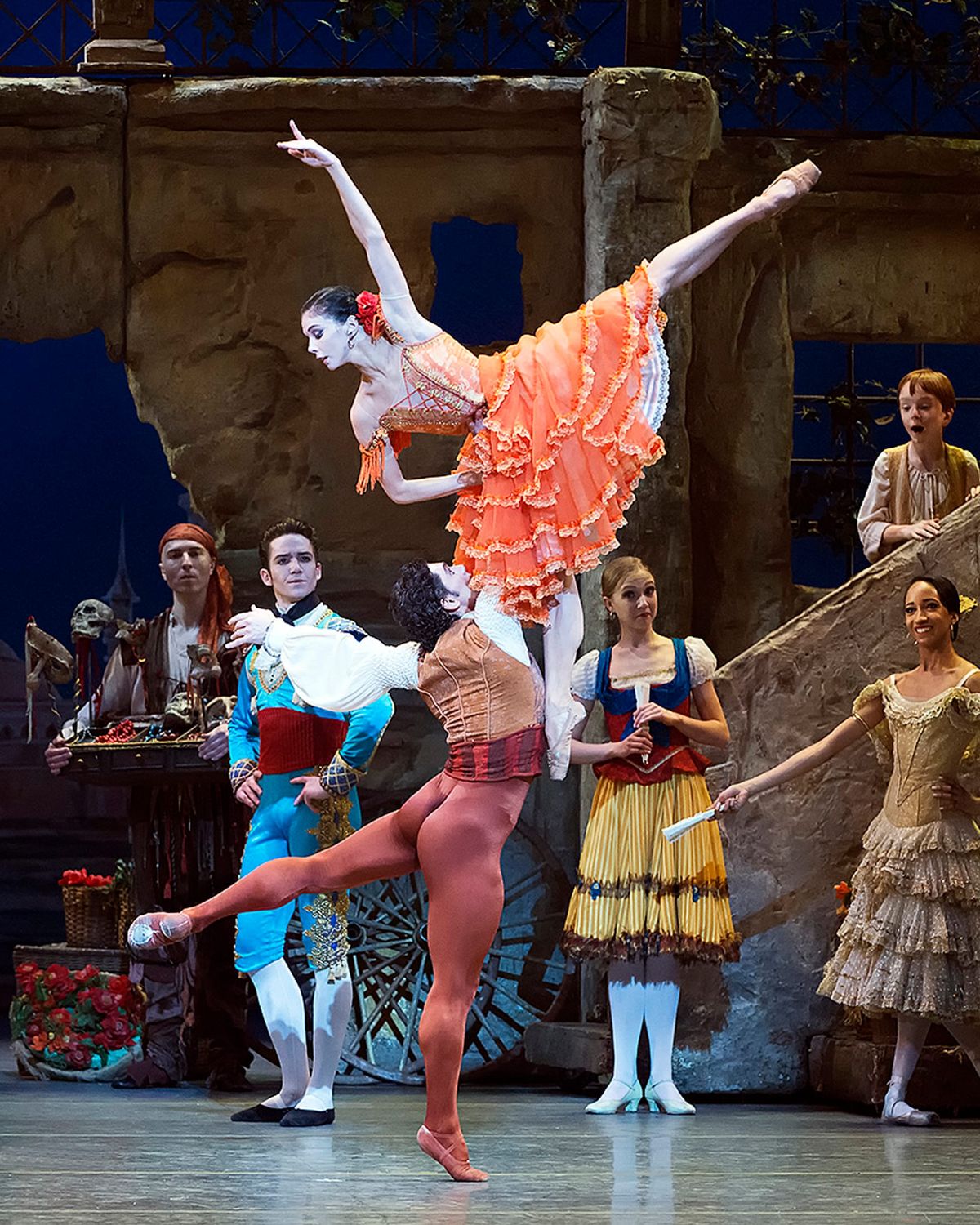
"Don Quixote"
American Ballet Theatre
Metropolitan Opera House
Lincoln Center
New York, New York
Mary 28, 2013
The first glimpse that New York had of Natalia Osipova came during the Bolshoi tour of 2005, when she burst out of the corps with her flying jumps and engaging personality. I wrote at the time that it she seemed to have turned up at the Bolshoi school one day with a note around her neck saying "Hello, my name is Kitri". Apparently, the Bolshoi agreed, and Kitri became one of her most frequently performed roles. She and her frequent partner Ivan Vasiliev danced it yet again with ABT, and it appears that familiarity has bred a bit of contempt, as they tore through the choreography with energy and strength, but little feeling.
"Don Quixote", for all the genteel sneering it engenders, is more than an excuse for pyrotechnics, and good, much less great, performances are joyous, warm lessons in true love triumphing over greed. This performance was a lesson in jumps and turns, all outrageously flamboyant, applause generating tricks. Vasiliev is a phenomenally strong dancer, but doesn't look his best in turquoise or orange tights, which emphasize his over-sized thighs and lack of line and turnout. (Basilio may be demi-caractère, but he is still a ballet dancer.) He did jumps, much to the audience's delight, which he seemed to invent on the spot--200˚sideways split jumps, backwards scissors in the air, flips over extended legs--he couldn't even walk towards his ballerina without inserting a turn or two. But these, gasp-inducing as they were, looked like work, as his preparations and strain showed, the complete antithesis of actual dancing. His mime scenes, though, were charming, especially his fake death scene as he carefully laid his cape on the ground. But unlike most of ABT's Basilios, he seems unable or unwilling to carry this charm over into his dancing.
Osipova, too, tended to separate Kitri the character from Osipova, the phenom, and danced with a rather determined expression, as if Kitri were a Myrtha wannabe. Rarely have I seen such centered, fast, and accurate fouettés, but they left rather a sour aftertaste, as if they were just another trick to fling at the audience. The moment that lingers is the memory of Kitri gently kissing the Don as thanks for his help, a tender and generous gesture that brought to mind the fresh young dancer I remember from 2005.
The Don was played by Roman Zhurbin, who gave him a regal, if confused dignity. Indeed, the supporting roles were often the most interesting and vivid of the performance. Alexei Agoudine was a delicate, pompous and very funny Gamache, snobbishly and ostentatiously refusing to sit down before the noble Don. Roddy Doble was very funny as Lorenzo, Kitri's mercenary father, who was not above leering at Mercedes, the street dancer. In recent years, ABT has doubled the character dancing of Mercedes with the exalted classicism of the Queen of the Dryads, an odd decision which limits opportunities for the many talented soloists. This performance Simone Messmer, all smoldering shoulders and lightening feet, was an exciting Mercedes, while Misty Copeland was the Dryad Queen. Reportedly, she had trouble with the Italian fouettés a few nights before, but in this performance she sailed through them. This was the best pure classical dancing I have seen from her, open, radiant, and generous, though her jump wasn't as strong as some Queens'.
Sarah Lane was limpid and charming as Amour, showing how absolutely beautiful small elegant steps can be. (Unfortunately, Osipova dropped the lovely little prancing steps in her Act III solo for yet more turns.) Skylar Brandt, as one of the flower girls, showed a feathery jump, and Luciana Paris, as the other, had a lush, elegant line. The gypsies get more outrageous each outing, and this time they all appeared to be trying out for a Las Vegas gymnastic team, putting the camp into gypsy.
copyright © 2013 by Mary Cargill



