Gallants, Gossamer and Otherwise
Paul Taylor Dance Company
"Company B", "Gossamer Gallants", "Promethean Fire"
David H. Koch Theater
Lincoln Center for the Performing Arts
New York, New York
March 27, 2012
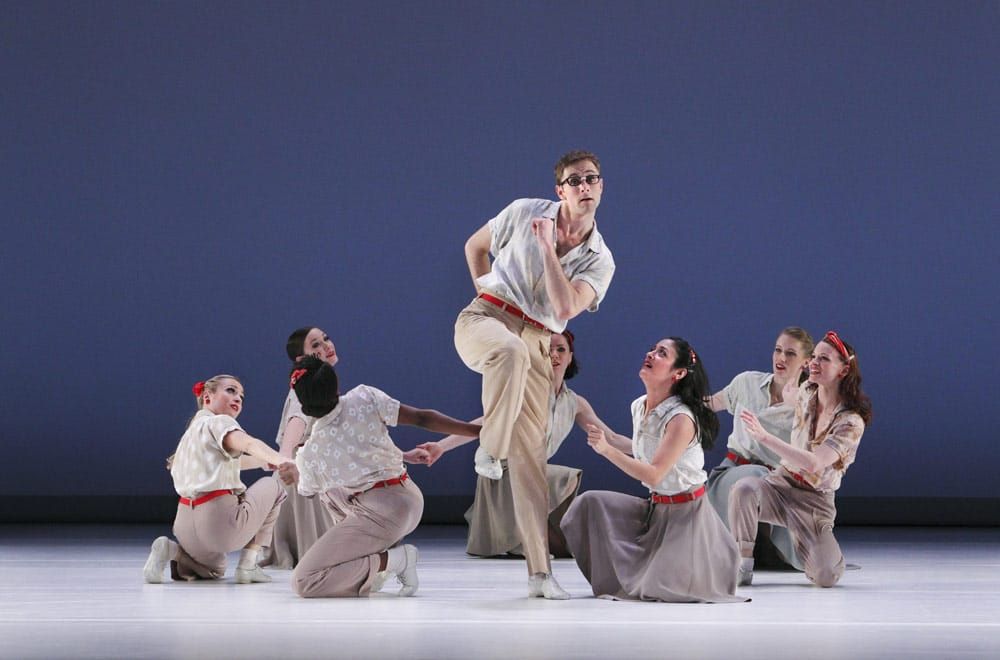
"Company B", Paul Taylor's salute to the men and women who endured World War II via the Andrews Sisters' songs, becomes darker at every viewing. The opening "Bei Mir Bist du Schon", with its cheerful, upbeat rhythms, is haunted by dark figures, wandering through the melody, like ghosts remembering their past. The larger stage tends to distance the audience, and helps the dances look as if they were filtered through a memory. The dancers, though, during the happier moments, had an immediate effect, and Laura Halzack and Jeffrey Smith were explosive during the "Pennsylvania Polka". "Tico, Tico", with a smooth and fluid Francisco Graciano, had an almost tragic impact, as this young soldier valiantly tried to keep up appearances (Graciano seemed almost desperate in his swaggering gesture of combing his hair). It was clear that both he and the Boogie Woogie Bugle Boy (Robert Kleinendorst) were among the victims. So too, in another way, were many of the women. Parisa Khobdeh, who could dream, and Amy Young, dancing with her ghost, were heartbreaking. It was a vivid performance of one of Taylor's most haunting works.
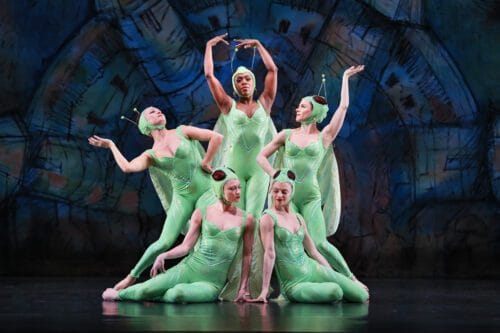
"Gossamer Gallants", new this year, to Smetana's dancers from "The Bartered Bride", won't, I suspect, be part of Taylor's greatest works. It is a jokey version of eager male houseflies being attacked by their female counterparts, despite their pitiful efforts at gallantry. (At one point, the men all make like Sir Walter Raleigh with their shiny capes.) The dance is well-constructed, musical, light. The men, with their black caps and shiny wings, have sharp little insect movements, rubbing their antennae-hands with glee at the thought of the bright green women. It is a cartoon, in the best sense of the word, clear, sharp, and easy to understand.
"Promethean Fire", from 2002, set to Bach orchestrated by Leopold Stokowski, is not a cartoon, it is a profoundly moving study of order emerging from darkness and chaos. The Koch Theater stage allowed the dancers more space to move, and I think it looked even better here than at City Center. The heart of the work, a complex pas de deux by a couple emerging from the mass of bodies, was danced by Michael Trusnovec and Parisa Khobdeh, very different dancers from the original couple, Patrick Corbin and Lisa Viola. Corbin was an everyman, while Trusnovec has a fluid nobility, and seemed to be both comforting and leading the group. Khobdeh is a much more lyrical dancer than Viola, who was a small powerful dynamo, and seemed to float where Viola pounded. The current pas de deux has a more otherworldly feeling, beautiful and serene (the brief moments of violence seem to come out of nowhere), with the woman as a vision or an ideal, whereas the original couple seemed to struggle more with some unseen force. Both versions have their unique beauties and power. The final, formal tableaux, as the dancers pose, bathed in light, has an almost mystic power, matching the full-blooded music.
copyright © 2012 by Mary Cargill



