Fusion
"The Peony Pavilion"
The National Ballet of China
David H. Koch Theater
New York, NY
July 8, 2015
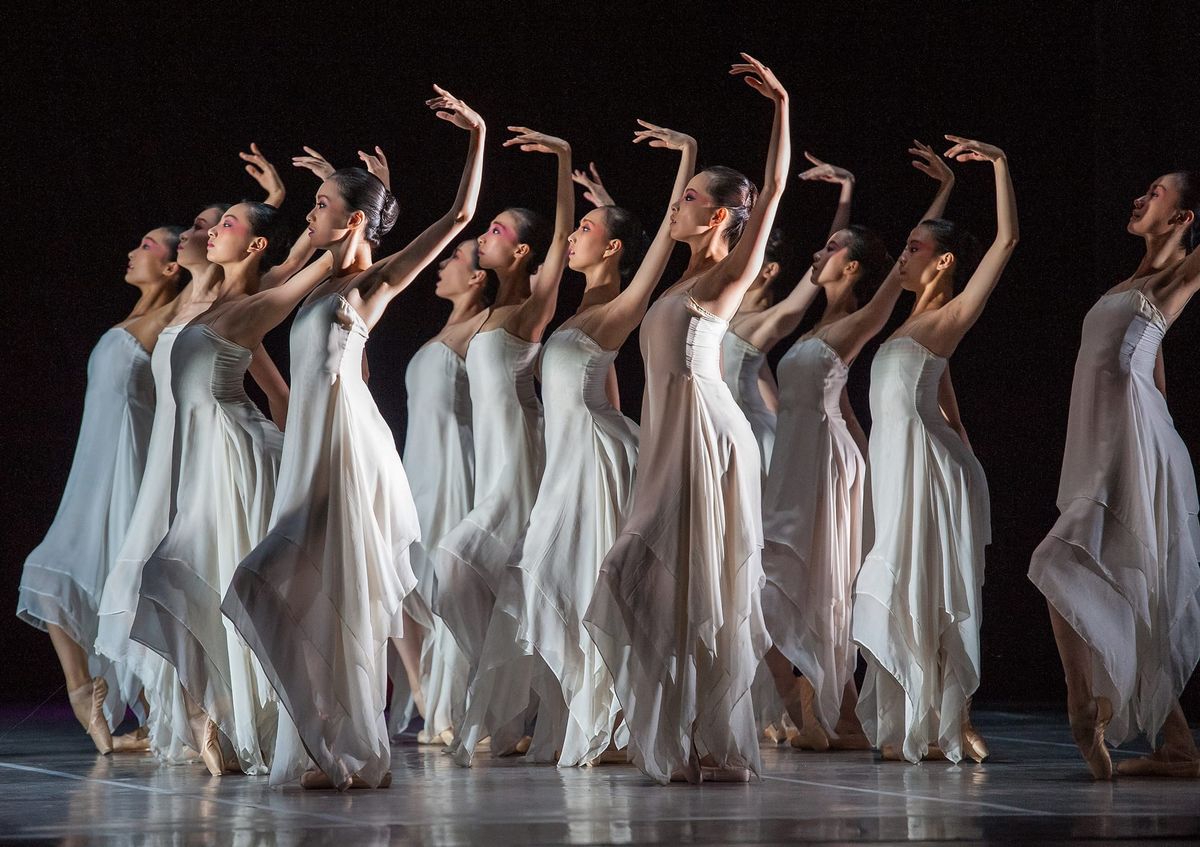
"The Peony Pavilion" was written in 1598 and the love story, basically a mixture of "Romeo and Juliet" and "Orpheus and Eurydice," is a mainstay of Chinese opera. The Lincoln Center Festival showcased the 20 hour version in 1999, an explosion of colorful costumes, singing and acrobatics. This year, the Festival presented another take, a two-hour distillation by the National Ballet of China. The ballet company was founded in 1959 and based firmly on Russian training. (Pyotr Gusev was instrumental in setting it up.) The dancers still show their Russian background; like many of their Slavic sisters, the women are willowy, with long arms and sway backs that help them whack their heads. They dance with a uniform precision and soft style that made the corps work very impressive.
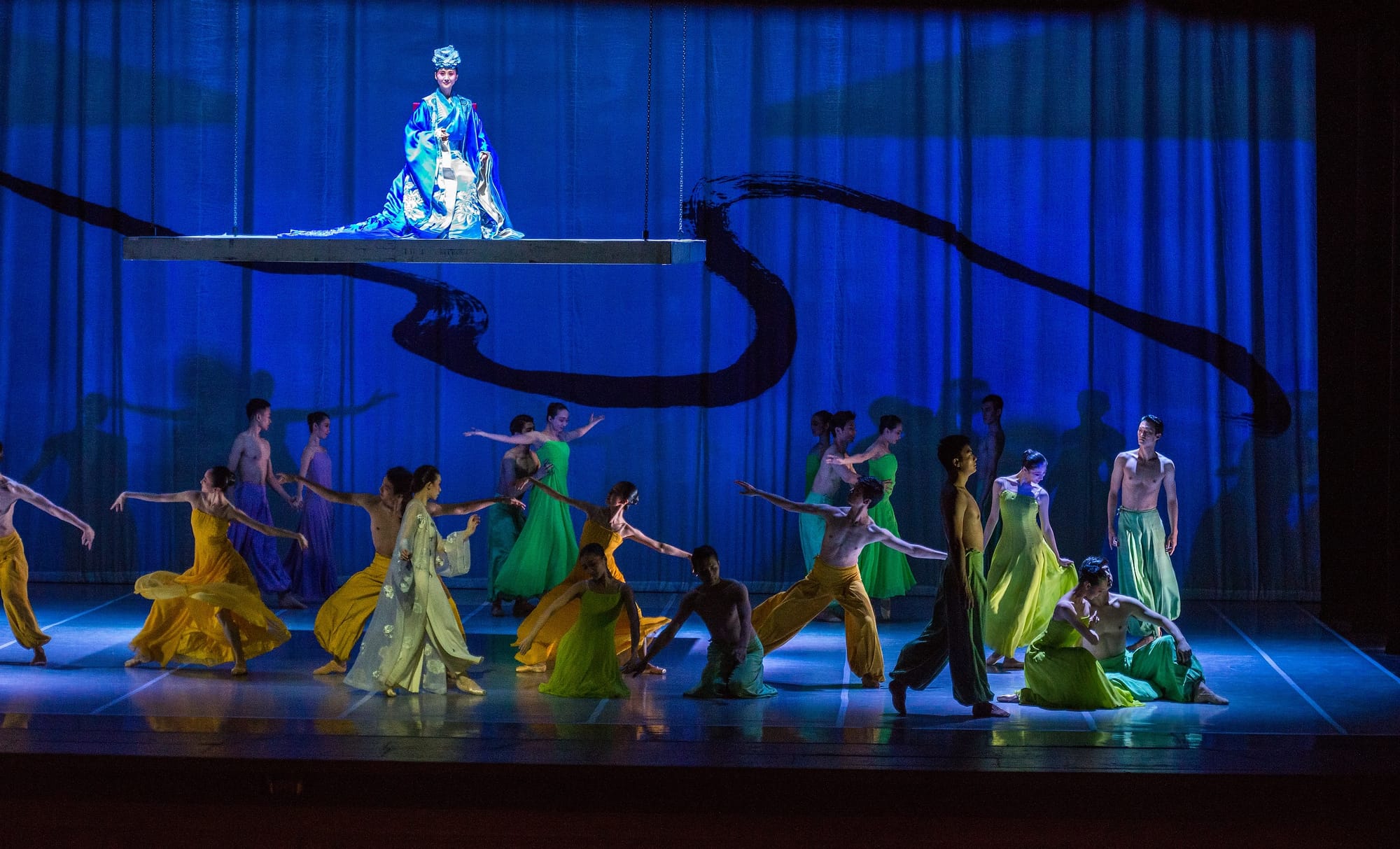
The ballet tells the story of the heroine Du Liniang's dream of Liu Mengmei, a dream so powerful that she dies rather than live without him. The King of the Underworld is so moved by her story that he gives her back to the living where she finds Liu and marries him in a cascade of plum blossoms. The choreography, by Fei Bo, is a sometimes uneasy amalgam of East and West. There are a lot of Graham-like moments, with the dancers rolling on the floor in front of stylized branches, a number of pas de deux modeled on ice-dancing lifts, and moments of the old Romantic trope of two lovers gliding past each other and not quite connecting. A Chinese opera singer, Yu Xeujiao, in a resplendent traditional costume, also wandered through the dancers. Her high-pitched, fluty voice sounded to my Western ears a bit like a cat meowing but her stylized comments on the action (helpfully translated in the program) and flat-footed, floating walk were hypnotically beautiful, if stylistically at odds with the rest of the dancers.
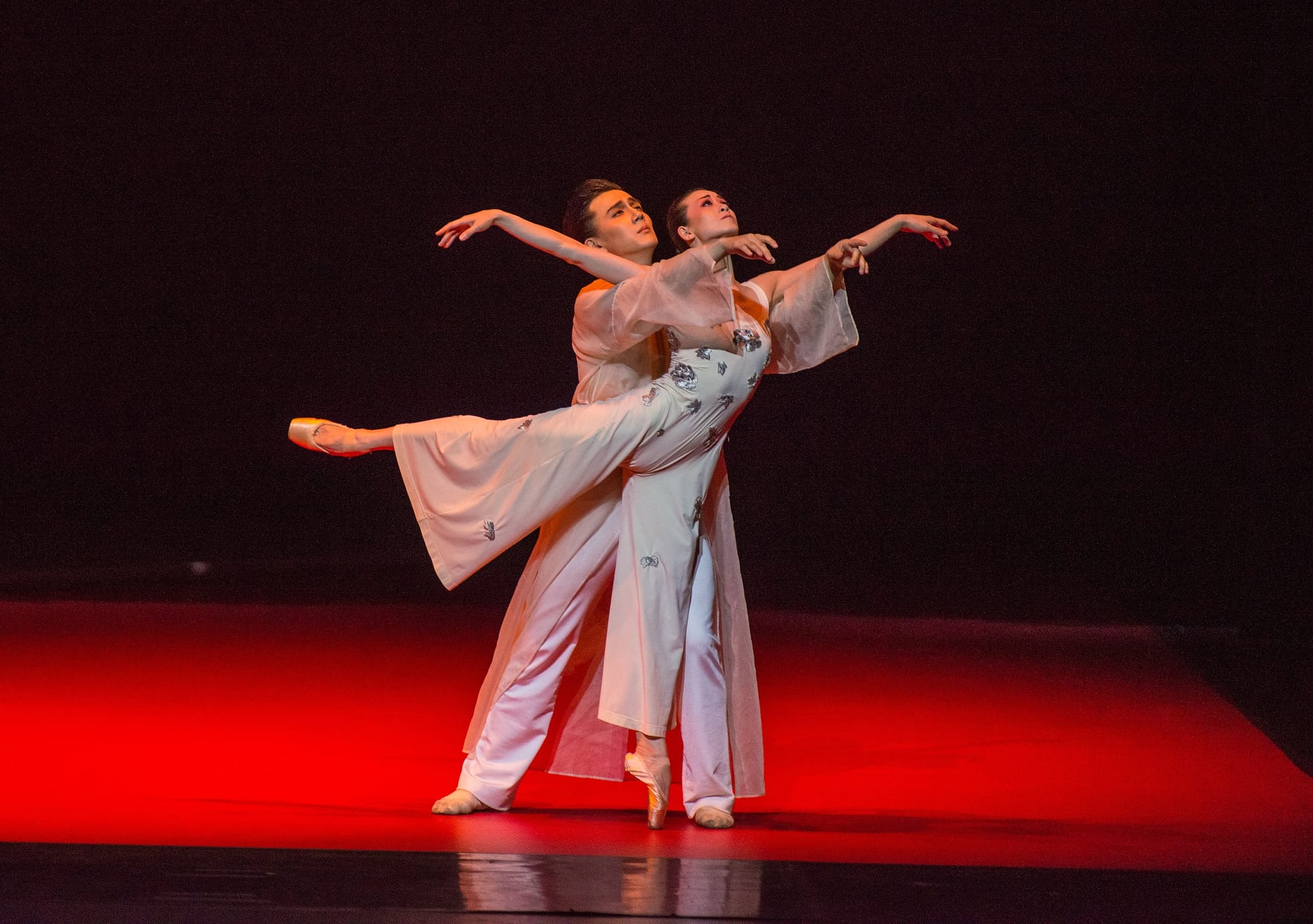
The dancers, Zhu Yan as the heroine Du Liniang, Ma Xiaodong as her dream lover Liu Mengmei, and Zhang Jian as the Flower Goddess gave fine, committed performances. I especially enjoyed Ma Xiaodong's dignified and soulful dancing. His stylized masculinity, elegant line and easy jumps dominated the stage. Zhu Yan's choreography emphasized her stretchy line. There was some unexplained business with her shoes (Liu Mengmei took them off and cradled them lovingly at one point) and she and the other women danced for a while with one shoe off, creating oddly effective rhythms. Her scene in the Underworld (a massive cave full of acrobatic black demons in small circles of light, with only the King's red beard for color) as she told her story with quasi-mimed movements was very moving. She has the gift of simplicity.
The production, too, designed by the German Michael Simon, stressed simplicity, with spare, geometric formations of constantly moving shapes. It was imaginative and effective. I was especially struck by the broad slab that lifted the singer up and down and, when reversed, became a dark, smoky mirror showing the entrance to the Underworld. The music, composed, arranged and orchestrated by Guo Wenjing, ranged from atonal sounds with a Chinese accent to wholesale borrowings from Western composers. (Debussy's "Prélude à l’après-midi d’un faun" was particularly prominent.) The raucous and soaring music for the final scene, as the dancers rushed around in a blaze of red, was grand and stirring -- somewhere a movie is missing its score.
copyright © 2015 by Mary Cargill



