Fusion

Fusion
Sa Dance Company

"Ivillage: My Indian Village", "Inseparation", "Flight", "Bollysa"
Sa Dance Company
Ailey Citigroup Theater
New York, New York
June 28, 2014


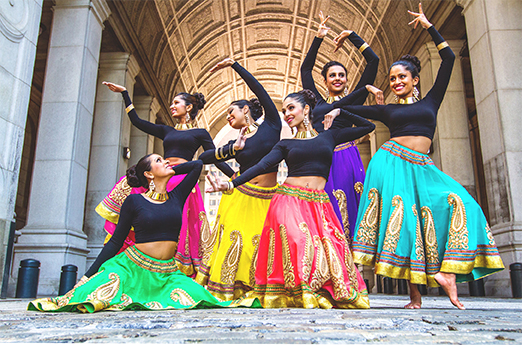
The word "Sa" means, according to the program notes, the first and last note in the octave used in Indian classical music.  The Sa Dance Company, a group of 10 stunningly beautiful women, melds blends the various schools of Indian classical dance with more modern versions; the brief biographies in the program shows the range of types these dancers have studied, from Kathak, Odissi, and Bharatanatyam to ballet, tap, jazz, and hip-hop. The founder and choreographer, Payal Kadakia writes that she uses her works to explore Indian American identity; these are not traditional Indian dances.

This mixture of the energy and coordination of hip hop with the warmth and filigreed upper body of Indian dance is a winning combination, and the colorful, cheerful group dances with their stomping bare feet and lip-syncing were enormously entertaining.  The first dance, set in an imagined Indian village was "tinged with nostalgia for a life we never actually had", according to Kadakia.  The (recorded) music by several Indian pop musicians was pulsating and dynamic and the lilting, swaying dancing included stylized groups miming cooking, sewing, planting, cleaning, and, not least, gossiping in beautiful, colorful costumes.

This communal feeling continued through the program, and the group dances had the folk-like feel of being danced for a group of friends and many in the audience clapped along with the more percussive movements.  The middle two dances were a bit darker and more subdued; "Inseparation" was danced in dark purple and "Flight" in black leotards.  The final piece, "Bollysa", was an explosion of red with gold accents, inspired, according to the notes, by Bollywood, and the whirling, stomping circle dances were constantly shifting pictures.  There was a brief nod to romance, as a group of four mimed, so beautifully, tears and lost loves and then merged back into the joyful group. The program was simply intoxicating.

copyright © 2014 by Mary Cargill

Read more

All That Worth Protecting

All That Worth Protecting


“When the Water Breaks,” “Monarcas,” “Floes,” “Symbiotic Twins,” “Network,” “After the Rain,” “Asylum,” “Moss Anthology: Variation #5b (2025)”
vildwerk.
New York Live Arts
New York, NY
December 17, 2025


Dance lovers are drawn to dance because of its inherent beauty: visual, musical, and in story ballets, narrative. And it’s no coincidence. Humans are creatures captivated by beauty, whether born of nature or shaped by human effort. And so, when vildwerk., a three-year-old nonprofit with an urgent mission, married an

By Marianne Adams
Complexions: Gorgeous, Stalled

Complexions: Gorgeous, Stalled


“Beethoven Concerto,” “Deeply,” “I Got U,” “Love Rocks”
Complexions Contemporary Ballet
The Joyce Theater
New York, NY
November 25, 2025


Founded in 1994, Complexions Contemporary Ballet’s endurance is to be applauded, and its two-week run at The Joyce Theater is testament to the weight of commitment.  The company bills itself as an innovator, yet Program B, which I saw on this night, revealed that steadfast dedication to creation was more of its forte than innovation itself.  Two

By Marianne Adams
Toxic Masculinity

Toxic Masculinity


"The Winter's Tale"
The National Ballet of Canada
Four Seasons Centre for the Performing Arts
Toronto, Canada
November 14, 2025


The National Ballet of Canada’s 2025-2026 season skews heavily towards newer works with a contemporary style, featuring ballets by Crystal Pite, Will Tuckett, Jera Wolfe, Helen Pickett, Wayne McGregor, Bobbi Jene Smith and Or Schraiber. The revival of Christopher Wheeldon’s “The Winter’s Tale” is the most traditional story ballet of the whole season, which is saying something.

By Denise Sum
Tapping Into It, the Soul of Things

Tapping Into It, the Soul of Things


American Street Dancer
Rennie Harris Puremovement
The Joyce Theater
New York, NY
November 12, 2025


There's something powerful about watching a body create rhythm and sound. Rennie Harris's company’s new program titled “American Street Dancer” offered an entire evening of such flavors in the form of a documentary-style performance that honored the African-American roots of American street dance and celebrated three distinctive regional traditions: Detroit jitting, Chicago footwork, and a now seldom performed on the streets, and dear to

By Marianne Adams


