Fun in the Forest
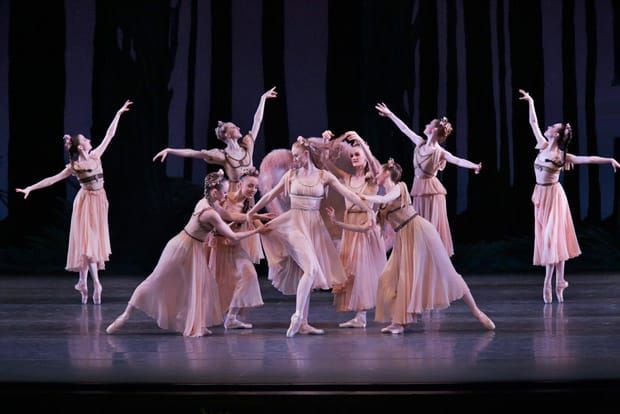
"A Midsummer Night's Dream"
New York City Ballet
David H. Koch Theater
Lincoln Center
New York, New York
May 30, 2019
As is semi-traditional, the New York City Ballet is ending its Spring season with a flourish of Balanchine, Shakespeare, and Mendelssohn with refreshed costumes, looking much brighter (though in an odd oversight, some of the men's bloomers in the second act divertissement were missing their red ribbons). The end of the season also saw a number of debuts, an emphatic statement about the depth of the company, as well as a preview of coming attractions. Roman Mejia's Puck was much more than a preview as that phenomenally talented young dancer flew through the role, but the other debutants (Unity Phelan, Emilie Gerrity, Andrew Scordato, and Alex Knight as the confused lovers, and Lars Nelson as the very confused Bottom) reveled in the comedy.
Teresa Reichlen and Anthony Huxley danced Titania and Oberon. Reichlen's tall, fair elegance is certainly royal, but her Titania was a bit passive. Her mime made pretty gestures, without the angry imperious Queen's dismissal of Oberon's request, and her dancing too was a bit clipped and monotone. Her deep arabesque and effortless jumps made pretty shapes but she didn't shade them. Her (admittedly narratively extraneous) pas de deux with the unnamed cavalier (the elegant and beautifully controlled Silas Farley) was one long note, beautiful but bland; he might have been a boy toy she was tiring of. Her infatuation with Bottom, though, had a real spark; Nelson's abject, defeated, hapless rustic contrasted with Reichlen's devotion had the audience roaring.
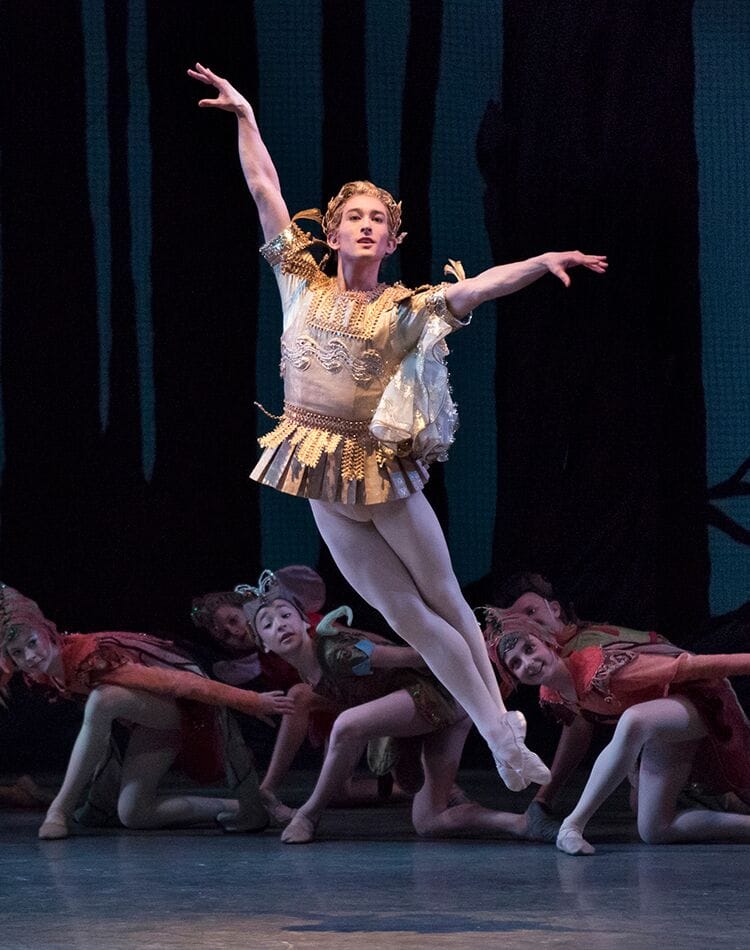
Huxley's Oberon had a regal power; the golden wig certainly helped give him an extra brightness but his firm, powerful, commanding mime, elegant upper body, and extraor- dinarily clear dancing (all those seemingly effortless beats seemed to gain power as he crossed the stage) deserved the crown. His royal dignity (even while seeming to float over the ground) was a wonderful contrast to Mejia's eager, mischievous Puck. Mejia is a real stage animal, absorbed in the story, reacting to everything around him; he is a generous performer who can make the stage brighter, not just by his dancing (which is breathtaking) but by his warmth.
The lovers whose lives he so clumsily interfered with were also confidently funny, with just a touch of slapstick. Phelan, as the poor neglected Helena, had a genuine pathos, and the moment when she takes the leaf to dry her tears, not seeing the magical creatures around her, had a poetic mystery. Gerrity was a slightly fatuous Hermia, with Scordato as the equally smitten Lysander, who made looking for flowers seems foppish. All is resolved, of course, after some energetic and bombastic sword fighting and the dramatic dancing of Emily Kikta's Hippolyta. Kikta, a tall and voluptuous dancer, used her height and powerful legs with some fiercely impressive fouettés to whip through the fog.
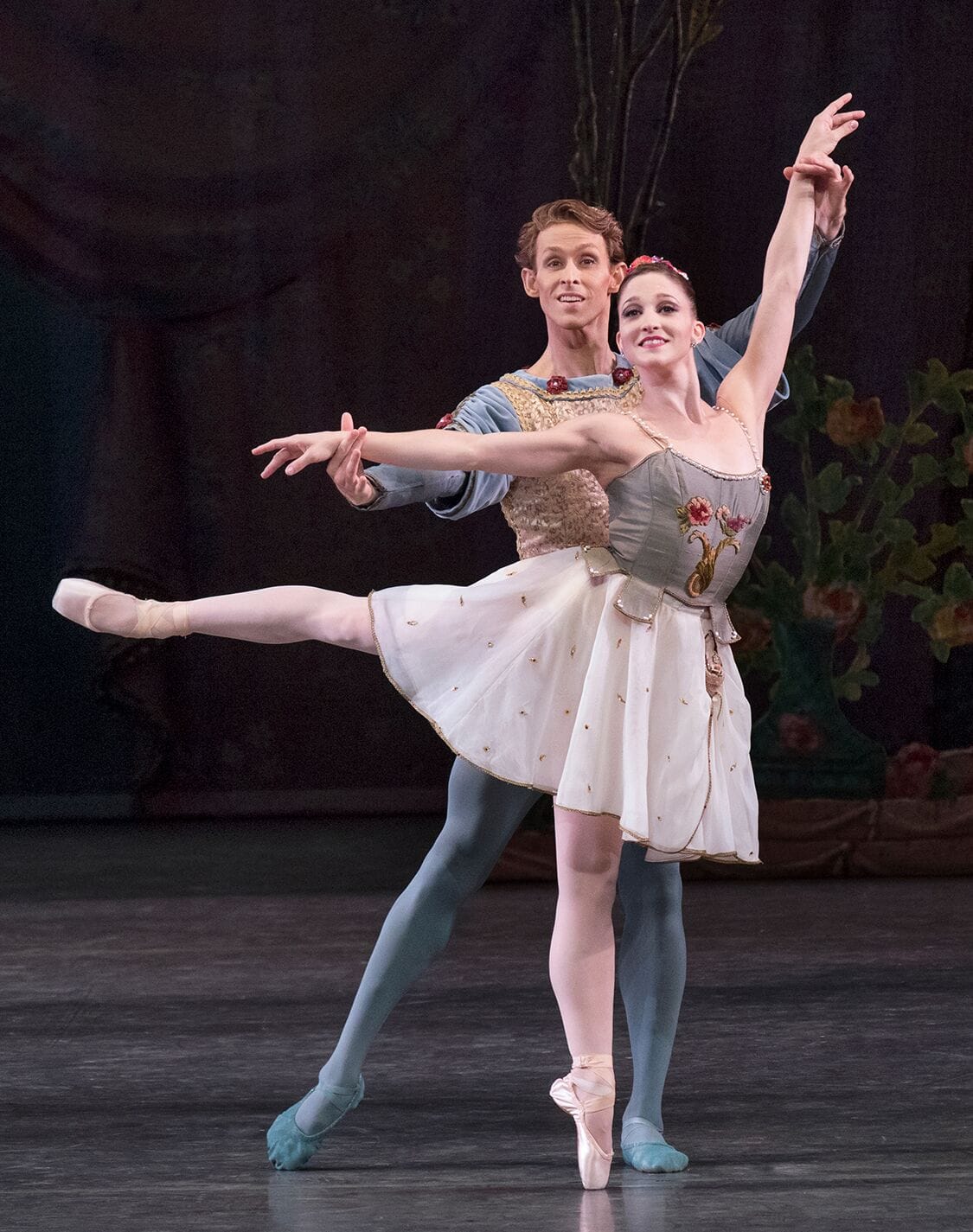
She and her consort Theseus (Aaron Sanz, who dealt with the lovers with a witty exasperation ) oversaw the second act festivities, where Balanchine inserted a luminous abstract ballet, seemingly unrelated to the Act I plot, but, like so many of Petipa's vision scenes, a transcendent interlude. Ashley Bouder and Adrian Danchig-Waring danced the pas de deux. Danchig-Waring was a delicate partner, and brief solo moments had an understated power, particularly his pirouettes which spun with no hint of preparation. Bouder's forthright dancing was directed to the audience, a hostess greeting guests rather than the lyrical mystery that can make the dance shimmer. Her impeccable control and pristine classicism gave her dancing a wonderful shape, but there were no unearthly secrets being shared. She was in an elegant ballroom, not lost in the forest.
Copyright © 2019 by Mary Cargill



