French Pastries
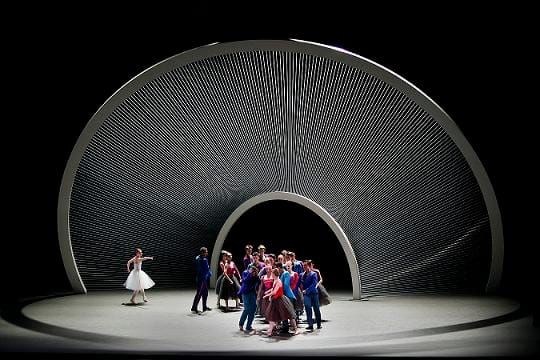
"Why I Am Not Where You Are", "Namouna, a Grand Divertissement"
New York City Ballet
David H. Koch Theater
New York, NY
April 29, 2010
The Spring Gala featured two new ballets, both to French music, and both, according to interviews published in the playbill, based on stories. The evening opened with an intriguing film (by former NYCB dancer Kirstin Sloan) focused on the designs that the architect Santiago Calatrava has done for several of the new ballets scheduled for the season, a tantalizing glimpse of what look to be stunning architectural effects. One of these was featured in Benjamin Millepied's "Why Am I Not Where You Are", to music by Thierry Escaich. The design, silver slats set in a large cut-out semicircle, was the most original and striking aspect of the work. The music, while certainly danceable, sounded very much like "The Firebird" without the folk-tune flavor, and the story was "La Valse" with the sexes exchanged.
Sean Suozzi was the victim, opening the work (dressed in white) with a solo full of floating steps. Groups of girls, in bright, garish costimes (designed by Marc Happel) invade, followed by a group of boys, in more garish costumes, with military stripes on their pants. There is a great deal of hectic partnering, and Sara Mearns, in an even brighter red costume, seems to be the evil genius. The luminous waif-like Kathryn Morgan joins the dance, and seems to be drawn towards Suozzi, though it is clear she can't see him (shades of "Giselle"). Eventually, Suozzi puts on colored clothes (or rather the military meanies dress him), he is blindfolded, and Morgan's colored gown is torn off, leaving her in white. Now she can't see him, and he is carried off, apparently lifeless, and Morgan is left to mourn.
The dancing was fine, though the steps didn't always help; at one point Mearns and Morgan danced together, doing the same steps; we could only tell Mearns was Bad because she had a frown. There was little attempt to use actual steps to convey meaning.
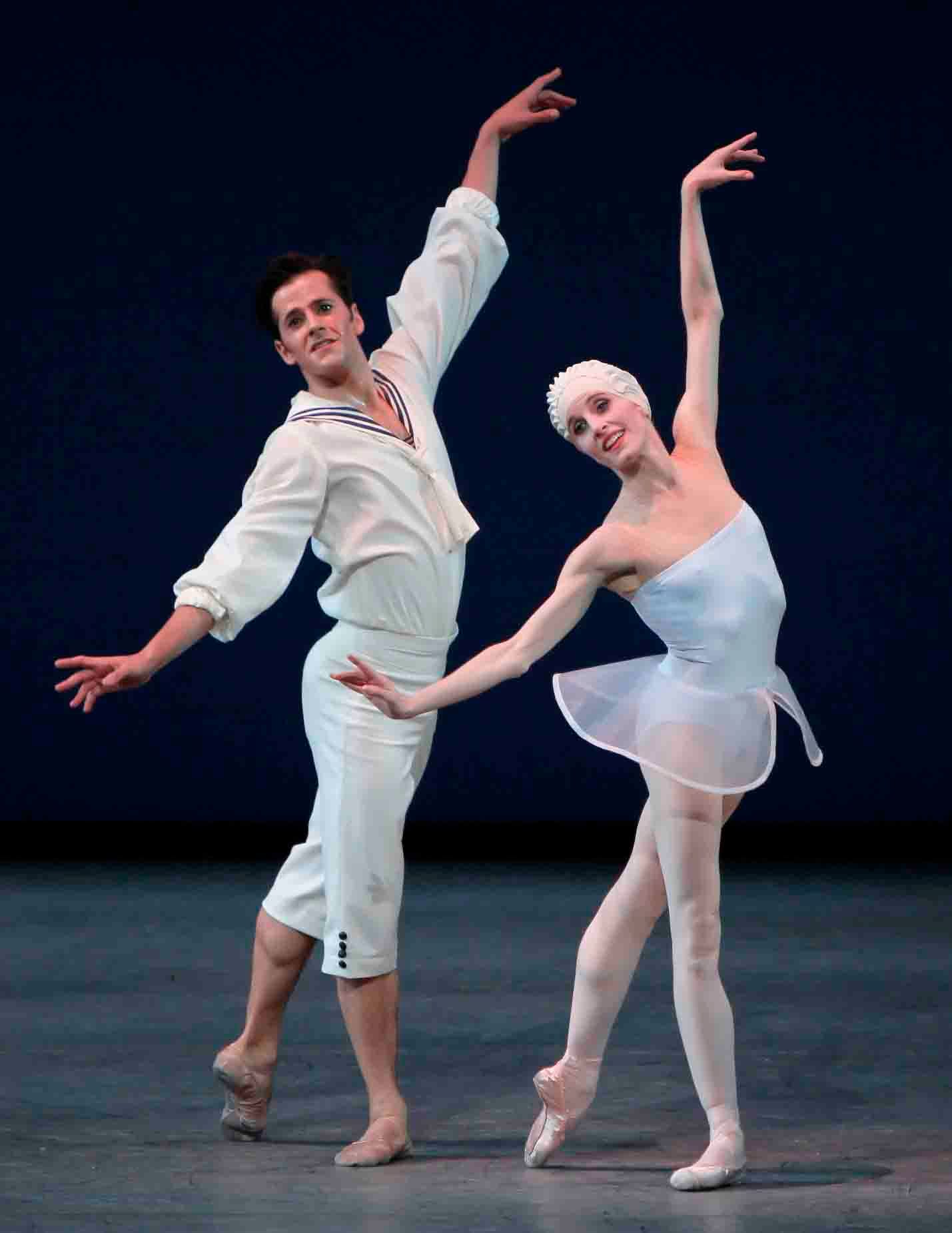
Alexei Ratmansky choreographed his new ballet (which had no sets) to exerpts from Edouard Lalo's 1882 ballet "Namouna", which was not a success, though the music has a spun-sugar delicacy and cheerful, lovely melodies. The original story featured a slave girl and the island of Corfu; Ratmansky says in his interview that he wanted to keep some of the story but make it more abstract and to use simple but effective steps. Many of the steps are simple but effective, and some of the groupings are wonderfully evocative of grand nineteenth century ballets. However, his choreography is completely undermined by some of the worst costumes I have ever seen. (The designers are Marc Happel, also responsible for the cartoon-like costumes of the Millepied work, and Rustam Khamdamov.) The corps wear yellow shifts with what appear to be plastic black Louise Brooks wigs, a long way from the gentle lilt of the music. The yearning hero (Robert Fairchild) gets a boy's sailor suit with white pedal pushers, which has the effect of Solor carrying a big lollipop. His three choices (Wendy Whelan, Jenifer Ringer, and Sara Mearns) vary between colored shifts and stiff, insect wing skirts, with hats that make them look like some sci-fi characters with extra large brains; the poor corps at times join in the brainiac brigade.
Daniel Ulbricht, Megan Fairchild, and Abi Stafford form a pas de trois, completely unrelated emotionally to any of the other goings on, but they have some charming choreography, full of little steps and quick turns (though Ratmansky does have a tendency to give Ulbricht and other dancers too many turns). But their costumes, while not as bad as the exposed brains, are distracting and unflattering--gold bodysuits and helmets don't do much for anyone, much less the compact Ulbricht.
The work was too long and emotionally diffuse, since there was little to distinguish Whelan, who finally ended up with Fairchild, from the other two dancers, except that Ringer did get to smoke a cigarette with our hero. The original libretto included a "valse de la cigarette", where Namouna shares a smoke, but Ratmansky stretched this out into an interminable joke, with much of the corps puffing away. With much cutting, new costumes, and atmospheric sets, this ballet could be charming, but now unfortunately, it meanders in too many directions, and it is hard to tell whether it is an homage, a send-up, or just a time-filler, and the luscious music, the fine dancers, and the nuggets of lovely choreography deserve much better.
copyright © 2010 by Mary Cargill



