French Dressing
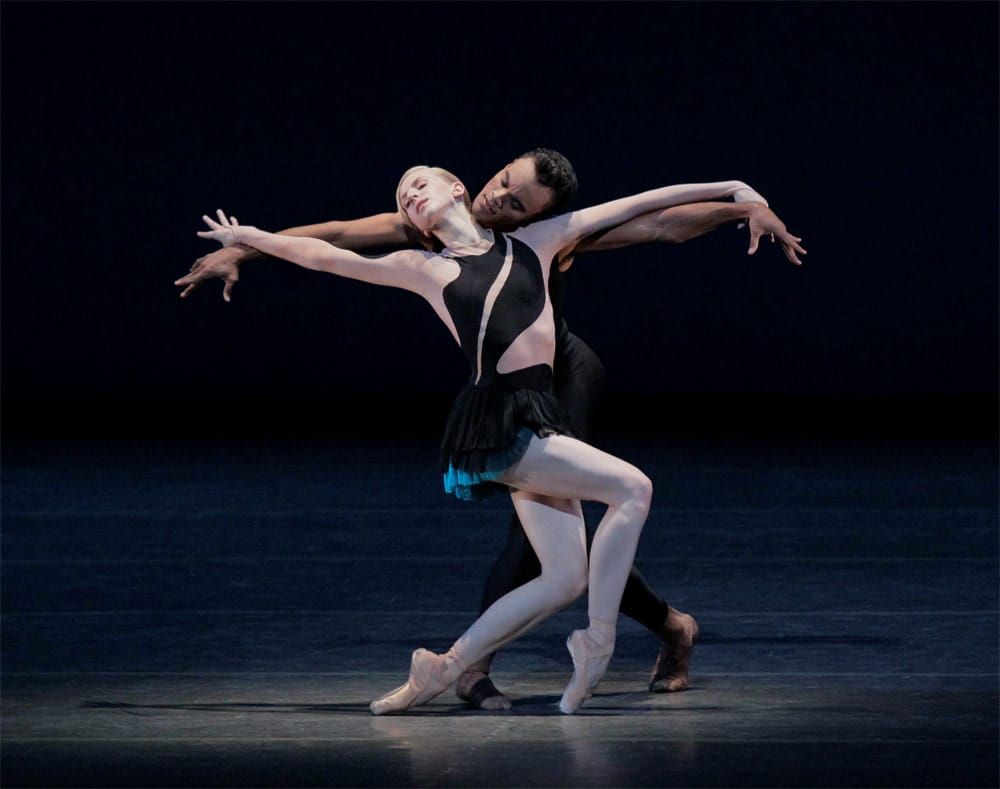
"Mes Oiseaux", "Liebeslieder Walzer", "Symphony in C"
New York City Ballet
The David H. Koch Theater
Lincoln Center
New York, New York
May 19, 2012
Even in the pure-dance air of the New York City Ballet, costumes are important, and the recent triple bill showed a variety of dressings. The first ballet, Peter Martins' new "Mes Oiseaux", was dressed by the dress designer Gilles Mendel, and featured three girls (Lauren Lovette, Ashly Isaacs, and Claire Kretzschmar, all corps dancers) wearing chic black cut-out leotards over colored skirts. They were partnered by Taylor Stanley (another corps dancer) also wearing black. The costumes were simple and flattering, though the girls did without tights, making their legs look pale and knotty--this current trend is always unflattering. But bare legs were not the only issue. Dancers need something to dance, and "Mes Oiseaux" ("My Birds" in English), is a generic collection of unconnected steps which shows little about the dancers. Certainly Lauren Lovette has proved, in other roles, that she is distinctive and gracious dancer, but Martins has her do the same, twitchy steps as Isaacs and Kretzschmar, and it is impossible to tell what drew him to these particular dancers. Yes, they all have great extensions and fluid backs but appear to be completely devoid of personality. Stanley danced with all three dancers (the debt to "Apollo" is obvious), but, since he spent most of his time either hoisting them up by their crotches or dancing with his back to them, all he conveyed was a cool disregard for his partners, reinforced by the finale, which seemed to end in a shrug. His choreography looked like he had been tossed a bunch of moves, which in turn he tossed back at the audience.
"Liebeslieder Walzer", on the other hand, is drenched with emotion. The performance was supposed to have been debuts for all but one dancer (Justin Peck), but Sara Mearns and Ask la Cour were replaced by Maria Kowroski and Jonathan Stafford. Liebeslieder is, for me, one of Balanchine's greatest works, but it is very difficult to perform; the dancers must communicate a feeling of community, of knowing each other well, of a specific time and place. The dancers in the more realistic first act must continue their roles in the more abstract second act, but most of all, these dancers must be adults with grown-up emotions. This cohesion needs to be developed, and for some reason, this most luminous and fragile ballet was only given four performances, two each for the different casts, and it isn't scheduled to return next season. So basically, the performance was a dress rehearsal for something that will never happen.
There were some very fine individual performances. Robert Fairchild, in the role so long associated with Bart Cook and more recently Nikolaj Hubbe, proved yet again that he is a powerful presence. His concentration, his demeanor, his every gesture (no one at NYCB can take a woman's hand with such loving dignity), created a warm, rich human being. His partner, Sterling Hyltin, wasn't able to match his depth. She was rather generically pleasant, and their final pas de deux, where they seem to echo each other thoughts, was danced rather than lived.
Experience isn't really the answer, as Kowroski has danced the Diana Adams/Suzanne Farrell for a number of years. Her first act was somewhat emotionally blank, and it was impossible to tell from her face if her partner's whispered message was "I will love you forever", or "I would like a cup of tea". There is a reason the dancers are in that room, wearing those costumes, and hiking a leg up so that frilly underwear is exposed destroys the feeling the sets and costumes work so hard to create.
Tyler Peck danced the Violette Verdy/Kyra Nichols role, and as always her dancing was impeccable, especially in the second half, where she did seem to become a sylph. I missed Nichol's magical use of the eyes, but it was a fine debut. However, her partner, Justin Peck, didn't project the intimations of tragedy that can make the role so moving. Megan Fairchild, with Chase Finlay, danced the Jillana/Stephanie Saland role. She had a light-hearted approach, a charming, decorous flirt, and I missed the darker undertones some dancers gave the role. Finlay, too, seemed to still be working out his role, though he has a wonderful ability to draw the eye as he stood by watching the dancers.
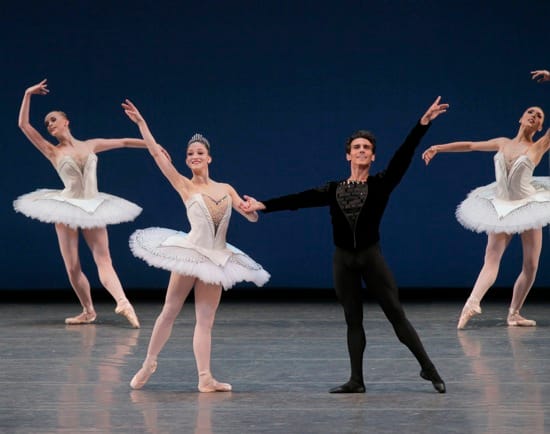
The new costumes for "Symphony in C", as has been widely reported, feature lots and lots of Swarovski crystals. The skirts are lovely (if a bit glittery), with graceful scallops, but the bodices, especially those for the four principal women, have a bit too much flesh-colored netting down the front for the French chic of the music and choreography. The men's costumes have been dressed up, with elegant black velvet bodices, though the black satin shoulder decorations look a bit like mushrooms sprouting in some undergrowth. But nothing, fortunately, detracts from the scintillating, formal, choreography.
Kowroski, doing double duty due to Mearns' injury, danced her previously scheduled second movement as well as the long, difficult Liebeslieder. Her slightly isolated stage presence works better in "Symphony in C", where the dancer is in a world of her own. She may have been tired, but the deep, rich arabesques were a bit wobbly (her partner, the lyrical Tyler Angle, is a bit too short for her), and the fast turns during the finale looked a bit strained.
Abi Stafford, with Andrew Veyette, opened the ballet, and she danced with her usual aplomb and diligence, but was dutiful rather than magnificent. Ashley Bouder and Joaquin De Luz flew threw the third movement. Bouder is a natural jumper, with an ability it seems, to arrive at a position and hold it for a second. But she doesn't freeze a shape, she used the extra time to continue the movemnt into her arms, and there were moments of breathtaking beauty, a combination of speed and calm that was just extraordinary. De Luz, too, combines speed with elegance.
Erica Pereira made her debut in the deceptively difficult fourth movement, with its fast turns and stop on a dime poses. Her first turn came a bit unstuck, but she kept up very well in the furious finale. But there is still an air of a dutiful, eager student about her, which all of the crystals in the world can't disguise.
Copyright 2012 by Mary Cargill



