For the Sunday Funnies

Matthew Bourne’s “The Red Shoes”
Opera House
The John F. Kennedy Center for the Performing Arts
Washington, DC
October 10, 2017
The storyteller, whether it is Homer or Matthew Bourne, entices our attention with living, breathing, recognizable characters with whom we empathize and not with the originality of the tale being told. Bourne, the British choreographer, has a good record of taking familiar yarns such as “Swan Lake”, “The Sleeping Beauty” and “Cinderella” in order to reawaken them as if they were his Galatea. His latest staging starts with the 1948 movie by Michael Powell and Emeric Pressburger that was based on Hans Christian Andersen’s written version in 1845 of “The Red Shoes” – a folk legend.
"The Red Shoes” by Powell and Pressburger has been one of my favorite movies since its premiere. Its romantic view of ballet and of career vs. love wasn’t irrelevant or unrealistic after World War 2 and has held up over the years. One of the movie’s major assets was apt casting (Marius Goring, Anton Walbrook, Albert Bassermann et al.) but especially Moira Shearer in the starring role. She had the freshness of manner and the right shade of red hair to be a convincing Victoria Page – pampered but not spoiled, a promising dancer who stood out from the corps because of her locks and her ambition. Shearer wasn’t yet, in 1948, the full fledged ballerina she would become by the time in 1951 of the follow-up movie of “The Tales of Hoffmann”. Her being unfinished technically, was perfect. However, “The Red Shoes” movie had flaws. Some characters in it were caricatured with too heavy a hand. For instance, part taken by Ludmilla Tcherina seems a needlessly crude parody of a Ballet Russe dancer, perhaps Tamara Toumanova. Still, there were magical scenes, particularly those on the Riviera, that made one forgive the comic book figures.
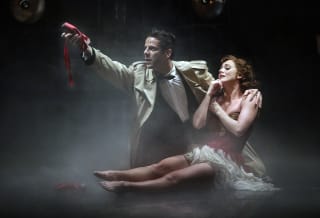
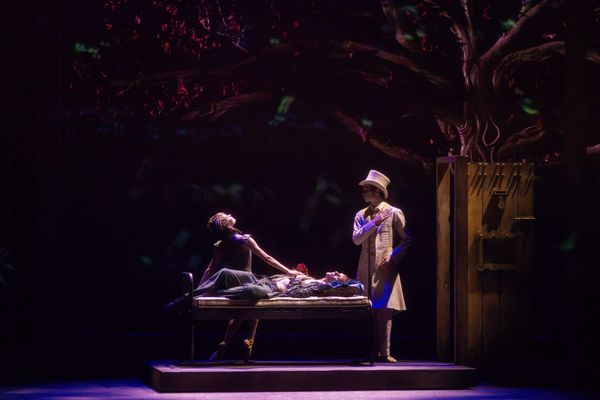
Much of Bourne’s “The Red Shoes” is in comic book style. Even the leading trio of conflicted dancer Victoria Page, impresario Boris Lermantov and musician Julian Craster remains a flat triangle. The action, although familiar to many in the audience, isn’t always easy to follow through the long Act 1. Dance numbers include extracts from a rehearsal of Fokine’s “Les Sylphides”, from a Riviera beach ballet, from a Walpurgisnight orgy and, of course, “The Red Shoes” ballet in which Victoria Page gives her debut performance as a soloist. We are shown a girl tempted to put on red shoes that she then can’t remove until they have danced her to death. For the movie, Robert Helpmann made choreography that wasn’t memorable but did tell that story efficiently. Bourne’s version goes on and on at needless length. There is also a “bad” dance number in which Victoria Page appears after she has walked out on Lermontov’s prestigious ballet company. Its choreography is indistinguishable from Bourne’s “good” dance numbers.
There are duets for Victoria Page and Julian Craster in Act 2 that capture some of their being in love. Full of lifts, they go on too long like “The Red Shoes” ballet. Bourne, throughout this entire show, can’t seem to stop being repetitious. The projection of Bernard Hermann’s music sounded pounding and shrill; stretches of silence seemed not significant but awkward. At this performance, the rotating proscenium curtain used for smooth changes of scene, got stuck soon after the start of the performance and caused a lengthy delay. Throughout, Bourne used this way of changing scenes too often.
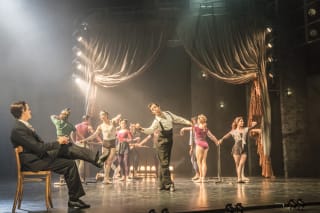
It is to the credit of the 25 members of Matthew Bourne’s New Adventures troupe that a good part of the opening night audience stayed through a long intermission to the end, and some beyond to a post-performance discussion. As the musician Craster, the well known Marcelo Gomes tried to give dimensions to his character by contrasting patience and impatience in his behavior. Ashley Shaw’s Victoria Page had persistence, the characteristic of a fighter who survives. Where were the traits of a woman torn by conflict? The dominating Lermontov, as portrayed by Sam Archer, became somewhat human in Act 2, although Bourne didn’t allow him variety for his melancholy brooding. All in all, a worthy tale not well told.
copyright © 2017 by George Jackson