For the Future?
The Suzanne Farrell BalletOpera HouseThe John F. Kennedy Center for the Performing ArtsWashington, DCDecember 7 & 8, 2017 by George Jackson
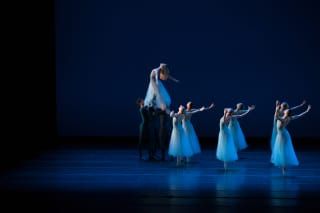
First things first! Last night, December 8, the company danced the greatest "Serenade" of the countless ones I've seen. It had utterly remarkable accelerations with the fastest allegros plus the richest retards. These things were independent of any particular dancers, and yet all were part of it. The phrasing changed my idea of "romantic" and "classical" in ballet. This was a new beast! Tonight, "Serenade" will be the final work on the Suzanne Farrell Ballet's final program. Everyone who cares about ballet should try to see it.
Otherwise, the company directed by Suzanne Farrell looked spic and span for the four final performances, December 7 - 9, at its home theater, the Kennedy Center. There had been brief engagements earlier this season at Florida State University and at Purchase College in New York State. Repertory for all these appearances consisted of five George Balanchine works - three larger ballets ("Chaconne", "Gounod Symphony" and "Serenade") plus two smaller pieces ("Tzigane" and "Meditation") arranged on two somewhat different programs. Especially the "Gounod" requires a big cast, 32 dancers, whereas "Meditation" is a duet. The mobile architecture of both these ballets fit well into the ample space of the Opera House and, at last, the ballerina for "Tzigane" - Natalia Magnicaballi - looked and behaved plausibly like the role's originator - Farrell!
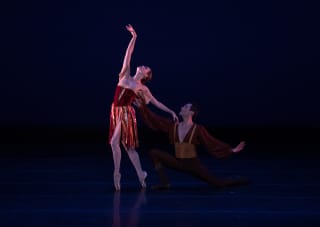
"Tzigane" begins as a gypsy romp for a sultry female figure whose flourishes with the palms of her hands and whose finger pointing evoke fortune telling. Alone on stage with Ravel's folksy music for a fiddler, this woman spins an atmosphere of allure and danger. Joined by a man who remains somewhat foreboding, the woman stretches forward eagerly and sinks back into his arms with satisfaction. As a couple, they are joined by four other pairs, stepping lively to conclude the scene with a heel-toe-heel, legs turned-in and turned-out, knees suspended, whirling czardas. Of all five works danced during this run, "Tzigane" most pointedly posed the question of what will Farrell do from now on?
After retiring from dancing in 1989, Farrell had started staging ballets during the 1999/2000 season and founded her company the next year. There was praise for her fresh and finely nuanced productions of Balanchine ballets and, on occasion, works by other choreographers such as Jerome Robbins, Maurice Bejart and Paul Mejia. Adverse comments often concerned the caliber of her dancers. As an ensemble, the part-time, pick-up Suzanne Farrell Ballet was judged to be no more than adequate. She tried to counter this criticism by collaborating with permanent companies, but her enterprise remained maverick and recently its sponsor, the Kennedy Center, decided to terminate it after the current season. From now on, will other companies ask Farrell for her insightful stagings? If not, that would be a loss for the practice and art of ballet.
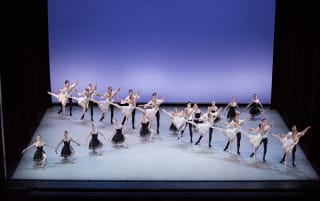
The distinction Farrell makes between the boxy, baroque pomp of "Chaconne" (to Gluck's music) and the complex, concentrated intricacies of "Gounod", is an example of why her company has been needed. Both these ballets deploy the dancing human body sharply, angularly i.e., neo-classically. Yet, there are fine differences of attack between "Chaconne" and "Gounod". The dynamic Balanchine devised for the Gluck music is simpler and it was right that the dancers cut its limb angles more evenly than for Gounod's score with its hints of inflection.
The great surprise, though, of these last performances, has been the Tchaikovsky "Serenade (for Strings)". It harkens back to Balanchine's 1934 steps. This was the first ballet he choreographed after arriving in the USA. Its women, enveloped in skirts of flowing gauze, are often seen as examples of neo-romantic ballet. Yet, is it ahead into his athletic American future that Balanchine looked with this choreography, or was he remembering Russia and its robustly romantic past? Farrell's staging leaves no doubt that "Serenade" is singular. Its leaps have thrust. Its dominant direction is forward. The dancers' attack is daring, bold. When there is collapse, it is not final but matter-of-fact and reversible. Rebirth remains an option.
"Meditation" was given two rather different performances. Elisabeth Holowchuk and Kirk Henning danced it with so much passion on December 7 that every moment of this terminated encounter of lovers seemed actual. I preferred Heather Ogden and Michael Cook's rendering on December 8, in which she is a memory that materializes for a spell. When she departs, the man continues on his bittersweet way.
Among those contributing importantly to the Farrell company have been its ballet mistress Kristin Gallagher, conductor Nathan Fifield for the Kennedy Center's Opera House Orchestra and that orchestra's violinist and concert master Oleg Rylatko (in particular for "Tzigane"), and also administrative director Meg Booth. Of the leading dancers, Heather Ogden can be seen at National Ballet of Canada and Natalia Magnicaballi at Ballet Arizona. Kirk Henning and the fleet Thomas Garret have been at Virginia's Richmond Ballet. Violetta Angelova, Allynne Noelle, Elisabeth Holowchuk and Michael Cook are independent dancers. Farrell never casts her stagings until the last moment. For the December 8 "Serenade", the dancers were led by streamlined Ogden plus Angelova, Magnicaballi, Cook and Ted Seymour. I'm looking forward to tonight's casts.
copyright © 2017 by George Jackson



