Flamenco Speaks
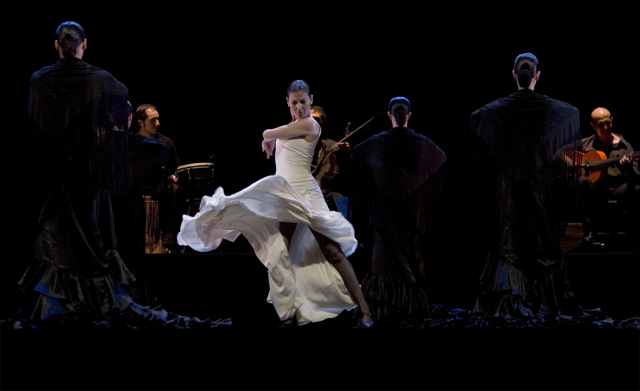
"Voces, Suite Flamenca"
Ballet Flamenco Sara Baras
New York City Center
New York, NY
March 4, 2015
With a mix of traditional and modern styles, the U.S. premiere of Saras Baras’s new “Voces, Suite Flamenca” paid homage to and quite literally presented the “voces” – “voices” – of flamenco greats who have inspired Baras and transformed flamenco music, songs and dance. In doing so, “Voces” eluded any narrative or interpretation, but instead showed several distinct vignettes introduced by recordings of the legends speaking about their craft, each of which set the tone, though not the themes, for Baras, her husband and dance partner José Serrano, six corps dancers, three singers, and four musicians to pay their tributes in their own voices.
When the curtain went up, Baras was already onstage. Several upturned chairs and tables greeted the audience and six posters of the late flamenco stars, the guitarists Paco de Lucía and Moraíto, singers Camarón de la Isla and Enrique Morente, and dancers Antonio Gades and Carmen Amaya, adorned the back. With a lift of her head and a piercing look toward the audience, Baras, dressed in simple black pants and white shirt, slowly walked along the stage, pausing before each picture as a spotlight illuminated it, as though in an unspoken dialogue with them.
This pensive episode ended with the company’s corps dancers replacing Baras on the stage, and soon the first voice, that of guitarist Paco de Lucía, came through the speakers. He spoke of the sea, the flowing nature of the music, and the insatiable drive to be the best guitarist and expand the language of flamenco’s musical vocabulary. Famous for introducing percussions and the Peruvian instrument cajón within flamenco, the guitarist’s passion and quest for innovation was echoed in Baras’s performance when she returned to the stage in a long dress, and, joined by Serrano, proceeded to dance. The couple alternated doing small solos, feeding off each other, their footwork building up with technical intricacies and pushing the limits of expression with each amplified punch of the heel.
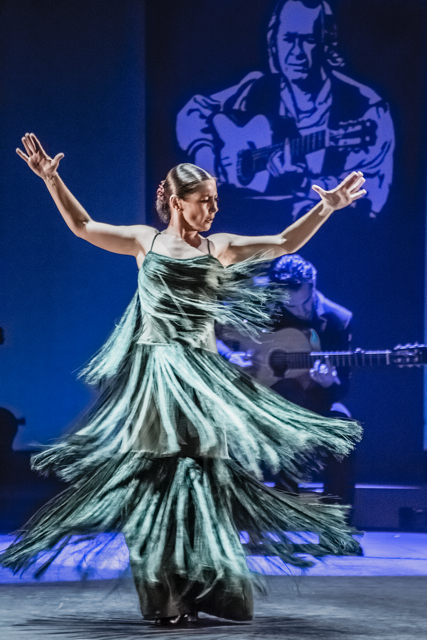
Serrano’s sections seamlessly blended with the rhythms set by the musicians, expertly climbing and riding the waves of the intensity they set for the music, then cuing Baras in. Known for liberally adapting traditionally male virtuosity of flamenco footwork into her dancing, Baras reflected Serrano’s movement and at times extracted from her serrated steps even fiercer rhythms than he did. This duet of individual expressions ended passionately in an embrace, with a piece of Serrano’s scarf on Baras’s face – a small mishap. Not missing a beat, she brought it to her lips, and then slowly, but passionately, handed it back to him, not letting anything interfere with the sea of submerging emotions born of their dancing.
Flamenco is undeniably these dancers’ element, and almost all of the dances that followed focused on either Baras or Serrano. Indeed, if there was any real fault in the show it was in the size of the spotlight that Baras carved out for herself and her husband. But with dancing like that, who could blame her? The corps, though impressive in the few dances where Baras was absent, such as “Las Carmenes” that loosely told the story of Carmen (and the music drew on the Bizet score), didn’t come close to the personal identity and technique that Baras possesses. That contrast was most apparent in “Taranta,” a dance where the three men and women were given solos along with Baras and still weren’t able to detract from the magnetic pull of the diva’s stage presence.
Though all the dances dazzled with breathtaking speed and precision in the footwork and flamenco’s fiery energy, the night’s true highlight were two separate, introspective solo numbers by Baras and Serrano. His followed the introduction by the voice of Enrique Morente, speaking of the need for freedom in art. The multicolored signing of varying and rich textures that accompanied Serrano’s dancing together forged a mesmerizing, near-hypnotic experience that built to an explosive breach of that state as Serrano’s movement exploded with liberated power and strength toward the end of the piece.
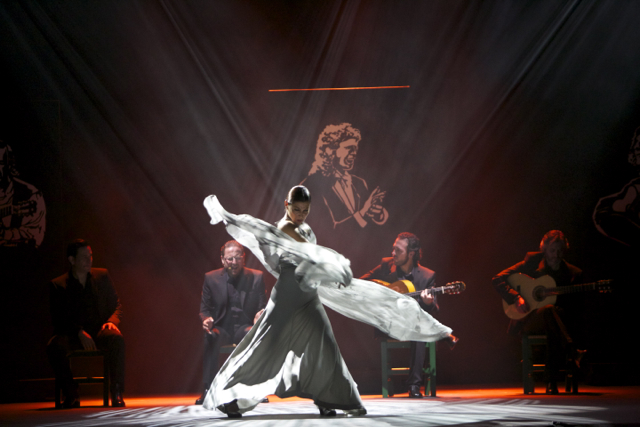
Baras’s solo, by contrast had a minimalist, intimate quality. Staying alone on stage, with the legends’ posters rotated away from the audience revealing mirrored sides instead of portraits forming a semi-circle, Baras started a slow, exploring dance accompanied only by guitarist Keko Baldomera and her own reflections. Dancing in a sleek black pantsuit, much like one of the evening’s honored heroines, Carmen Amaya, who controversially first donned the more masculine costume for the dance many decades ago, she seemed to listen to the music, pausing often, testing it with serpentine hand coils, then letting her razor sharp footwork cut through it and expose the burning red fire of flamenco blood.
Undoubtedly the voices Baras presented were as much her own and her dancers’ as they were her inspirations', and whether they always said the same thing is debatable. One thing was clear though: when flamenco speaks, the audience listens.
copyright © 2015 by Marianne Adams



