Flamenco Festival
Compañía Eva Yerbabuena
March 9, 2018
Ballet Flamenco Jesús Carmona
March 11, 2018
Flamenco Festival
New York City Center
New York
Each year the Flamenco Festival brings several of Spain’s major companies to New York. This year one of them was headed by a woman, Compañía Eva Yerbabuana, another by a man, Ballet Flamenco Jesús Carmona. The were very different, but less due to the gender of their directors than to their approach to the medium. Yerbabuena’s show, meticulously produced, included innovations but in general honored flamenco’s tradition. Carmona’s concert was messy and exuberantly experimental. The titles each had chosen for their performances were telling. Hers was “Carne y Hueso” (meat and bones), his “Ímpetus” (bursting with energy); not that these reflected any kind of narrative in the programs, rather they indicated the direction each dancer-choreographer intended to take.
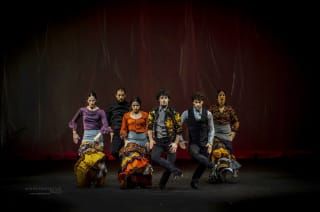
Yerbabuena’s company consisted of herself, five male dancers, three singers, one guitarist and a percussionist. The show began with a dramatically darkened stage through which triangular shafts of light penetrated from above, while smoking dry ice swirled about. Spotlights picked out the dancers as they proceeded through eight numbers, each in a different flamenco rhythm.
Yerbabuena did no dancing with the company. Rather, as is the tradition in flamenco, she was seen only in solos, accompanied by singers and musicians. Her first appearance was from the back of the stage, walking slowly forward into the light. As she did this, the singers’ voices alternated and overlapped in ways that were hauntingly reminiscent of the call to prayer as it echoes through a city from one meuzzen to another. This sound seemed to encapsulate the entire history of flamenco, its Muslim, Sephardic and gypsy roots melded together.
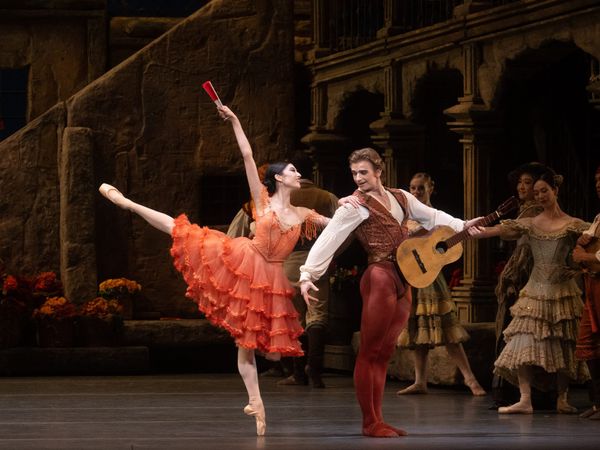
For the dance (soleá) Yerbabuena wore a multi-colored dress and apron, looking like a country woman dressed for a festival. Her dancing is not elegant, but rather, fiercely powerful. Her gestures are harsh, blunt, and energetic. She points, windmills her arms or flings them out above her head, she trembles her fingers, picks up her skirt roughly, jumps into a shallow squat. It’s the flamenco one imagines seeing at a village fête, but danced by a virtuoso. It is an artistry that mirrors the pain of the harsh life expressed in flamenco song. Then there is her footwork. She is like a Spanish Savion Glover, seeming to pay no attention to the audience, focused on the rhythm spelled out by the guitar, the clapping of the singers (palmas, an art form of its own), and the song. The feet, moving with flashing speed, contribute to and complicate the rhythm, one instrument in communication with the others.
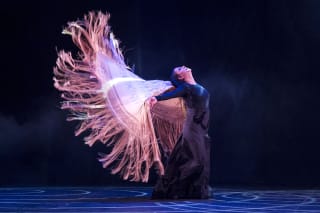
Yerbabuena’s second dance, to petenera, was done with a huge fringed shawl, which she manipulated when she danced, carving arcs in space, or wrapping herself tightly within the fabric. The third solo ended the evening and was an alegrías, one of the few light-hearted flamenco songs and rhythms. For this Yerbabuena wore a man’s traditional costume of pants and bolero jacket, here feminized in apricot with crystal embroidered vest. The dance focused on footwork and was spectacular in its speed, complexity, and her connection to the musicians.
Most of the rest of the numbers featured the male dancers (Christian Lozano, Ángel Fariña, Fernando Jiménez, Mariano Bernal, and Alejandro Rodrígez) often in synchronized movement, all of it polished and highly disciplined. If there were a few more bare chests than necessary, so be it. For once it was the men who were objectified. The evening included one solo for Jiménez called “The Clown” (a bulerias), which was a flamenco Charlie Chaplin imitation, and the single miscalculation of the evening. Although well-performed, it was out of keeping with the rest of the program.
Paco Jarana was the evening’s able guitarist, accompanied on percussion by Antonio Coronel--not a traditional element in flamenco, but used with tact. The excellent singers were Alfredo Tejada, Enrique el Extremeño and José Valencia, the last a guest artist who was given a solo. But it was Enrique el Extremeño who made the most profound impression, his voice deep, rich and full of an emotion that burst from a contained interiority.
Carmona’s show seemed on paper to be very similar to Yerbabuena’s in structure, consisting of what looked like nine individual dances. In fact, all the numbers were run together, so it was difficult to know what one was seeing. This may have been an effort to make the evening a seamless whole, but instead, it was often confusing. On the other hand, one can understand Carmona’s desire to open up the flamenco performance structure. This is hard to do because the form is not given to an overarching narrative or even a thematic through-line because it consists of independent songs and rhythms. Even the verses of songs may be independent of each other, like individual haiku.
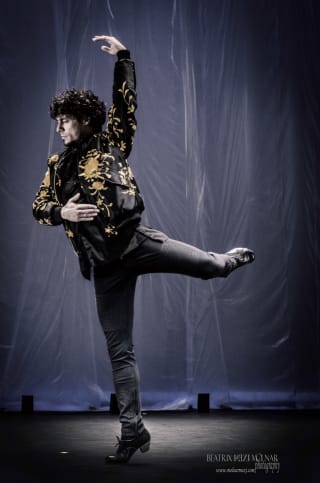
Format was not the only area where Carmona pushed flamenco’s boundaries. His musicians included a violinist (Alexis Lefevre) and percussionist (Paco Vega), as well as the traditional guitarists (Daniel Jurado and Oscar Lago) and singer (Jonathan Reyes). The violin, in particular, was an unusual choice of instrument. As for the dances, Carmona calls his company “ballet flamenco” and ballet was often in evidence in the interpolation of ballet steps into the flamenco idiom. Multiple pirouettes, attitude and chaîné turns, even a series of pas de chat, made their way into the dances. Here again, Carmona appeared to want to extend flamenco’s technical and emotional range.
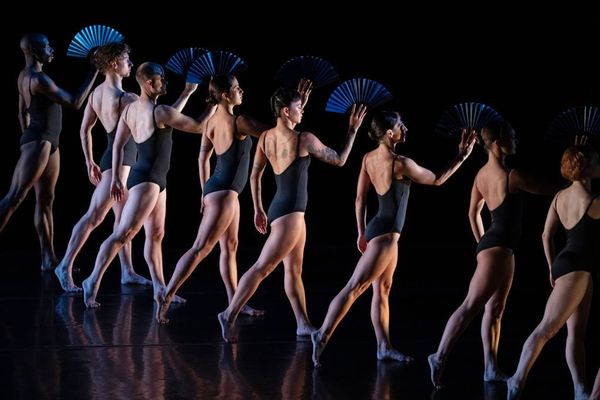
As opposed to Yerbabuena, Carmona often performed with the other dancers, and his production felt more like a company endeavor than a soloist with back-up. His opening number was not flamenco at all, but was set to Isaac Albeniz’s well-known “Asturias,” although given a flamenco flavor in Lago’s adaptation. To this music Carmona began with an extended period of arm movements that were often sinuous enough to recall “Swan Lake.” He then moved into a more purely flamenco vocabulary, although with ballet additions. He was joined by the other dancers in this first number, which then segued directly into the next. There was a trio for the women (Lucía Campillo, Águeda Saavedra and Marta Gálvez), who traded a large fringed shawl, much like Yerbabuena’s, while they moved, and another for a man and woman (Galvez and Cristian García), which they did without the high-heeled shoes and boots normally used in flamenco. At one point the dancers walked on and off the stage a number of times in semi-darkness, as if channeling postmodern dance.
Then finally, in a buleria and the last two dances, a seguirilla and caña, Carmona demonstrated why he is called extraordinary. Here he worked primarily with his singer, Reyes, as they played off each other. Like a baseball player that can pitch 100-mile-an-hour balls, Carmona has a technique that is astonishing. But even these dances were not all about footwork. Carmona also took time for stillness, not just to prepare for the next round of ferocious movement, but to locate himself in a particular moment. The audience was not always patient with this, perhaps wanting more excitement, but it added another important dimension to his performance.
Altogether, the Yerbabuena and Carmona companies not only made an interesting contrast, they also showed where flamenco, at least in its staged versions, is today. Both are gifted, serious artists, and whether highly experimental or more traditional, both demonstrated a respect for their art form that was encouraging in an age when dumbing down or rank commercialism is more often the norm.
copyright © 2018 by Gay Morris