Fiesta Ware
"Don Quixote"
Bolshoi Ballet
David H. Koch Theater
New York, NY
July 22, 2014
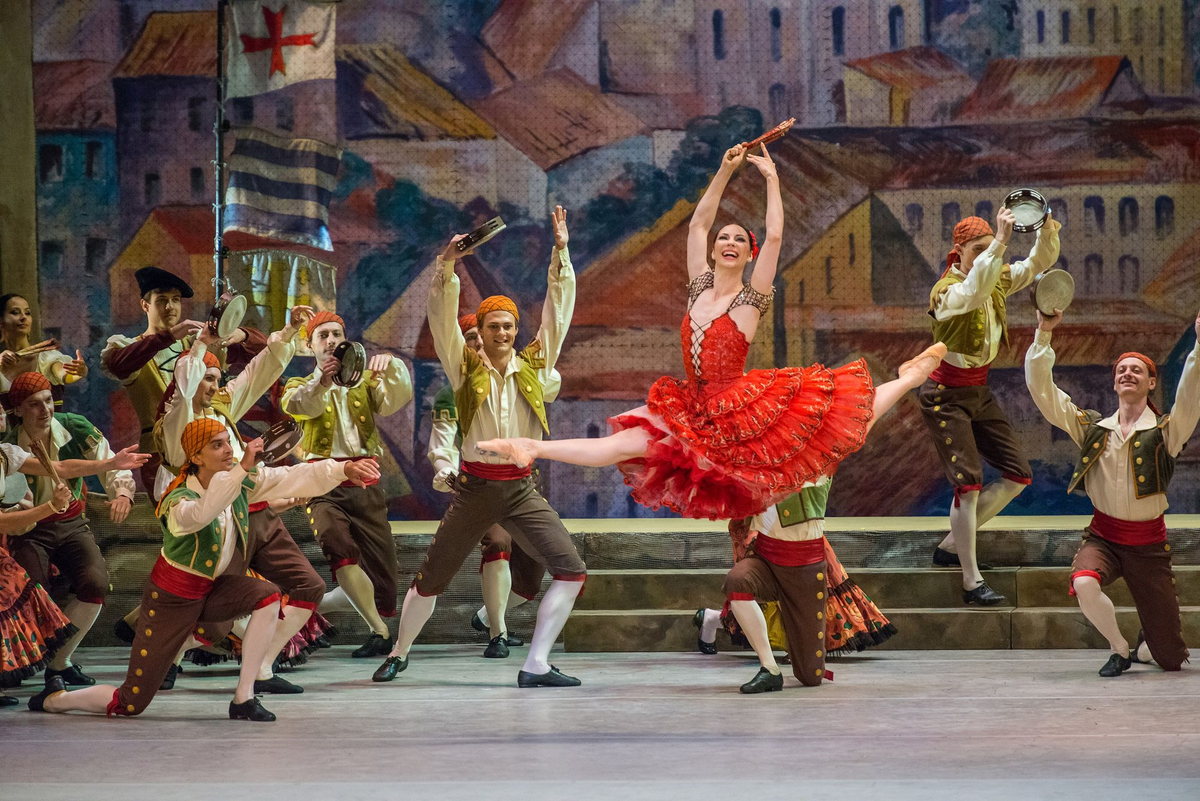
The Bolshoi's "Don Quixote" has a venerable history; Petipa choreographed it for the company in 1869, and, with various revisions, most notably by Alexander Gorsky in 1900, the Bolshoi has been dancing it steadily. this current version, from 1999, is a restoration of the Petipa/Gorsky version, with some enhancements. The costumes, too, are based on older ones, the 1903 designs by Vasily Diyachkov, though I suspect that Espada has helped himself to some extra sequins. And the classical variations in Act 1 (Kitri, two friends, and a street dancer) are now danced with bare legs and scruffy beige point shoes, which don't look at all 1903ish. Perhaps this is meant to give Kitri and friends a realistic barefoot peasant air, but point work is completely artificial and combining it with wobbly bare flesh is a bit off-putting, especially since the corps were quite spiffy in bright white tights and shiny black shoes.
Bare legs aside, "Don Quixote" shows off the company's many strengths, it open-hearted bravura and its full-blooded character dancing. There were a bewildering number of character dancers--Mercedes, a Spanish dancer, a gypsy, and a bolero couple all had their turns, adding nothing to the plot except color and thrills. Indeed, the Bolshoi's "Don Quixote" can be viewed as a variety show, full of unrelated numbers, hosted by the Don, with Kitri and Basilio as frequent guest stars.
The Don, Alexei Loparevich, is a tall, lean dancer, and he gave the character a quirky dignity. His subtle and understated mime showed a dreamer who could fall asleep in the middle of his books, a gentle soul who was welcome anywhere. Maria Alexandrova, the Kitri, has been clicking her castanets for a number of years. She is just coming back from a serious injury and at times seemed to be dancing on a smile and a prayer; this was not the most technically flashy "Don" I have ever seen but it was ond of the sunniest. Alexandrova's smile seemed to embrace the audience as if she were telling each one that dancing for them was the final feather in her fan, and at the same time managed to include the rest of the cast. She even avoided the old Bolshoi shtick of stopping the music after the fouettes to soak up the applause, letting Basilio burst into his turns at the crest of the music.
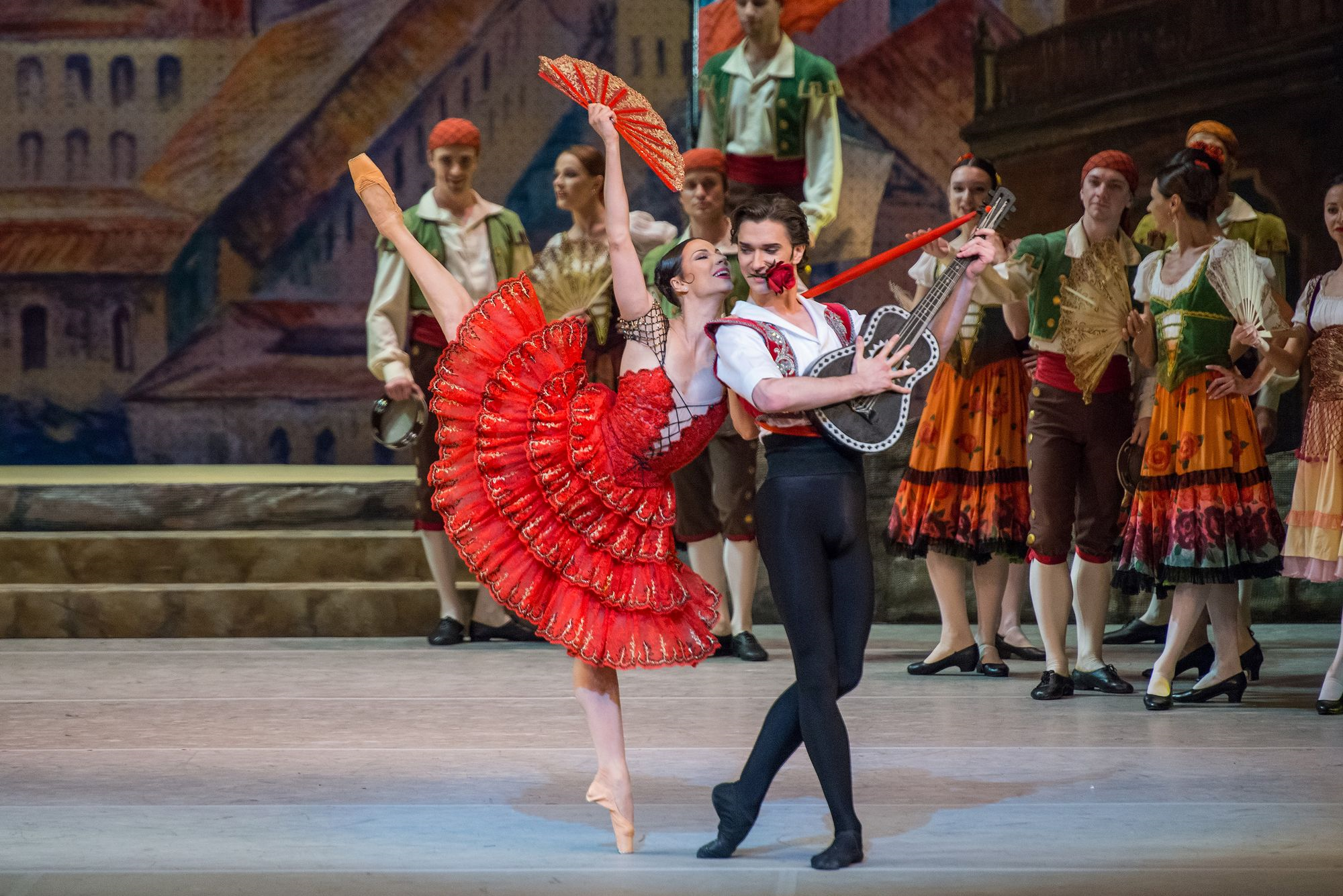
Her Basilio, Vladislav Lantratov, was completely captivated. He is somewhat slim for a Bolshoi dancer and at times seemed a bit overwhelmed by Alexandrova's burst of energy, but he has an appealing charm, somewhat reminiscent of Angel Corella's, and his dancing was clean and sharp, and his mime clear. The Bolshoi's fake suicide takes place in the second act, almost as a throw away amidst a lot of Spanish swishing in that very crowded tavern, so the love story is somewhat downplayed, but any Kitri would be happy with his Basilio.
The tavern's Spanish contingent, including Mercedes (Oxazna Sharova) in red, dancing on a table, and an unnamed Spanish dancer (Maria Zharkova), in white, who danced on the floor, assisted by a couple of guitar players, were ravishing, as they showed off their liquid spines to no one in particular.
The gypsies, too, camping by the windmill, had no dramatic point, though their various dances were utterly engaging--in Bolshoi land, gypsies even sleep with their tambourines. Kristina Karasyova danced a gypsy solo, interpolated by Kasyan Goleizovsky in 1940. This fierce and elemental solo, full of rage and despair, looks like it was created from smoke and boulders, a world away from the 19th century hub bub surrounding it. But it was a world that only the Bolshoi can create and it was an honor to see it.
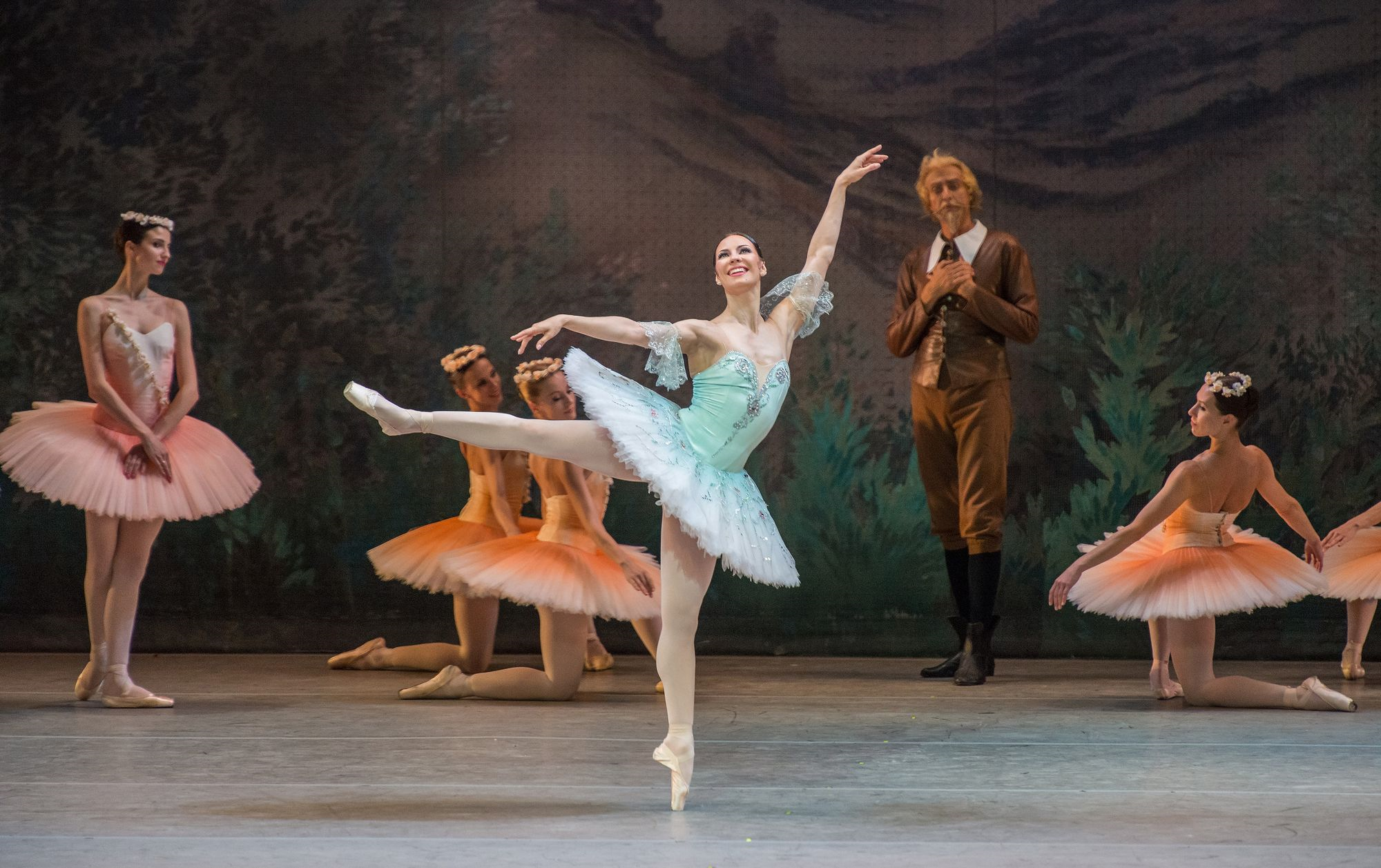
The dryad scene is danced in daylight, far away from the misty vision of ABT's version. The Don was more visible, and the dryads seemed more playful, teasing him as they danced around him. Olga Smirnova was the dryad queen, and her Maryinsky training showed in her lush upper body; I loved the way she smiled at the Don, almost flirting with him. Alexandrova danced with a classical purity, but did not try to turn herself into a vision; she was the same forthright, happy, and captivating dancer in every act. Her Act III solo, with the little prancing steps, was especially lovely, both delicate and powerful.
The other classical variations were very well danced. Maria Vinogradova, Anna Tikhomirova, as the Street Dancer (the matador Espada's main squeeze in Act I, never to appear again) was thrilling as she boureed through the daggers. She was obviously a Kitri in training, as she showed off her jumps, kicking the back of her head with abandon. Maria Vinogradova, in the first variation of the final grand pas, showed off a fluid, effortless jump. The corps, too, with their hearty character dancing, deserves special praise, and the orchestra, led by Pavel Klinichev, sparkled, and brought out unexpected nuances in the cheerful, tuneful, danceable Minkus score. For all its silliness, "Don Quixote" has been entertaining audiences for years, and Alexandrova, even with her current technical limitations, made it seem fresh.
copyright © 2014 by Mary Cargill



