Falling Forward
Fall for Dance Program 1
"Wartime Elegy", "Piano Songs", "Sama"
National Ballet of Ukraine/Aaron Bell/Gallim
New York City Center
New York, NY
September 18, 2024
The Fall for Dance Festival at City Center is 21 years old this year and, based on the rapturous audience reception on opening night, shows no sign of slowing down. Ticket prices have increased from $10 to $30, still an incredible bargain. The opening night program featured the usual eclectic mix; a classical company, a solo, and a modern work. The valiant National Ballet of Ukraine brought the New York premiere of Alexei Ratmansky’s 2022 “Wartime Elegy”, Aaron Bell of American Ballet Theatre danced Tiler Peck’s “Piano Songs”, co-commissioned by Fall for Dance and the Vail Dance Festival, and the innovative modern dance company Gallim danced “Sama”, choreographed by its director Andrea Martin in 2019 for the Juilliard School and the British company Rambert2.
Though certainly topical, “Wartime Elegy” was not overtly political; there were no villains, just an underlying sadness. It featured eight dancers from the much larger company and had three parts, with an elegiac opening as the dancers in black (the four women in flowing chiffon skirts and the four men in short black unitards), form and reform into small groups, seeming to comfort each other. Occasionally dancers emerged for a solo or pas de deux, but the emphasis was on the community and the shifting, haunting architecture of the group. The choreography was not flashy—lots of beautifully extended arabesques and low lifts—and the music, by the Ukrainian composer Valentin Silvestrov, was gently melodic.
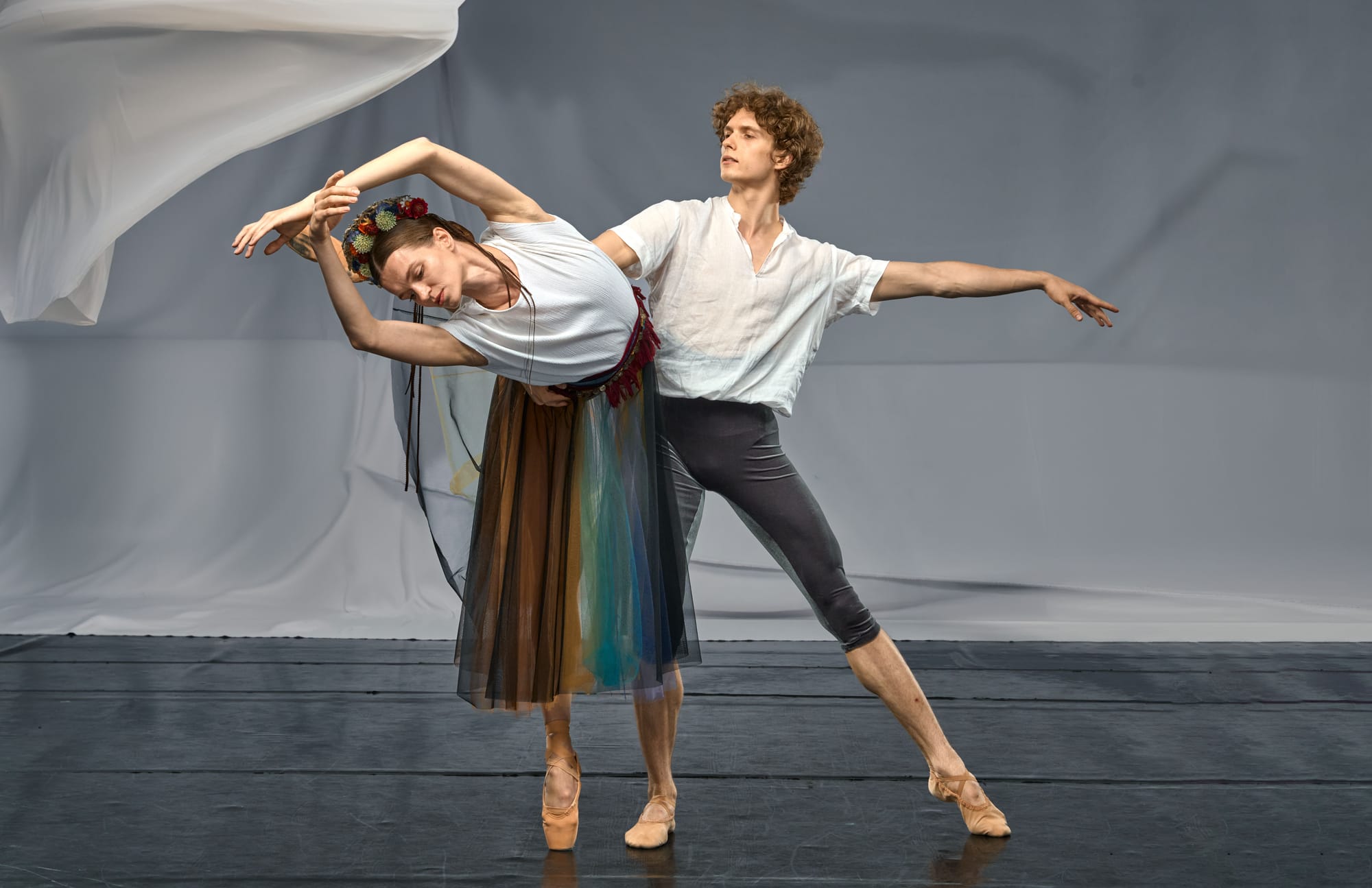
The middle section, to recordings of Ukrainian folk music, may have represented the memories of happier times or hope for a peaceful future. The dancers changed costumes, returning in modified peasant garb, the men with knee length tights and loose shirts and the women with colorful skirts and crowns of flowers. They danced bright, slightly stylized folk dances (the women were on point), with lilting arms, swaying torsos, and liquid jumps. The men, in a friendly competition, had more exuberant jumps and lots of bouncy footwork.
The mood then shifted back to grey, and the dancers appeared to merge into shadows, rising and falling, and finally reaching upwards toward a faded projection of Nike, the goddess of victory. It is impossible and I don’t think necessary to try to separate the ballet and the company from the current events; they are beautifully trained and elegant dancers, but beyond their physical gifts, their (and Ratmansky’s) commitment to art and beauty under such appalling circumstances is both humbling and uplifting.
Aaron Bell’s solo, danced after a brief pause, had no dark undertones but he was able to capture the audience with his open and winning dancing. It was simply set with two pianos on stage and a simple dark backdrop, which rose to reveal a gold drop halfway through the piece. The choreography had an improvisational quality, alternating between bravura jumps and moody introspection, as if Bell were wondering what to do next. He is a charismatic performer and an elegant dancer, but the piece did meander a bit; in the end he (or Peck) just gave up and he lay down, exhausted. It was a fun, if shallow, dance.
Andrea Miller’s “Sama” aimed for depth. The promotional material quoted the choreographer on the work: ”In the digital and information age we might be numbing our bodies as the fundamental key of being in the world and knowing it. Is this the beginning of an apocalypse of the body? There are essential, ambiguous and complex elements of our humanity that we can only be accessed through our physical experience. Forget conventional, oversimplifying or automated rules of reasoning. The body is the chance of being without reducing.” The work itself was a vigorous and dynamic feast of movement, but clearly philosophical musings and dance can be uneasy companions.
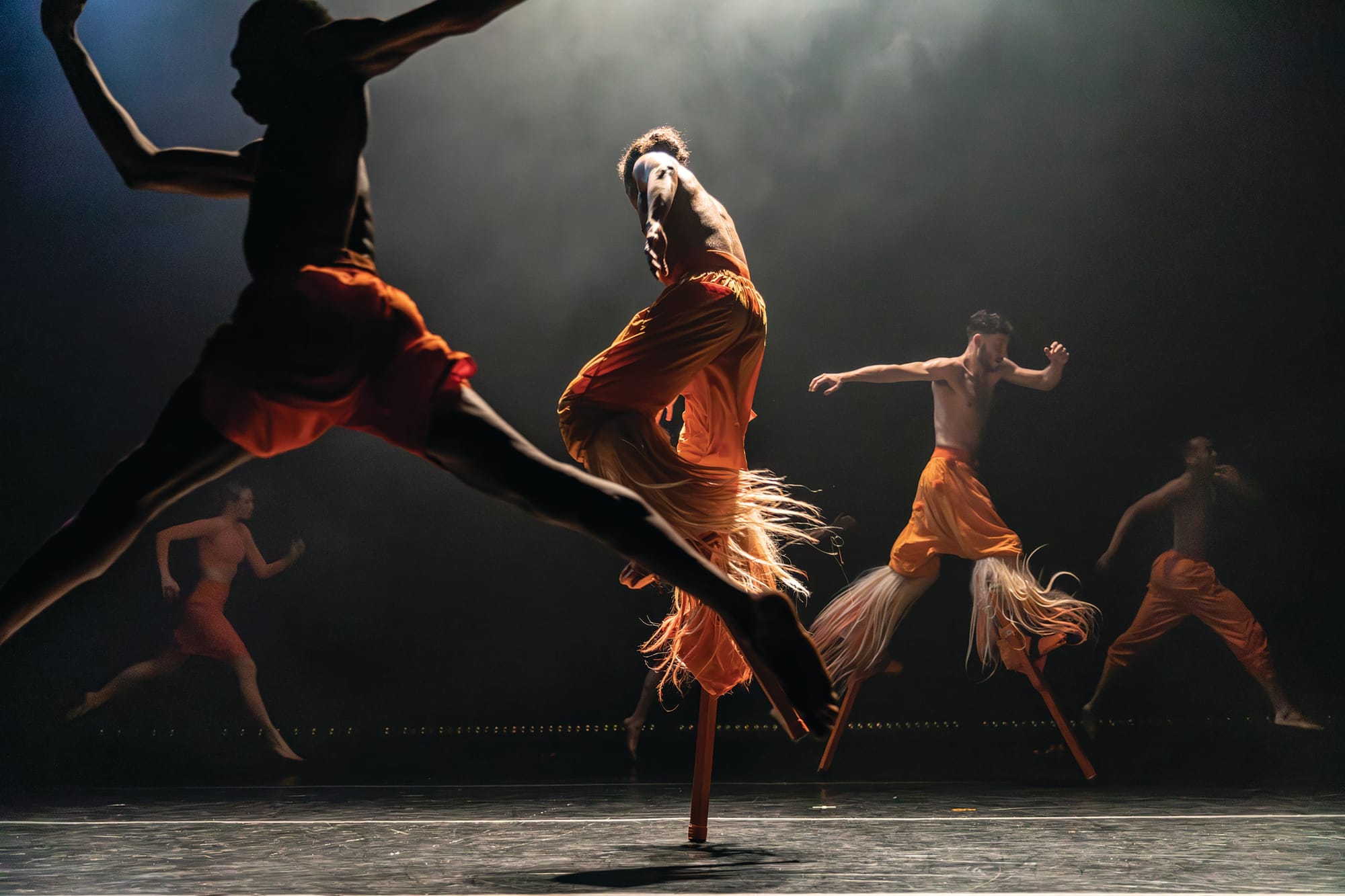
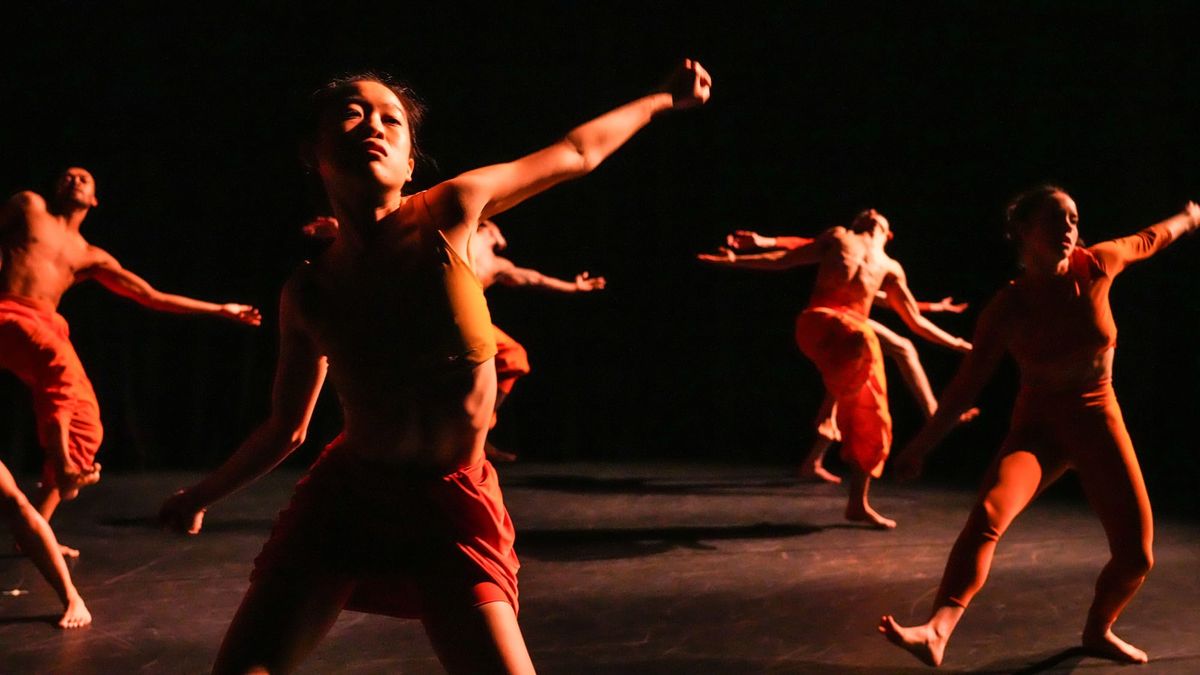
The work opened in the dark, the smoky red lighting giving the stomping bodies an eerie glow. The male dancers wore loose trousers suggesting a secret rite of some Eastern religion. (According to Wikipedia Sama is a Sufi ceremony performed by the whirling dervishes; this may be the origin of Miller’s title.). The ominous, pulsating music (by Nico Saar, Vladimir Zaldwich, and Frédéric Despierre) reinforced the mystery and seemed to urge them dancers on. And on they poured, with powerful, snaky moves, bending with an insect-like flexibility, an almost inhuman mass of dramatic, never-ending movement. The dancers all had phenomenal strength which they matched with a dynamic and infectious rhythm and some unexpected gifts, like the two men on stilts stomping and lunging with precise musicality. This did not look like their bodies were a “chance of being” to me, it looked like brilliantly talented dancers who had worked extremely hard to entertain their audience; the audience responded with raucous enthusiasm.
© 2024 Mary Cargill



