Fall Gala
"Seven Sonatas", "One of Three", "The Dying Swan", "Everything Doesn't Happen at Once"
American Ballet Theatre
Avery Fisher Hall
New York, NY
October 7, 2009
Since ABT's now traditional Fall venue at City Center was supposed to be under renovation, the company planned an unusual and brief appearance at Avery Fisher Hall; since it is the home of the Philharmonic Orchestra, this is not an ideal place to see ballet, but the imaginative response was to commission three new works for the hall. Since there is no place for an orchestra, all of them used on stage musicians, and since there are no wings, they used no scenery and minimal lighting. The choreographers included ABT's new resident, Alexei Ratmansky, the Canadian Aszure Barton, and the NYCB dancer Benjamin Millepied, with the familiar Fokine "Dying Swan" for the gala audience.
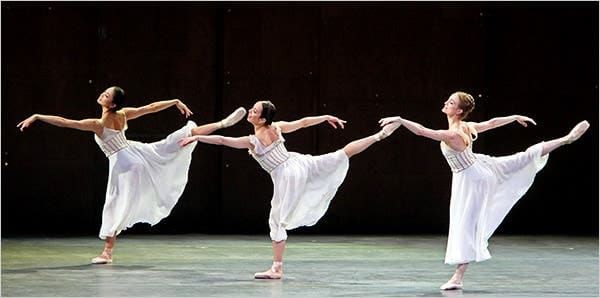
"Seven Sonatas" by Ratmansky was performed to seven piano sonatas by Scarlatti. A straightforward title for a straightforward piece; it was by far the most accomplished and polished of the new pieces. It does have a marked similarity to the various piano ballets, especially to Robbins' evergreen "Dances at a Gathering", but there are worse things that can be said about any ballet. The three couples (Stella Abrera and Gennadi Saveliev, Xiomara Reyes and Herman Cornejo, and Julie Kent and David Hallberg) were dressed in white, the men in slightly formal tunics and the women in chiffon dresses with the same hint for formality, so reflective of the music. It opened with the six of them dancing with a slightly distant feeling, as if they were in a bubble. Cornejo, Reyes, Hallberg, and Kent got brief and varied solos; Cornejo looked like an elegant whirlwind, and Kent had a boneless lyricism.
Then each couple had a pas de deux with varied emotional undertones; Abrera and Saveliev seemed consumed by some underlying tragedy, Reyes and Cornejo were playful, and Kent and Hallberg more mature, comfortable lovers. The final sonata brought the six together on stage again, dancing with a more staccato feel, as if their earlier paradise had disappeared. Unlike some of his previous choreography, there were no gimmicks or exaggerated emotions, just a glorious flow of inventive, expressive steps. Though I would have been satisfied with five sonatas, he made his cast look wonderful.
Aszure Barton's "One of Three" was set to the Violin Sonata in G by Ravel, again played on stage. It was a forgettably jokey piece, though used the music as a background rather than a springboard--it would have been just as pleasant danced to another piece. In the program notes she "thanked her dancers and collaborators for sharing this experience and participating in the process", a way, perhaps
of sharing the responsibility. It was basically choreography as doodling, with no development, purpose, or real interest, other than enjoying the fine dancers prance around. Cory Stearns pranced with the best of them, though the suit jacket he wore tended to fly around awkwardly. He pranced for Murphy, looking very 1930's in a long white gown that made her red hair glow. She posed in arabesque now and then, and popped her leg up to her ear, but did little in the way of actual dancing.
Benjamin Millepied's "Everything Doesn't Happen at Once" was the most ambitious and the most opaque, beginning with its irritatingly vague title. It was set to minimalist music by David Lang, which burbled aimlessly. There were striking elements, especially the lighting, which made the floor shine like an ice rink. The women's short black costumes were very flattering (though like the other ballets, the budget apparently doesn't run to tights, and the throbbing leg muscles looked ungainly), but the poor men had to wear black biker shorts with short, open vests, presumably to give the audience a chance to see them sweat. Beneath the glib and slick surface, there is a truly vulgar depth to his choreography, which seems to exist only for applause.
The main couple, Marcelo Gomes and Isabella Boylston, had one of those "women who are rag dolls and men who lift them" pas de deux, where she showed off her extensions. Gomes did the best he could to look interested, and then disappeared into the large crowd. (I suppose it does take a certain skill to made a dancer as towering as Gomes vanish.) Daniil Simkin was brought on in the final section to fling himself about, diving left then right, then doing some flashy turns; it was painful to see a dancer as rich and talented as he is used as a party trick.
Over 100 years ago, at a gala far away, Michel Fokine choreographed a three minute solo for Anna Pavlova to the music of Saint-Saens. He would probably be surprised to know that his quickly prepared dance has seen the light at innumerable galas since then. Avery Fisher is not ideal for the moonlit piece, since the musicians on the stage intrude on the magic, and there are no black curtains to create magic, though of coursee this piece has been done in much less glamorous settings. Veronika Part danced it simply and only her headdress alluded to the poor swan; there were none of the feathers so associated with Pavlova and so brilliantly parodied by the Trockaderos. It was a refined, elegant, and elegiac rendition, without a whiff of ham. It was like watching a pearl ribbon unfolding, bending, and turning. If there are ballet galas 100 years from now, her performance proved that "The Dying Swan" will probably be on the program.
copyright © 2009 by Mary Cargill



