Facinatin' Dancing
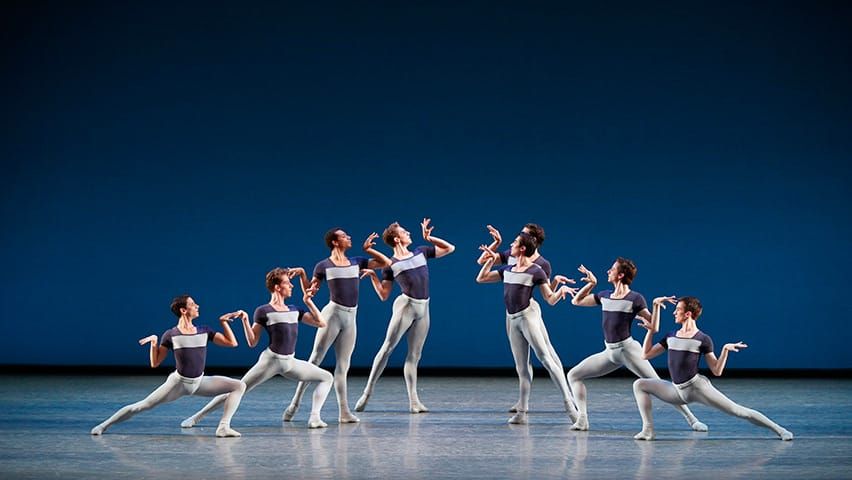
"Concerto Barocco", "Kammermusik No. 2", "Who Cares?"
New York City Ballet
David H. Koch Theater
New York, NY
January 21, 2014
City Ballet opened its Winter season crisply, with three Balanchine works and one intermission. The scrupulous architecture of "Concerto Barocco" is really indestructible, as those glorious patterns weave in and out. At times, though, the corps looked a bit tentative, and there were a few near misses. There were no misses from Sara Mearns, dancing the second violin with her usual ability to make the stage disappear and let the audience feel she is seeing some mystery beyond those four walls. She combines this otherworldly quality with almost dizzying speed and attack, and she commanded the stage.
Maria Kowroski, as the first violin, the one who gets the pas de deux, unfortunately, came a distant second. Her extreme flexibility, while striking, seemed uninflected and she danced everything with the same, slightly diffident, approach, never varying the dynamics. Tyler Angle, in his debut as the mysterious partner, was attentive and gracious.
"Kammermusik No. 2" is to some extent a mirror image of "Concerto Barocco"; each has a corps of eight, with Kammermusik's raucous and angular males (cousins, surely, to the Prodigal's goons) substituting for Barocco's crisp, serene females. It was an interesting pairing. There are differences, too, of course, since Kammermusik has two couples, each with a pas de deux. Rebecca Krohn, with Amar Ramasar, despite an awkward slip, made the knotty, odd, frantic choreography gripping and unpredictable. Their pas de deux, where they seem to reach and miss each other as she hides her eyes, was a touching lament for lost opportunities. Abi Stafford, with Jared Angle, danced clearly, with beautifully articulated shapes, but her approach was a bit perky for the energetic, driven music.
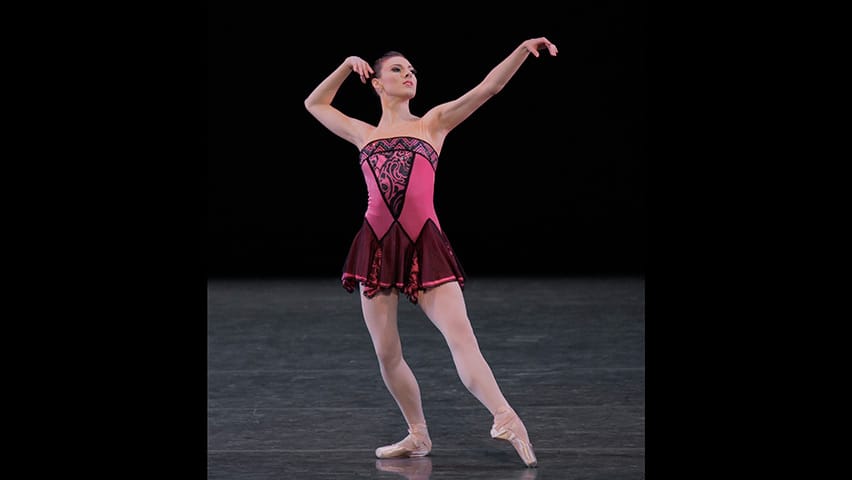
"Who Cares?" is definitely on the perky side, with its brassy Hershy Kay orchestrations of George Gershwin songs. The Santo Loquasto costumes, new last year, are still jarring and cheesy. The corps girls look like members of a high school drill team, and the boys like Gershin's urban sophisticates decided to rendezvous in Central Park in their jammies. Listening to the melodies evoking those complex rhymes and sophisticated lyrics and watching the garish costumes on the stage was a bit like drinking champagne from a plastic cup.
But at least it was good champagne. Ashley Laracey and Sean Suozzi were infectious "Do, Do, Doing", as were Lauren King and Devin Alberda in "Lady Bo Good", dancing with a jazzy energy and classical precision. Tiler Peck's "The Man I Love", with Robert Fairchild, is a desert island performance, one for the ages. She has the gumption to take risks, the technique to make it all look so easy, and the imagination to make every move about the woman on stage, a woman wary but hopeful, drawing back, pausing, and then finally swept away by love. Her "Facinatin' Rhythm" solo, with its complex dynamics, was elegant, sparkling, and radiantly musical.
Her cohorts were a sparking vintage, too. Fairchild, whose costume has fortunately lost some of its sequins, was a loose-limbed, forthright, All-American hero. Teresa Reichlen's Stairway to Paradise did have one slip, but she danced with a luxurious dynamism. Ashley Bouder is dynamism incarnate, and at times she can seem to vamp the audience, but she has a technical purity that gives her dancing a feeling of suspending time, as she pauses in a breathtakingly pure arabesque or holds a pose for a moment, seeming to extend the music. Lucky Robert Fairchild, to have three such gorgeous dancers to choose from. And lucky audience, to be able to watch them.
copyright © 2014 by Mary Cargill



